 flip
flipRoast Beef and Yorkshire Pudding
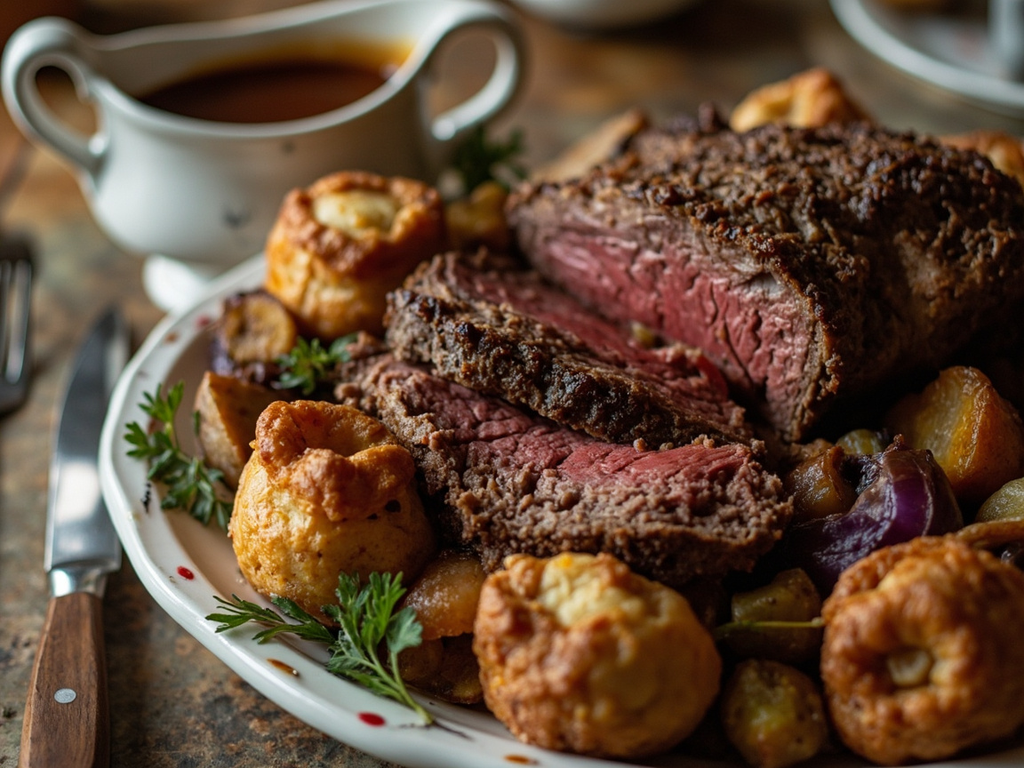
Roast Beef and Yorkshire Pudding
Why this dish? Roast beef is the national British dish and the centerpiece of the aristocratic dinner. In Ada's house, as in any home of her rank, the Sunday roast and formal dinners revolved around this cut of beef, a symbol of Victorian prosperity, served with its inseparable Yorkshire pudding.
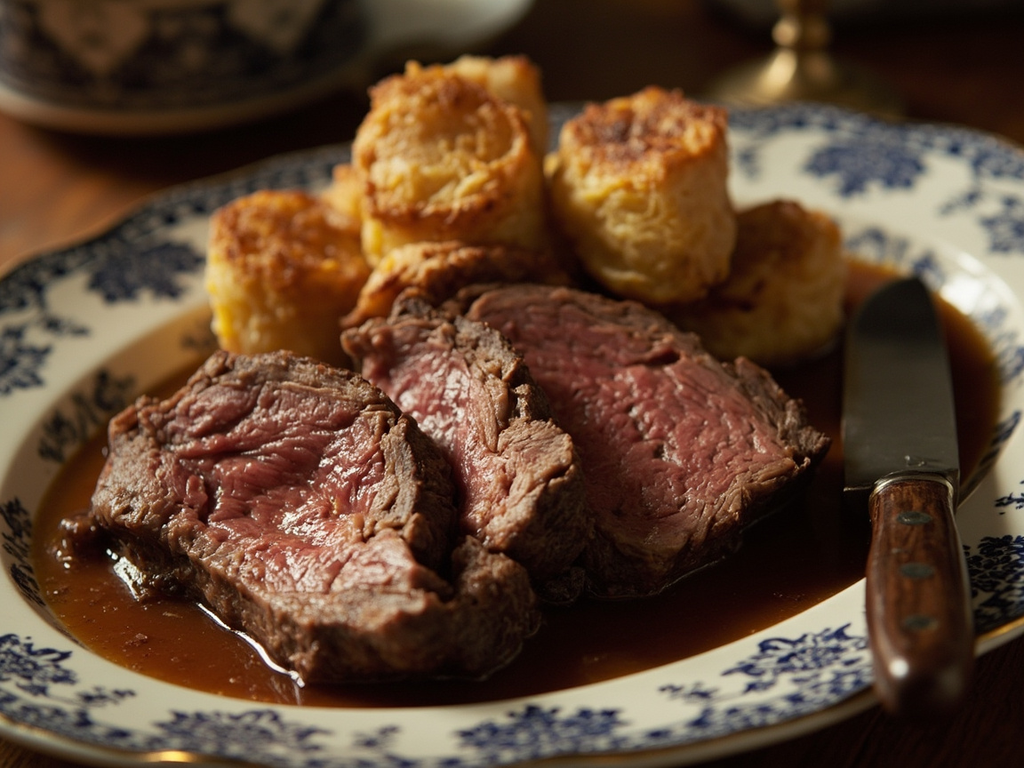
A perfectly roasted cut of beef, golden crust and pink center, served with puffed Yorkshire puddings baked in dripping and a rich gravy.
Here, without dispute, is the dish that crowns our table when we entertain. The beef must roast slowly, basted in its own fat, until the crust sings under the knife and the heart remains pink. The little puddings require a blazing oven: the batter leaps up as if by magic, which I have always found most pleasing for a mind that loves fine mechanisms. Carve before your guests, I pray you: the spectacle is worth the flavor.
- •Beef roasting joint (rib) — a fine piece (meat)
- •Beef dripping (suet) — as needed (cooking fat)
- •Flour — one pound (pudding batter)
- •Eggs — a few (pudding batter)
- •Milk — one pint (pudding batter)
- •Salt and pepper — to taste (seasoning)
- •English mustard — for serving (condiment)
Roast Beef and Yorkshire Pudding
A perfectly roasted cut of beef, golden crust and pink center, served with puffed Yorkshire puddings baked in dripping and a rich gravy.
Why this dish? Roast beef is the national British dish and the centerpiece of the aristocratic dinner. In Ada's house, as in any home of her rank, the Sunday roast and formal dinners revolved around this cut of beef, a symbol of Victorian prosperity, served with its inseparable Yorkshire pudding.
Here, without dispute, is the dish that crowns our table when we entertain. The beef must roast slowly, basted in its own fat, until the crust sings under the knife and the heart remains pink. The little puddings require a blazing oven: the batter leaps up as if by magic, which I have always found most pleasing for a mind that loves fine mechanisms. Carve before your guests, I pray you: the spectacle is worth the flavor.
Ingredients (period version)
- Beef roasting joint (rib) — a fine piece (meat)
- Beef dripping (suet) — as needed (cooking fat)
- Flour — one pound (pudding batter)
- Eggs — a few (pudding batter)
- Milk — one pint (pudding batter)
- Salt and pepper — to taste (seasoning)
- English mustard — for serving (condiment)
Ingredients
- Beef roast (rib or sirloin) — 1.2 kg (meat)
- Oil or beef dripping — 4 tbsp (cooking fat)
- Flour — 140 g (pudding batter)
- Eggs — 4 (pudding batter)
- Milk — 200 ml (pudding batter)
- Salt, pepper — to taste (seasoning)
- English mustard — for serving (condiment)
Method
- Bring the beef to room temperature, season with salt and pepper, sear, then roast in the oven at 200°C (about 15 minutes per 500 g for medium-rare). Rest under a cloth.
- Prepare the pudding batter: whisk flour, eggs, milk, and a pinch of salt into a smooth batter, rest for 30 minutes.
- Add a little fat to each hole of a muffin tin, heat in the oven at 220°C until smoking.
- Pour the batter into the hot fat and bake for 20-25 minutes without opening the oven, until puffed and golden.
- Deglaze the roasting pan for gravy, slice the beef thinly, and serve with puddings, gravy, and mustard.
How it was made : In the 19th century, beef was spitted and roasted before the hearth, slowly turning on the spit, with the collected dripping used to cook the pudding batter placed underneath to catch the juices. Yorkshire pudding was sometimes eaten as a first course, with gravy, to fill up before the meat.
The contemporary twist : Serve the beef rare in thin slices on an oak board, with horseradish mustard to awaken the palate.
Sources : Mrs Beeton, Book of Household Management (1861) · Hannah Glasse, The Art of Cookery (19th-century reprints)
Ada Lovelace · Charactorium