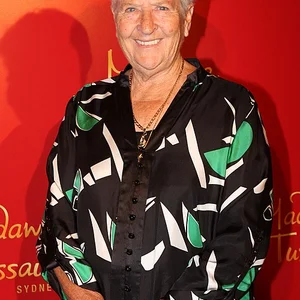

Dawn Fraser is an Australian swimmer, considered one of the greatest sprinters in the history of swimming. She won the gold medal in the 100-metre freestyle at three consecutive Olympic Games (1956, 1960, 1964), an unmatched feat in this event.
Frequently asked questions
Key Facts
- Born on 4 September 1937 in Balmain, near Sydney (Australia)
- Gold medal in the 100 m freestyle at the Olympic Games in Melbourne (1956), Rome (1960) and Tokyo (1964)
- First woman to break the one-minute barrier in the 100 m freestyle in 1962
- Banned for ten years by the Australian federation after an incident at the Tokyo 1964 Olympics (the ban was later lifted)
- Named Australian of the Year in 1964 and inducted into the International Swimming Hall of Fame
Works & Achievements
Fraser's first Olympic victory, in which she also set a world record over the distance.
Her second consecutive Olympic title, confirming her dominance in the sprint.
The first woman in history to break the symbolic one-minute barrier over the distance.
Her third consecutive title in the same event, a feat never matched in swimming, achieved after a serious accident.
The story of her life, from her working-class childhood to her triumphs and her clashes with sporting authorities.
Anecdotes
At the 1960 Rome Olympic Games, Dawn Fraser became the first woman to swim the 100-metre freestyle in under a minute in international competition; she would officially break the symbolic 60-second barrier in 1962, a record she would hold for years.
In 1964, just before the Tokyo Games, Dawn Fraser was involved in a serious car accident in which her mother was killed. With a neck injury, she had to swim wearing an orthopaedic brace for weeks, yet still won her third consecutive Olympic gold medal in the 100 m freestyle.
During those same Tokyo Games in 1964, Fraser was accused of trying to steal an Olympic flag from outside the Japanese emperor's palace. The episode, combined with her reputation for indiscipline, earned her a ten-year suspension from the Australian federation, a penalty that would end her international career.
Dawn Fraser grew up in Balmain, a working-class district of Sydney, in a modest family of eight children. Asthmatic as a child, she was actually encouraged to swim to strengthen her lungs, and it was coach Harry Gallagher who spotted her immense talent.
In 2000, she was one of the athletes chosen to carry the Olympic flame during the opening ceremony of the Sydney Games, a symbolic crowning of a career marked as much by its feats as by its conflicts with the sporting authorities.
Primary Sources
In her autobiography, Fraser looks back on her working-class childhood in Balmain, her asthma, and the role swimming played in her life as a means of emancipation.
The official minutes record Dawn Fraser's victories in the 100 m freestyle at the Melbourne (1956), Rome (1960), and Tokyo (1964) Games.
FINA ratifies Dawn Fraser's world record in the 100 m freestyle, which dropped below the 60-second mark in 1962.
Key Places
Working-class district of Sydney where Dawn Fraser was born and grew up in a modest family of eight children.
Site of the 1956 Olympic Games where Fraser won her first gold medal in the 100 m freestyle.
Olympic pool of the 1960 Rome Games where Fraser retained her title in the 100 m freestyle.
Venue for the swimming events of the 1964 Tokyo Games where Fraser claimed her third consecutive gold medal.
Site of the 2000 Sydney Games where Fraser, honoured as a national legend, took part in the opening ceremony.
Typical Objects
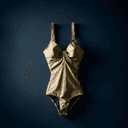
A one-piece fabric swimsuit, worn by female swimmers in the 1950s and 1960s, long before modern high-tech bodysuits. It symbolizes the evolution of women's sport and competitive swimming.
A rubber cap pulled on to protect the hair and reduce drag in the water. An essential accessory for female swimmers during the golden age of Olympic swimming.
📷 CC BY-SA 3.0 · Wikimedia Commons ↗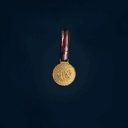
The supreme reward given to the winner of an Olympic event. Fraser won four of them, including three consecutive titles in the same 100 m freestyle.
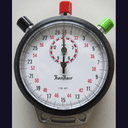
A timing instrument essential to swimming, which determines records and qualifications. It accompanied every one of Fraser's training sessions and races.
📷 Wikimedia · Wikimedia Commons ↗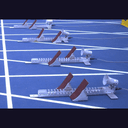
A small raised platform at the edge of the pool from which swimmers dive at the starting signal. A fundamental element of sprint swimming competitions.
📷 Domaine public · Wikimedia Commons ↗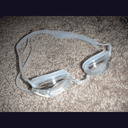
Eye protection against the chlorinated water of pools; still uncommon in the 1950s and 1960s, they would become widespread after Fraser's career.
📷 Domaine public · Wikimedia Commons ↗School Curriculum
Vocabulary & Tags
Key Vocabulary
Daily Life
Morning
Dawn Fraser's days began early, with long training sessions in the pool before work or school. Under the guidance of her coach Harry Gallagher, she swam lap after lap to build endurance and sprint speed.
Afternoon
Afternoons were often devoted to a second training session, alternating between technical work, starts, and timed sets. In the 1950s and 1960s, swimmers trained without the modern scientific tools, relying on feel and the stopwatch.
Evening
In the evening, Fraser recovered, taking care of her diet and rest to sustain an intense training load. Coming from a working-class background, she stayed close to her family and her Balmain neighbourhood.
Food
Like the athletes of her era, Fraser followed a hearty diet meant to fuel her efforts, without today's sophisticated sports nutrition. Australian working-class family meals, based on meat and starches, shaped her everyday life.
Clothing
In training and competition, she wore the one-piece swimsuit and rubber swim cap typical of swimming in the 1950s and 1960s. Out of the pool, she dressed simply, in keeping with her working-class roots.
Housing
Fraser grew up in a modest house in Balmain, a working-class port neighbourhood of Sydney. This humble environment, far from the privileged sporting world, forged her independent and combative character.
Historical Timeline
Period Vocabulary
Liens externes & ressources
Références
Œuvres
Médaille d'or olympique du 100 m nage libre (Melbourne)
1956
Médaille d'or olympique du 100 m nage libre (Rome)
1960
Record du monde du 100 m nage libre sous les 60 secondes
1962
Médaille d'or olympique du 100 m nage libre (Tokyo)
1964
Dawn: One Hell of a Life (autobiographie)
2001