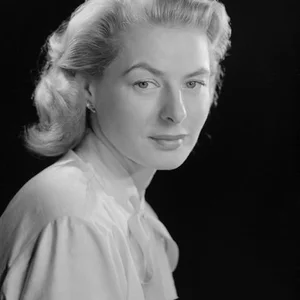

Swedish actress (1915–1982), a towering figure of classic Hollywood cinema. Made famous by Casablanca (1942), she won three Academy Awards and established herself as one of the greatest actresses of the twentieth century.
Ingrid Bergman(1915 — 1982)
Ingrid Bergman
Suède
8 min read
Frequently asked questions
Famous Quotes
« I have never done anything thinking about what people would say about it.»
« Happiness is good health and a bad memory.»
Key Facts
- 1915: Born in Stockholm, Sweden
- 1942: Role of Ilsa Lund in Casablanca alongside Humphrey Bogart
- 1944: First Academy Award for Gaslight
- 1950: Media scandal following her affair with Roberto Rossellini; blacklisted from Hollywood
- 1974: Third Academy Award for Murder on the Orient Express
Works & Achievements
A landmark film by Michael Curtiz in which Bergman plays Ilsa Lund, a woman torn between love and duty during World War II. It has become one of the most quoted films in cinema history and remains the most iconic role of her career.
A psychological thriller by George Cukor in which Bergman plays a woman manipulated by her husband into believing she is losing her mind. Her shattering performance earned her her first Academy Award for Best Actress.
A spy thriller by Alfred Hitchcock in which Bergman plays a woman infiltrating a Nazi network in Argentina. One of her most complex roles, weaving together love, sacrifice, and moral ambiguity.
A film by Roberto Rossellini shot on the volcano of the eponymous island, symbolizing Bergman's break with Hollywood and her entry into European neorealism. The shoot also marked the beginning of their life together.
A film by Anatole Litvak marking Bergman's triumphant return to Hollywood after seven years in exile. She plays a mysterious young woman claiming to be the daughter of Tsar Nicholas II, a role that won her her second Oscar.
Sidney Lumet's adaptation of Agatha Christie's novel, in which Bergman plays a Swedish missionary. Her restrained and moving turn in this supporting role earned her her third and final Oscar.
A film by Ingmar Bergman in which Ingrid Bergman plays a celebrated concert pianist forced to confront the daughter she long neglected. Widely regarded as her late-career masterpiece and one of the greatest performances in cinema history.
Anecdotes
On the set of Casablanca (1942), Ingrid Bergman admitted she had no idea which actor her character would choose in the end — because the screenwriters themselves hadn't decided yet. Director Michael Curtiz maintained this ambiguity to the very last, and that genuine uncertainty is written all over the actress's face in one of the most celebrated scenes in world cinema.
In 1949, Ingrid Bergman wrote a bold letter to Italian director Roberto Rossellini, expressing her admiration for his film Rome, Open City and proposing they work together. That letter changed her life: she left Hollywood, fell in love with Rossellini, and had a child with him before they married — triggering a scandal so enormous that a US senator denounced her before Congress as an apostle of degradation and she was banned from Hollywood for seven years.
Ingrid Bergman is one of the few actresses to have won three Academy Awards: Best Actress for Gaslight (1945) and Anastasia (1957), then Best Supporting Actress for Murder on the Orient Express (1975). When she received that third Oscar, she publicly paid tribute to her rival Valentina Cortese, genuinely believing it was she who deserved the award.
For her triumphant return to Hollywood with Anastasia (1956), after seven years of forced exile following the Rossellini scandal, Ingrid Bergman won the Academy Award for Best Actress. But she was unable to attend the ceremony in Los Angeles, still being persona non grata in the United States: it was Cary Grant who accepted the award on her behalf, and the audience gave her a standing ovation.
Ingrid Bergman learned in 1974 that she had breast cancer, the same year she was filming Murder on the Orient Express. She continued to work with remarkable energy for eight years, keeping her illness private for a long time. She died on August 29, 1982 — her 67th birthday — in London, leaving behind a career that spanned three continents and five decades.
Primary Sources
I have no regrets. I wouldn't have lived my life the way I did if I was going to worry about what people were going to say.
If you need a Swedish actress who speaks English very well, who has not forgotten her German, who is not very understandable in French, and who in Italian knows only 'ti amo', I am ready to come and make a film with you.
Mrs. Rossellini, who has become a powerful, notorious apostle of degradation... Under our law, no alien guilty of turpitude can set foot on American soil again.
I am a Swedish actress. I want to remain myself, to play real roles — not always a film heroine without flaws or weaknesses.
Key Places
Ingrid Bergman's birthplace, where she grew up as an orphan, studied at the Royal Dramatic Theatre and launched her film career. Sweden always remained at the heart of her identity, and she returned there regularly throughout her life.
The world capital of cinema, where Bergman established herself as one of the greatest stars of the Golden Age (1939–1949), working under the direction of Hitchcock, Cukor, Fleming, and Curtiz. She built her international reputation there before being effectively blacklisted.
The city where Bergman joined Roberto Rossellini in 1949, marking her break with Hollywood and her immersion in European neorealist cinema. This radical choice transformed both her personal life and her artistic path.
The filming location for Rossellini's *Stromboli* (1950), shot on this active volcano in the Tyrrhenian Sea. It was here that their affair became public, triggering the international scandal that led to Bergman's banishment from the United States.
Bergman settled in London in the final years of her life, after periods spent on three continents. It was in this city that she died on August 29, 1982 — the very day of her 67th birthday.
Typical Objects

Ingrid Bergman approached her roles with remarkable rigor, covering her scripts with personal notes on the psychology of her characters. This method allowed her to deliver performances of great emotional depth, which her directors consistently praised as exceptionally well-prepared.

The ultimate symbol of Hollywood recognition, Bergman won three over thirty years — an exceptional achievement in cinema history. These awards mark a career that spanned Hollywood's golden age, public scandal, and triumphant comeback.

An avid photographer, Ingrid Bergman captured behind-the-scenes moments and her private life with her camera. Her personal photographic archive has since become a valuable window into the backstage world of classic cinema.

A nomadic figure between Sweden, the United States, Italy, France, and England, Bergman spent much of her life in hotels and on film sets. Her cosmopolitan way of life reflects the fate of an international actress long before that term became common.

The period outfits created for Bergman in her films — notably those worn in *Casablanca* and *Notorious* — became icons of 1940s cinematic fashion, combining understated elegance with natural beauty.

The standard camera of the major Hollywood studios in the 1940s, the Mitchell BNC captured Bergman under the studio lights. It was with this professional equipment that her greatest golden-age performances were immortalized on film.
School Curriculum
Vocabulary & Tags
Key Vocabulary
Daily Life
Morning
On the great Hollywood studio lots of the 1940s, Ingrid Bergman arrived as early as 6 a.m. for hair and makeup sessions that could last up to two hours. She used that time to review her lines and mentally prepare for the day's scenes — a discipline that impressed every director she worked with.
Afternoon
Afternoons were devoted to long hours of filming under the blinding studio lights, with multiple takes and constant adjustments to the staging. Between takes, Bergman frequently discussed her character's interpretation with directors, always pushing for more emotional truth than the script strictly demanded.
Evening
Evenings often found Bergman returning late to her Beverly Hills home, exhausted but invigorated by the day's work. She cherished dinners with family or friends from the arts world, and devoted time to her daughter Pia as well as to reading and amateur photography.
Food
Ingrid Bergman ate simply and in the Nordic tradition she inherited from her Swedish roots: she was fond of fish, fresh vegetables, and dairy products. Far from the glamour of Hollywood's grand restaurants, she preferred home-cooked meals over the ostentatious dining favored by other stars.
Clothing
On screen, Bergman was dressed by the studios' leading costume designers, who created elegant yet understated outfits for her that showcased her natural beauty without excess artifice. In private life, she preferred simple, comfortable clothes, refusing to conform to the glamorous image the star system expected of her off set.
Housing
During the 1940s, Ingrid Bergman lived in a well-appointed house in Benedict Canyon, Beverly Hills, with her first husband Dr. Peter Lindstrom and their daughter Pia. After her Italian years with Rossellini and her constant travels between Europe and America, she adopted a nomadic lifestyle, dividing her time between Paris, London, and Sweden according to her film projects and personal life.
Historical Timeline
Period Vocabulary
Liens externes & ressources
Références
Œuvres
Hantise (Gaslight)
1944
Les Enchaînés (Notorious)
1946
Le Crime de l'Orient-Express (Murder on the Orient Express)
1974