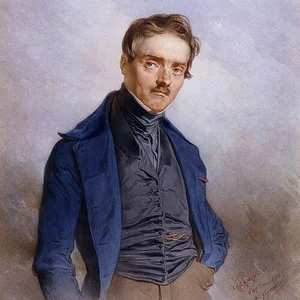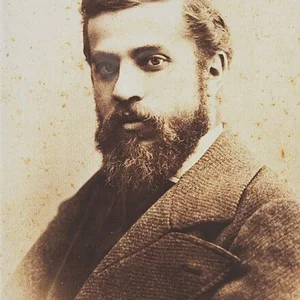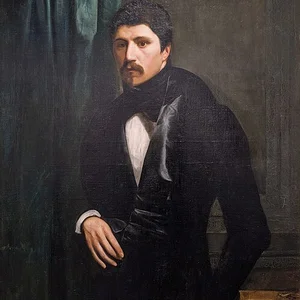

Joseph Guichard (1806–1880) was a French painter, a student of both Ingres and Delacroix. He was Berthe Morisot's teacher and played an important role in passing on academic techniques at the dawn of Impressionism.
Joseph Guichard(1806 — 1880)
Joseph Guichard
France
8 min read
Frequently asked questions
Key Facts
- Born in Lyon in 1806, studied under Ingres and Delacroix in Paris
- Teacher of Berthe Morisot, whom he introduced to painting in the 1860s
- Regular exhibitor at the Paris Salon in the mid-19th century
- Director of the École des Beaux-Arts in Lyon from 1870 to 1880
- Died in Lyon in 1880
Works & Achievements
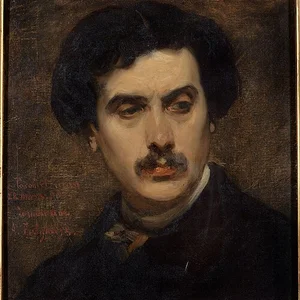
A representative example of Guichard's style, combining the precision of draughtsmanship inherited from Ingres with a refined psychological insight into the sitter. Demonstrates his mastery of rendering textures and light on flesh tones.
A large-format work on a noble subject — the genre most highly regarded by the Académie — which earned him a distinction at the Paris Salon. This type of composition was the centrepiece of the academic curriculum.
A cycle of mural and decorative paintings for Lyonnais buildings, in the tradition of the great academic iconographic programmes. These institutional commissions attest to Guichard's prestige in his home city.
A collection of studies and corrections produced in the course of lessons given to Berthe and Edma Morisot, illustrating Guichard's rigorous method grounded in life drawing and copying at the Louvre.
Anecdotes
Joseph Guichard was one of the rare painters of his era to have studied successively under the two greatest rivals in French painting: Jean-Auguste-Dominique Ingres, master of classical draftsmanship and pure line, and Eugène Delacroix, champion of Romanticism and color. Moving from one to the other was an intellectually daring act, so opposed were their aesthetics and so irreconcilable their admirers.
Around 1861, when the sisters Berthe and Edma Morisot were entrusted to him as pupils, Guichard wrote their mother a letter that has since become famous. He warned her that her daughters had such keen talent that they risked "becoming true painters" — which he presented as a social danger for young women of the bourgeoisie, whose artistic practice was meant to remain an ornament rather than a professional calling.
Guichard was convinced that copying the masters at the Louvre was the foundational exercise of any serious pictorial training. It was he who accompanied the Morisot sisters for their first copying sessions at the museum, having them reproduce Rubens and Veronese before allowing them to work from nature — a method inherited directly from Ingres's teaching.
When Berthe Morisot, his former pupil, joined the Impressionist movement and exhibited alongside Monet and Renoir at the group's first exhibition in 1874, Guichard expressed his dismay. Faithful to the academic values passed down to him by his own masters, he saw in this break a betrayal of everything he had imparted — embodying the generational rift then running through the French art world.
Primary Sources
Considering the character of your daughters, I must tell you that they will not be mere amateurs. They will become painters. Have you truly considered what that means?
Guichard (Joseph), born in Lyon. Student of MM. Ingres and Delacroix.
M. Guichard came to see our studies; he found that we were working well and encouraged us to continue painting from nature.
Key Places
Birthplace and final resting place of Joseph Guichard, who was born there in 1806 and died in 1880. He taught at the École des Beaux-Arts, contributing to the renown of the Lyonnaise school and passing on to a new generation the academic techniques he had acquired in Paris.
The Parisian studio of Jean-Auguste-Dominique Ingres, where Guichard learned the rigour of classical draughtsmanship, reverence for Antiquity, and the demands of the line. This training formed the foundation of his later practice and teaching.
The studio of Eugène Delacroix, where Guichard completed his training by discovering the expressive power of colour and the spirit of Romanticism. Moving from Ingres to Delacroix was an intellectually rare step that made Guichard a bridge between two opposing aesthetics.
The official annual fine arts exhibition and the central hub of French artistic life in the nineteenth century. Guichard exhibited there regularly and received recognition, which secured his reputation and his portrait commissions.
The bourgeois home in the Passy neighbourhood where Guichard gave lessons to the sisters Berthe and Edma Morisot in the 1860s. It was in this setting that he introduced the future Impressionist to the fundamentals of academic painting, even as he sensed a talent that would one day surpass his own.
Typical Objects

A pear-wood board on which the painter arranged colors in a precise order, from light to dark tones. In the academic tradition inherited from Ingres, the methodical arrangement of the palette was part of learning the craft.

A thin rod topped with a padded ball, used to steady the hand during meticulous finishing work. A characteristic tool of academic studios where the precision of line — as taught by Ingres — was paramount.

The official catalogue published by the Académie des Beaux-Arts listing works accepted to the Paris Salon. Appearing in it — and above all winning a medal — was, for an academic painter like Guichard, the mark of success and institutional recognition.

A study drawn from a live model, the cornerstone exercise of academic training. Guichard, a direct heir to Ingres, made drawing the foundation of all instruction and required his students — including the Morisot sisters — to spend long hours working in charcoal or red chalk.

A large wooden easel enabling work on large-format canvases, indispensable in the Parisian and Lyonnais studios of the 19th century. Guichard kept one in his own studio, positioned to take advantage of north light.

A grey or blue linen work garment worn over one's clothes to protect against paint and turpentine stains. In academic studios, the smock distinguished the master at work from the student observing.
School Curriculum
Vocabulary & Tags
Key Vocabulary
Daily Life
Morning
Guichard started his day early, in keeping with the discipline of academic workshops. The morning was devoted entirely to work from live models or from nature, as the early light was considered most favorable for rendering the nuances of flesh tones. In Lyon, he would walk the few streets separating him from the École des Beaux-Arts to meet his students.
Afternoon
The afternoon was reserved for correcting students' work, fulfilling portrait commissions for Lyon's bourgeoisie, or continuing the large compositions in progress on his easel. Guichard sometimes received colleagues or patrons in his studio, where artistic discussions and negotiations mingled with the smells of turpentine and lead white.
Evening
Evenings were often social: dinners with Lyonnais or Parisian patrons, visits to bourgeois salons where a recognized academic painter was invited to offer opinions on collections. Guichard cultivated the networks of commissions and influence that were indispensable to the career of an institutional artist in the nineteenth century.
Food
The table of a well-established Lyonnais painter was generous: pike quenelles, cooking sausage, local cheeses on the better days. Like any Lyon native, Guichard appreciated the city's traditional *bouchons* and the wines of Beaujolais or the Côtes-du-Rhône to accompany his meals.
Clothing
In the studio, Guichard wore a grey or blue canvas work smock over his jacket, protecting his clothes from spatters of paint and varnish. When going out or receiving visitors, he dressed in the dark frock coat and silk waistcoat characteristic of a bourgeois artist of the nineteenth century, mindful of the social standing his success had earned him.
Housing
Guichard lived in Lyon in a bourgeois apartment, one large, well-lit room of which served as his studio, fitted with a north-facing skylight for steady, glare-free light. His walls were covered with canvases, charcoal studies, and prints bearing witness to his influences — in particular the works of his two masters, Ingres and Delacroix.
Historical Timeline
Period Vocabulary
Liens externes & ressources
Références
Œuvres
Portrait de femme
vers 1845
Composition historique présentée au Salon
vers 1841
Études pédagogiques avec les sœurs Morisot
vers 1861-1863