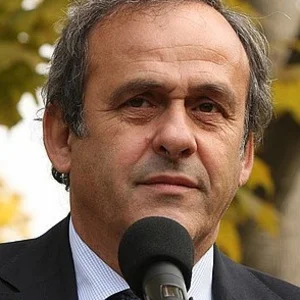

Michel Platini is a French footballer, considered one of the greatest playmakers in history. A three-time Ballon d'Or winner, he was captain of the France team that won the European Championship in 1984, before becoming a coach and then a leader of European football.
Michel Platini(1955 — ?)
Michel Platini
France
6 min read
Frequently asked questions
Key Facts
- Born on 21 June 1955 in Joeuf, in Lorraine, into a family of Italian origin
- Won three consecutive Ballons d'Or (1983, 1984, 1985)
- Captain of the France team that won the European Championship in 1984, of which he was the top scorer (9 goals)
- Star of Juventus of Turin, with whom he won the European Cup in 1985
- President of UEFA from 2007 to 2015, before a suspension in connection with a football governance affair
Works & Achievements
As captain and top scorer (9 goals), Platini gave France its first major international title, the cornerstone of the modern history of Les Bleus.
Named the best player in the world three years in a row, a feat that places him among the greatest in the history of football.
Platini scored the decisive goal in the final, winning Juventus the most prestigious European cup, against the tragic backdrop of the Heysel disaster.
After his playing career, he coached Les Bleus and groomed the new generation that would lead to the 1998 World Cup title.
As co-president of the organising committee, he contributed to the success of the World Cup that saw France become world champions on home soil.
At the helm of European football, he introduced Financial Fair Play to curb club debt and bring greater integrity to football finances.
Anecdotes
At Euro 1984 in France, Michel Platini scored 9 goals in just 5 matches, a record that still stands for a single tournament. He found the net in every game, including two consecutive hat-tricks (three goals each) against Belgium and Yugoslavia. This performance remains one of the most impressive in the history of international competitions.
On 8 July 1982, in the World Cup semi-final in Seville, France and West Germany played a legendary match. After leading and then drawing level, Les Bleus lost in the first penalty shoot-out in World Cup history. Platini converted his kick, but France were eliminated amid a sense of deep injustice following an unpunished foul by German goalkeeper Schumacher.
Within the France national team, Platini was part of a trio nicknamed the “carré magique” (magic square) alongside Alain Giresse, Jean Tigana and Luis Fernández. This skilful, creative midfield was the pride of French football in the 1980s and inspired a game built on short passing and collective intelligence.
Nicknamed “Le Roi” (The King) in Italy, Platini won three consecutive Ballon d'Or awards (1983, 1984, 1985), a feat achieved by only a handful of players. At Juventus in Turin, he became an idol adored by Italian fans thanks to his fearsome free kicks and his eye for goal.
In 2015, while heading UEFA and considering a run for the FIFA presidency, Platini was banned from all football activity following a controversial payment affair. This episode ended his career as an administrator and illustrates the tensions surrounding the governance of world football.
Primary Sources
This French team had something special, a desire to play together. We wanted to give this title to the French public.
Clubs must balance their spending with their revenues and must not repeatedly spend more than they earn.
This match will remain the most beautiful and the most cruel of my career. We deserved to win.
Key Places
Michel Platini's hometown, in a steel-producing region shaped by Italian immigration. His father was a mathematics teacher and a football coach there.
The club where Platini made his professional debut and emerged at the highest level of French football. He won the Coupe de France there in 1978.
A major French club of the 1970s where Platini played from 1979 to 1982 before a passionate crowd, in a stadium nicknamed the “Cauldron.”
The Italian city where Platini reached his peak with Juventus, winning titles and Ballon d'Or awards. He became a true idol there.
The site of the legendary 1982 World Cup semi-final against West Germany, marked by a penalty shootout and the cruel elimination of the French team.
The stadium where the French national team won Euro 1984 against Spain, crowning the Platini generation.
Typical Objects

The central instrument of the game, made of stitched leather in the 1980s and later from synthetic materials. Platini controlled its trajectory with rare precision on his free kicks.

The jersey bearing the number 10, symbol of the playmaker and creative force of the team. Platini wore it in blue for France and in black and white for Juventus.

Football boots fitted with studs for grip on the grass. An essential tool for the professional footballer to run, shoot and change direction.

Trophy awarded to the best footballer of the year, granted by the specialist press. Platini won it three times in a row, a rare distinction.

The Henri Delaunay Cup, awarded to the winner of the Euro. Platini lifted it as captain of Les Bleus in 1984.

A band worn on the arm designating the captain, the player responsible for the team on the pitch. Platini was the emblematic leader of French football's golden generation.
School Curriculum
Vocabulary & Tags
Key Vocabulary
Daily Life
Morning
As a professional footballer, Platini began his day with a light breakfast and a trip to the club's training center. Mornings were devoted to physical and tactical sessions on the pitch.
Afternoon
Afternoons combined treatment, recovery, strength training, and technical work, especially the famous free kicks that he practiced tirelessly. As matches approached, the team studied the opponent and prepared its strategy.
Evening
Match evenings plunged him into the intensity of packed stadiums, in France as in Italy. Outside of competition, he spent time with his family and guarded his private life away from media pressure.
Food
The diet of a top-level athlete favored pasta, rice, and protein for energy and recovery. In Italy, Mediterranean cuisine suited the athlete's needs well.
Clothing
On the pitch, he wore the jersey of his club or of the French national team, shorts and high socks with shin guards. Off the pitch, he adopted the polished style of the 1980s, suits and casual outfits.
Housing
A well-paid star player, he lived in comfortable residences near his clubs, in Saint-Étienne and then in the Turin region. His material life reflected the early days of football's professionalization and growing media coverage.
Historical Timeline
Period Vocabulary
Liens externes & ressources
Références
Œuvres
Championnat d'Europe des nations 1984
1984
Trois Ballons d'or consécutifs
1983-1985
Coupe d'Europe des clubs champions avec la Juventus
1985
Sélectionneur de l'équipe de France
1988-1992
Organisation de la Coupe du monde 1998
1998
Présidence de l'UEFA et fair-play financier
2007-2015