 flip
flipPot-au-feu Bourgeois and Its Boiled Beef
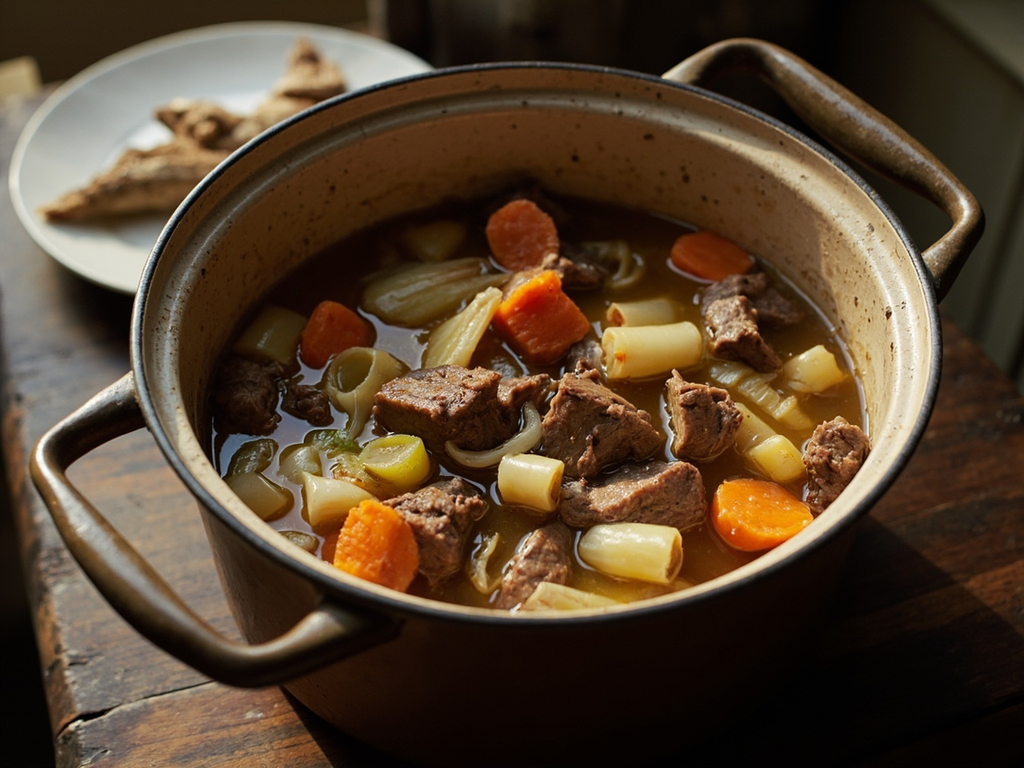
Pot-au-feu Bourgeois and Its Boiled Beef
Why this dish? This was the staple dish of every bourgeois Parisian table in Musset's time: a single fire yields the broth served as soup, then the "boiled" meat for the main part of the meal. Economical and nourishing, it appeared constantly on the table of the rue des Martyrs where his family lived.
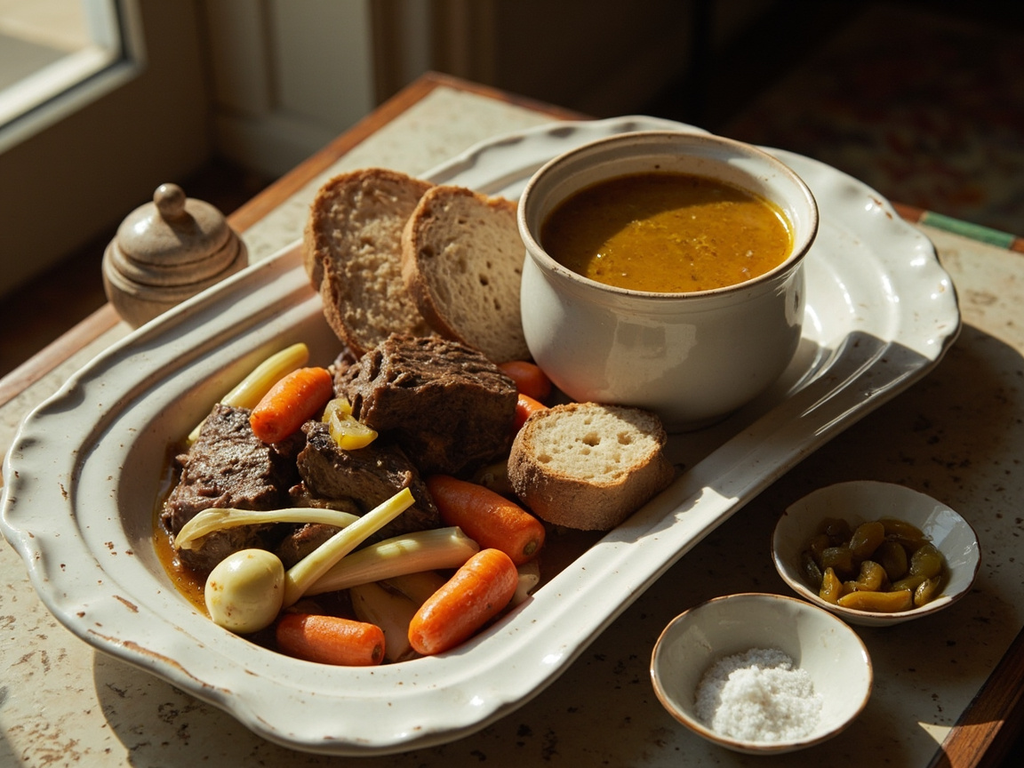
A piece of beef and root vegetables simmered for hours in water. First you drink the golden broth over bread, then you share the tender meat with a little coarse salt and pickles.
Ah, pot-au-feu! There is the only love that never betrays you, my dear reader. My mother put it on the fire in the morning and we did not touch it until nightfall, when the whole house smelled of broth. The secret, I give it to you: never let the water boil vigorously, let it only simmer, like a hesitant heart — otherwise your meat hardens and your broth clouds. Skim, skim again, and you will have liquid gold.
- •Piece of beef for boiling (gîte, paleron) — a fine piece (meat and broth flavor)
- •Marrow bone — one section (richness and marrow)
- •Carrots, turnips, leeks — a bunch (broth vegetables)
- •Onion studded with cloves — one (aroma)
- •Coarse salt, peppercorns — to taste (seasoning)
Pot-au-feu Bourgeois and Its Boiled Beef
A piece of beef and root vegetables simmered for hours in water. First you drink the golden broth over bread, then you share the tender meat with a little coarse salt and pickles.
Why this dish? This was the staple dish of every bourgeois Parisian table in Musset's time: a single fire yields the broth served as soup, then the "boiled" meat for the main part of the meal. Economical and nourishing, it appeared constantly on the table of the rue des Martyrs where his family lived.
Ah, pot-au-feu! There is the only love that never betrays you, my dear reader. My mother put it on the fire in the morning and we did not touch it until nightfall, when the whole house smelled of broth. The secret, I give it to you: never let the water boil vigorously, let it only simmer, like a hesitant heart — otherwise your meat hardens and your broth clouds. Skim, skim again, and you will have liquid gold.
Ingredients (period version)
- Piece of beef for boiling (gîte, paleron) — a fine piece (meat and broth flavor)
- Marrow bone — one section (richness and marrow)
- Carrots, turnips, leeks — a bunch (broth vegetables)
- Onion studded with cloves — one (aroma)
- Coarse salt, peppercorns — to taste (seasoning)
Ingredients
- Beef chuck or brisket — 1 kg (main meat)
- Marrow bones — 2 sections (richness)
- Carrots — 4 (vegetable)
- Turnips — 3 (vegetable)
- Leeks — 2 (vegetable)
- Onion studded with 2 cloves — 1 (aroma)
- Coarse salt, peppercorns — 1 tbsp / 6 grains (seasoning)
Method
- Place the meat in a large pot of cold water, bring gently to a simmer and skim thoroughly.
- Add the studded onion, salt and pepper; simmer covered for 2 h 30, never boiling hard.
- Add carrots, turnips and tied leeks; continue for 1 hour.
- Add marrow bones 30 minutes before the end.
- Serve the strained broth over bread as a first course, then sliced meat with the vegetables, coarse salt and pickles.
How it was made : In the 19th century, pot-au-feu simmered on the cast-iron plate of the stove or in the hearth, sometimes all day. The broth was also used as a base for other sauces and soups: nothing was wasted.
The contemporary twist : Serve the marrow on grilled toast sprinkled with fleur de sel, as an amuse-bouche, before the boiled meat.
Sources : Jules Gouffé, Le Livre de cuisine (1867) · Tradition culinaire bourgeoise parisienne du XIXe siècle
Alfred de Musset · Charactorium