 flip
flipKougelhopf
Kougelhopf
Why this dish? King of Alsatian pastries, the kougelhopf reigned on Sunday and Shabbat morning tables throughout Alsace, both Jewish and Christian. Its fluted silhouette directly evokes Dreyfus's native Mulhouse, which he had to leave as a child when Alsace became German in 1871.
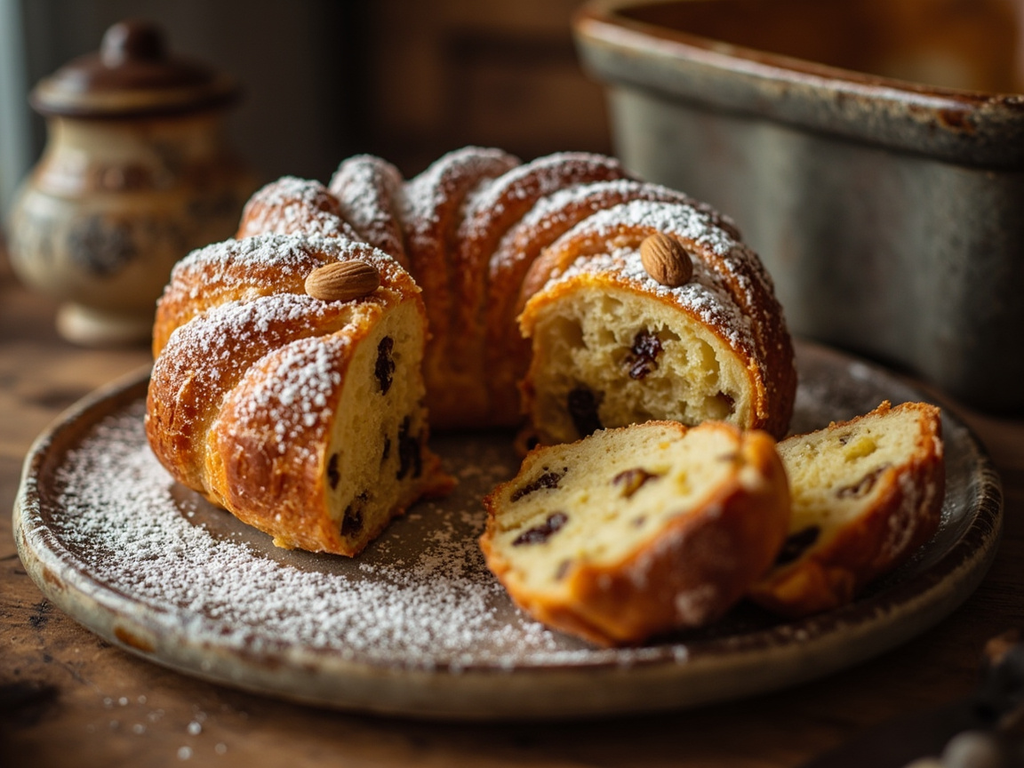
A soft, slightly sweet brioche, scented with macerated raisins and topped with almonds in its twisted mold, simply dusted with powdered sugar.
Ah, the kougelhopf! All my Mulhouse childhood resides in that fluted shape. At the bottom of the mold, we placed an almond in each groove, then poured in a long-risen dough, rich in butter — or fat, depending on the table. It had to rise patiently, without being rushed. Turned out warm and dusted with sugar, we broke it on Sunday morning with coffee: for me, it was the very taste of the country that had been taken from me.
- •Wheat flour — one pound (dough base)
- •Sourdough or brewer's yeast — a little (fermentation)
- •Eggs — a few (richness and binder)
- •Butter — generously (softness (goose fat if meat meal))
- •Raisins — a handful (sweet garnish)
- •Whole almonds — a dozen (mold decoration)
Kougelhopf
A soft, slightly sweet brioche, scented with macerated raisins and topped with almonds in its twisted mold, simply dusted with powdered sugar.
Why this dish? King of Alsatian pastries, the kougelhopf reigned on Sunday and Shabbat morning tables throughout Alsace, both Jewish and Christian. Its fluted silhouette directly evokes Dreyfus's native Mulhouse, which he had to leave as a child when Alsace became German in 1871.
Ah, the kougelhopf! All my Mulhouse childhood resides in that fluted shape. At the bottom of the mold, we placed an almond in each groove, then poured in a long-risen dough, rich in butter — or fat, depending on the table. It had to rise patiently, without being rushed. Turned out warm and dusted with sugar, we broke it on Sunday morning with coffee: for me, it was the very taste of the country that had been taken from me.
Ingredients (period version)
- Wheat flour — one pound (dough base)
- Sourdough or brewer's yeast — a little (fermentation)
- Eggs — a few (richness and binder)
- Butter — generously (softness (goose fat if meat meal))
- Raisins — a handful (sweet garnish)
- Whole almonds — a dozen (mold decoration)
Ingredients
- All-purpose flour (T45) — 500 g (dough)
- Fresh baker's yeast — 20 g (leavening)
- Warm milk — 200 ml (hydration)
- Eggs — 2 (binder)
- Sugar — 60 g (sweetness)
- Soft butter — 150 g (softness)
- Raisins (soaked in kirsch or tea) — 100 g (garnish)
- Whole almonds — 12 (decoration)
- Powdered sugar + salt — to finish (finish)
Method
- Dissolve yeast in warm milk with a little flour; let foam for 15 minutes.
- Knead flour, sugar, salt, eggs and starter until a soft dough forms, then incorporate soft butter piece by piece.
- Knead thoroughly until the dough is smooth and pulls away; add drained raisins.
- Let rise covered for 1.5 hours until doubled.
- Butter a kougelhopf mold, place an almond in each groove, then add the degassed dough.
- Let rise again until it reaches the rim, then bake at 180 °C for 35 to 40 minutes.
- Unmold while warm and dust with powdered sugar.
How it was made : The fluted glazed earthenware mold, hung on the wall, was the pride of Alsatian kitchens. On a kosher table served after a meat meal, butter was replaced with goose fat or margarine, and milk was omitted to respect the separation.
The contemporary twist : A 'pareve' (dairy-free) version with oil and almond milk can be served equally after a meat dish or at everyone's afternoon snack.
Sources : Suzanne Roth, La cuisine alsacienne · Florence Kahn, La cuisine juive ashkénaze
Alfred Dreyfus · Charactorium