 flip
flipSunday Sauerbraten with Gingerbread Sauce
Sunday Sauerbraten with Gingerbread Sauce
Why this dish? Sauerbraten is the quintessential Sunday roast of German families, and the Stieglitz line came precisely from northern Germany. This is the kind of hot dish that crowned the Sunday Mittagessen, around which a bourgeois family like his gathered.
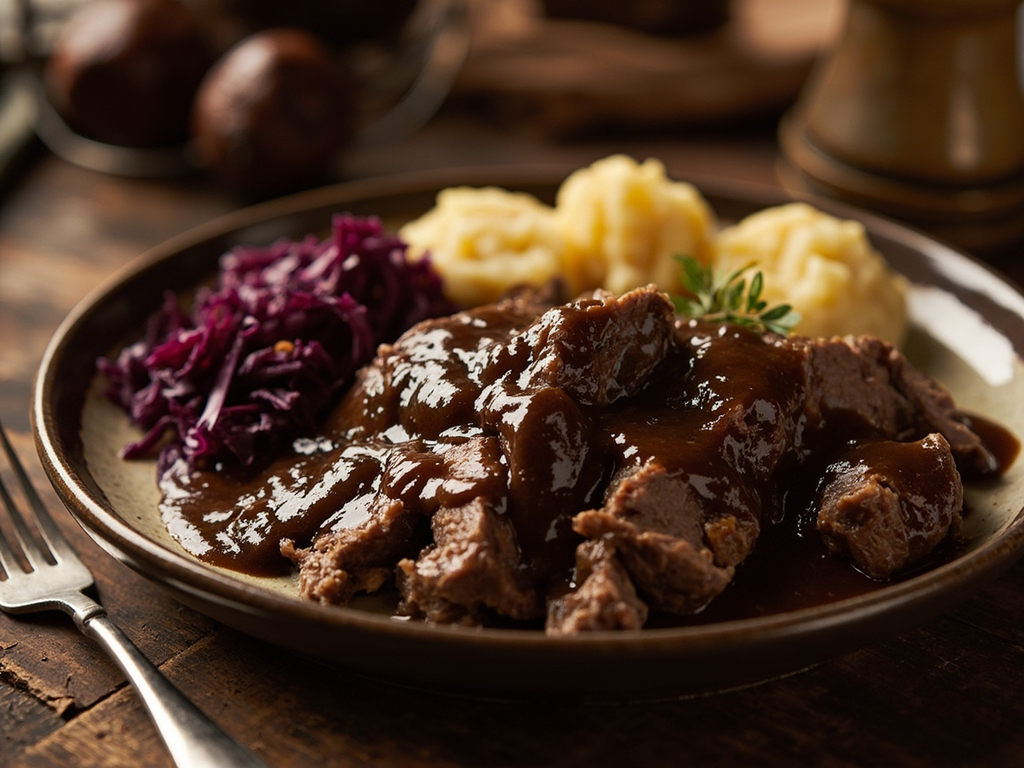
A beef roast long marinated in vinegar and spices, then braised until tender, served in a sweet-and-sour brown sauce thickened with crumbled gingerbread. The sour of the vinegar and the sweet of the spices balance each other: the great classic of the German festive meal.
Ah, Sauerbraten! You must have patience, my friend—the meat must soak three full days in vinegar and juniper berries; one does not rush time, any more than one rushes a print. The secret, my mother taught me: at the end, you crumble the gingerbread into the sauce, and then the brown thickens, the sour rounds out, the whole becomes deep like a well-placed shadow. It is served on Sunday, when the family is gathered, and it is still talked about the next day.
- •Beef chuck or bottom round — a good piece (meat)
- •Wine vinegar — enough to half-cover (sour marinade)
- •Red wine — a large glass (marinade)
- •Onions — two (aromatics)
- •Juniper berries, cloves, bay leaves, peppercorns — a handful (marinade spices)
- •Gingerbread (Lebkuchen / Pfefferkuchen) — a few slices (thickener and flavor for sauce)
- •Lard — a spoonful (fat for searing)
Sunday Sauerbraten with Gingerbread Sauce
A beef roast long marinated in vinegar and spices, then braised until tender, served in a sweet-and-sour brown sauce thickened with crumbled gingerbread. The sour of the vinegar and the sweet of the spices balance each other: the great classic of the German festive meal.
Why this dish? Sauerbraten is the quintessential Sunday roast of German families, and the Stieglitz line came precisely from northern Germany. This is the kind of hot dish that crowned the Sunday Mittagessen, around which a bourgeois family like his gathered.
Ah, Sauerbraten! You must have patience, my friend—the meat must soak three full days in vinegar and juniper berries; one does not rush time, any more than one rushes a print. The secret, my mother taught me: at the end, you crumble the gingerbread into the sauce, and then the brown thickens, the sour rounds out, the whole becomes deep like a well-placed shadow. It is served on Sunday, when the family is gathered, and it is still talked about the next day.
Ingredients (period version)
- Beef chuck or bottom round — a good piece (meat)
- Wine vinegar — enough to half-cover (sour marinade)
- Red wine — a large glass (marinade)
- Onions — two (aromatics)
- Juniper berries, cloves, bay leaves, peppercorns — a handful (marinade spices)
- Gingerbread (Lebkuchen / Pfefferkuchen) — a few slices (thickener and flavor for sauce)
- Lard — a spoonful (fat for searing)
Ingredients
- Beef chuck or bottom round — 1.2 kg (meat)
- Red wine vinegar — 250 ml (sour marinade)
- Red wine — 250 ml (marinade)
- Onions — 2 large (aromatics)
- Carrot — 1 (aromatic)
- Juniper berries — 6 (spice)
- Cloves — 4 (spice)
- Bay leaves — 2 (spice)
- Dry gingerbread — 60 g (thickener and flavor for sauce)
- Lard or clarified butter — 2 tbsp (fat for searing)
- Salt, pepper — to taste (seasoning)
Method
- Three days ahead: place the beef in a container with vinegar, wine, sliced onions, carrot, juniper, cloves, bay leaf, and pepper. Cover and marinate in the refrigerator, turning daily.
- On the day, drain the meat (reserve the strained marinade) and pat dry.
- Sear the roast on all sides in lard until well browned.
- Add the strained marinade, cover, and braise on low heat for 2.5 to 3 hours, until the meat is tender.
- Remove the meat, crumble the gingerbread into the juices and whisk: the sauce thickens and turns brown.
- Adjust the sweet-sour balance (add a little sugar if too acidic), slice the roast, and nap with sauce.
How it was made : Sauerbraten dates back to the German Middle Ages: the vinegar marinade initially served to tenderize and preserve tough meats. Thickening the sauce with gingerbread (or *Lebkuchen*) is a regional signature, especially Rhenish and North German, passed down in emigrant families.
The contemporary twist : Serve with *Kartoffelklöße* (potato dumplings) and braised red cabbage—the tricolor plate of brown, white, and purple makes a nice impression.
Alfred Stieglitz · Charactorium