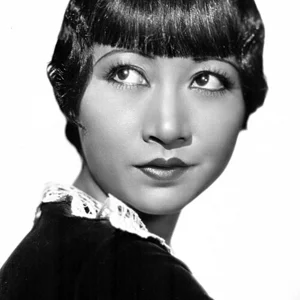

The first Chinese-American star of Hollywood, Anna May Wong (1905-1961) made her mark in both silent and sound cinema despite the industry's systemic racism. Throughout her career, she fought against stereotypes and anti-miscegenation laws that denied her leading roles.
Frequently asked questions
Famous Quotes
« Why is it that the screen Chinese is always the villain?»
« I was so tired of the roles I had to play.»
Key Facts
- 1905: born in Los Angeles in Chinatown
- 1922: first major role in 'The Toll of the Sea', one of the first films shot in Technicolor
- 1932: denied the lead role in 'The Good Earth' due to anti-miscegenation laws (Hays Code)
- 1951: first Asian actress to have her own American television show ('The Gallery of Madame Liu-Tsong')
- 2022: her likeness appears on the American quarter, making her the first Asian American to be featured on U.S. currency
Works & Achievements
Anna May Wong's first major role in one of the earliest Hollywood films shot in Technicolor. She plays a young Chinese woman tragically abandoned by her American lover — a victim role already emblematic of the limits imposed on Asian actresses.
Alongside superstar Douglas Fairbanks, Wong plays a Mongol slave girl in this lavish fantasy adventure film. Her expressive performance earned her international recognition and marked her entry into the Hollywood star system.
A British film in which she plays Shosho, a restaurant dishwasher who rises to become a star dancer. Considered her finest silent film, it finally gave her a complex, central role far removed from the usual Hollywood stereotypes.
Directed by Josef von Sternberg alongside Marlene Dietrich, this film is one of her greatest critical successes. Wong plays Hui Fei, a Chinese-American prostitute with a tragic fate, in a performance acclaimed as one of the most nuanced of her career.
An adaptation of a Sax Rohmer novel in which Anna May Wong plays the daughter of the infamous Dr. Fu Manchu. Although the film perpetuates Orientalist stereotypes, Wong's performance dominates the screen and earned her critical acclaim on both sides of the Atlantic.
The first American television series to star an Asian actress in the lead role. Wong plays a New York art gallery owner caught up in espionage adventures — a positive, modern role that marked a radical departure from the sinister Asian villainesses of the silver screen.
Anecdotes
In 1937, when Hollywood was adapting Pearl Buck's novel 'The Good Earth', Anna May Wong, the world's most famous Chinese-American actress, was denied the lead role of O-Lan — a Chinese peasant woman. MGM gave the part to Austrian actress Luise Rainer in 'yellowface', because anti-miscegenation laws prohibited an Asian actress from playing romantic scenes with a white actor. This rejection, one of the most humiliating of her career, left a deep and lasting mark on her.
Her real name was Wong Liu Tsong, meaning 'Cold Jade Moon' in Cantonese. As a child, she would accompany her father to his laundry in Los Angeles and spend her free hours watching film shoots on the streets of her neighborhood. She saved up five cents at a time to buy cinema tickets, captivated by this new art form, until she landed her first small roles at the age of 14.
Weary of Hollywood's systemic racism, Anna May Wong moved to Europe in 1928. In London and Berlin, she appeared in ambitious films, was acclaimed by the press, learned German, and mixed with the European cultural elite — including Marlene Dietrich, with whom she made 'Shanghai Express' in 1932. This European chapter offered her an artistic freedom she had never known in America.
In 1936, she traveled to China to reconnect with her roots. The reception was icy: the Chinese press attacked her harshly for the roles of venal women and villains she had played in Hollywood, arguing that she gave China a bad image. Anna May Wong — a stranger in her own ancestral homeland — returned to the United States deeply shaken but determined to keep fighting.
In 1951, she became the first Asian American to headline an American television series, 'The Gallery of Madame Liu-Tsong', in which she played an art dealer drawn into espionage adventures. It was a symbolic victory in an industry that had denied her leading roles for so long.
Primary Sources
I am condemned to be tragic, always playing the villainous Oriental woman. I don't want to be the wicked dragon lady forever. There seems to be no way out.
Why is it that the screen Chinese is always the villain? And so crude a villain — murderous, treacherous, a snake in the grass. We are not like that. How should we be, when the Chinese have the richest, the most mellow civilization in the world?
It is a shame that Chinese always have to be the bad man in the movies. I am hoping that someday a picture will be made that will tell the truth about the Chinese.
When I die, my epitaph should be: 'She died as she had always lived — on the wrong side of the camera.'
Key Places
The neighborhood where Anna May Wong was born and raised, between the family laundry and the early film crews she watched with fascination. This rootedness in the Chinese-American community shaped her identity and fueled her fight for dignified representation.
The setting of both her triumphs and her humiliations, the major Hollywood studios (Paramount, MGM, Universal) were at once the site of her international acclaim and the place where institutional racism systematically shut her out of leading roles.
The city where Anna May Wong found artistic refuge as early as 1928. There she made ambitious films such as *Piccadilly* (1929), was celebrated by British critics, and enjoyed a creative and social freedom that Hollywood denied her.
Around 1930, Anna May Wong moved through Berlin's vibrant cultural scene, made films, and learned German. The city represented modern, cosmopolitan Europe for her — until the rise of Nazism closed those doors as well.
During her 1936 journey, Anna May Wong visited China's major cities in search of her roots and to improve her Mandarin. The hostility of the Chinese nationalist press — which condemned her Hollywood roles — made for a painful experience of double rejection: neither fully American nor fully Chinese.
The city where Anna May Wong settled in her final years and where she died on February 3, 1961. She was preparing a return to the big screen in the film *Flower Drum Song* when she was taken by a heart attack.
Typical Objects

A fitted traditional Chinese dress, the qipao became Anna May Wong's sartorial signature both on screen and in real life. She turned it into a symbol of Sino-American cultural pride at a time when Asian identity was routinely mocked or caricatured.

The early film cameras young Anna watched on the streets of Los Angeles as a child were a revelation to her. She learned to master her expressions for this unforgiving mechanical eye, developing a particularly expressive acting style perfectly suited to silent cinema.

These documents governed every aspect of an actress's life under the American studio system. For Anna May Wong, contracts often contained discriminatory clauses restricting the types of roles she could play — an institutionalized reflection of the industry's racism.

A deeply symbolic object for a second-generation American whose nationality and sense of belonging were constantly called into question. Her passport allowed her to travel to Europe and China, yet the identity it certified — American — was perpetually denied by Hollywood, which confined her to roles as a foreigner.

Paradoxically, even though Anna May Wong was a genuine Asian actress, studios sometimes imposed makeup and hairstyles that amplified "exotic" stereotypes — while white actresses played Chinese characters in "yellowface," a racist form of makeup applied to non-Asian performers to make them appear Asian.

Anna May Wong received and turned down numerous scripts offering her demeaning roles: submissive servants, criminal femmes fatales, or traitors. These refusals — rare at a time when actresses had little power — are a testament to her integrity and her early political awareness.
School Curriculum
Vocabulary & Tags
Key Vocabulary
Tags
Daily Life
Morning
In the 1930s, Anna May Wong rose early to head to the Hollywood studios, where hair and makeup sessions could last two hours before the first shot. She took great care to master her lines perfectly, aware that as an Asian actress she could not afford to make mistakes without risking being replaced.
Afternoon
Afternoons on set alternated between long hours of waiting and short, intense scenes under blazing spotlights. Outside of filming, she took language classes — she spoke English, Cantonese, Mandarin, French, and German — and received journalists and fashion designers who admired her elegance.
Evening
A fixture of Hollywood and later London social life, Anna May Wong attended film premieres, artists' dinners, and literary evenings. In London, she was part of a cosmopolitan circle of personalities revolving around European theater and cinema. She read widely and corresponded regularly with her family back in Los Angeles.
Food
From a Cantonese family, Anna May Wong had grown up with traditional Chinatown cooking — rice, fish, stir-fried vegetables, and soups. In Europe, she adapted to local cuisine while seeking out Chinese restaurants in major cities, maintaining this culinary connection to her roots during her time abroad.
Clothing
Anna May Wong was renowned for her exceptional elegance, skillfully blending Western fashion with traditional Chinese garments. She often wore the qipao (cheongsam) in public, making it as much a statement of identity as of aesthetics. Leading Parisian and London couturiers created outfits for her, and she was regularly featured in rankings of the world's best-dressed women.
Housing
In Hollywood, Anna May Wong lived in several Los Angeles neighborhoods, navigating the de facto restrictions imposed on Asian residents in certain areas. During her European years, she occupied apartments in the artistic quarters of London and Berlin. Later in life, she owned a house in Santa Monica, where she lived alone, having never been free to marry due to anti-miscegenation laws that prohibited interracial unions in many American states.
Historical Timeline
Period Vocabulary
Liens externes & ressources
Références
Œuvres
The Gallery of Madame Liu-Tsong (série télévisée)
1951