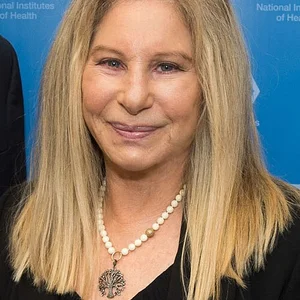

American singer and actress born in 1942 in New York, Barbra Streisand is one of the most awarded artists in entertainment history. She has shaped American pop music and cinema across more than six decades of career.
Barbra Streisand(1942 — ?)
Barbra Streisand
États-Unis
9 min read
Frequently asked questions
Famous Quotes
« Success, for me, is never having to end up regretting that I didn't try.»
Key Facts
- Born on April 24, 1942, in Brooklyn, New York
- Broadway debut in the early 1960s in 'I Can Get It for You Wholesale' (1962)
- Academy Award for Best Actress for 'Funny Girl' in 1969
- First woman to win an Oscar, an Emmy, a Grammy, and a Tony (EGOT)
- Over 150 million albums sold worldwide, one of the best-selling artists in history
Works & Achievements
Her debut studio album, recorded at Columbia Records at age 20, won two Grammy Awards and introduced the world to a voice of exceptional power and sensitivity, launching a recording career spanning more than six decades.
A musical tracing the life of comedian Fanny Brice, in which Streisand starred in the lead role. The show catapulted her to national stardom and remains one of the greatest successes in Broadway history.
The film adaptation directed by William Wyler, for which Streisand won the Academy Award for Best Actress in her very first screen role, launching a Hollywood career as brilliant as her musical one.
A romantic film starring Robert Redford, for which Streisand also performed the title song, which won the Academy Award for Best Original Song. The film was a massive popular success in a country gripped by self-doubt in the wake of Watergate.
A musical remake she co-produced, featuring the song "Evergreen," which she co-wrote and which won the Academy Award for Best Original Song. The film marked her entry into Hollywood film production.
A musical film adapted from a short story by Isaac Bashevis Singer, for which Streisand simultaneously served as producer, director, co-writer, and lead actress, becoming the first woman to direct and produce a major Hollywood studio film.
Her first major concert tour after twenty-seven years away from the stage, with tickets selling at record prices. The tour confirmed her status as a living legend of American entertainment and drew millions of audience members across North America and Europe.
Anecdotes
To stand out in a highly competitive artistic world, Barbara Joan Streisand deliberately dropped an “a” from her first name at the very start of her professional career in the early 1960s. This bold choice reflects her determination to forge a unique artistic identity, at a time when performers often adopted entirely fictional stage names to appeal to the studios.
At the 41st Academy Awards ceremony on April 14, 1969, Barbra Streisand won the Best Actress award for “Funny Girl,” sharing the honor in a tie with Katharine Hepburn for “The Lion in Winter.” This tie, extremely rare in Oscar history, reflects the cultural upheaval of the late 1960s, when bold new styles were asserting themselves against classic Hollywood values.
In June 1967, Barbra Streisand gave a free concert in Central Park before 135,000 New Yorkers. After suffering a paralyzing memory lapse on stage, she developed such a severe fear of performing live that she stopped giving concerts for twenty-seven years, not returning to the stage until 1994 for a long-awaited world tour.
In 1983, Barbra Streisand became the first woman to produce, direct, write the screenplay for, and star in a major Hollywood studio film with *Yentl*. She had spent ten years working to bring the project to life — inspired by a short story by Isaac Bashevis Singer — after facing repeated rejections from studios that doubted a woman could successfully carry out such an undertaking.
In 2018, Barbra Streisand had her dog Samantha, who had died the previous year, cloned, obtaining two genetically identical puppies she named Miss Violet and Miss Scarlett. The event sparked a worldwide debate on the ethics of animal cloning, illustrating how celebrities can shape contemporary scientific and moral discussions.
Primary Sources
Upon accepting the award, Streisand said that sharing the honor with Katharine Hepburn felt both extraordinary and unexpected, expressing her gratitude to the Academy for recognizing in *Funny Girl* the culmination of years of hard work.
Streisand said: "I thank the Hollywood Foreign Press Association for recognizing that a woman can tell a story and direct actors just as well as a man. This film is dedicated to all those who had to fight to have their voice heard."
Streisand confided: "I had a paralyzing fear of performing on stage since 1967. Every time I thought about it, I relived that moment in Central Park where I forgot the lyrics. But the audience deserves better than my fear."
In the notes accompanying the album, Streisand explained her collaboration with Barry Gibb of the Bee Gees: "Barry understood exactly what I wanted to express. Together, we set out to create something that would touch both the heart and the feet."
Key Places
A popular borough of New York City where Barbra Streisand was born and raised in the Williamsburg neighborhood. This modest, cosmopolitan environment, with its strong Ashkenazi Jewish community, profoundly shaped her artistic identity and civic commitments.
The iconic avenue of great American musical theater where Streisand triumphed with *Funny Girl* in 1964. Broadway is the heart of American live entertainment and remains the stage where artists prove their talent at the highest level.
The site of Streisand's legendary free concert in June 1967, performed before 135,000 spectators — one of the largest cultural gatherings in New York City history. The event remains one of the most celebrated outdoor concerts of twentieth-century America.
The world capital of cinema where Streisand built her acting career beginning in 1968. Hollywood embodies the American entertainment industry of the twentieth century, with its major studios, award ceremonies, and global cultural influence.
A coastal city on the outskirts of Los Angeles where Streisand has lived since the 1970s on a sprawling oceanfront estate. There she had a personal compound built — complete with shops, an art gallery, and a movie theater — reflecting the lifestyle of Hollywood's greatest stars.