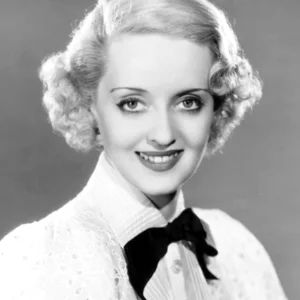

American actress (1908–1989), a towering figure of Hollywood cinema from the 1930s through the 1960s. Known for her roles as strong, complex women, she won two Academy Awards and established herself as one of the greatest stars of the studio system.
Bette Davis(1908 — 1989)
Bette Davis
États-Unis
9 min read
Frequently asked questions
Famous Quotes
« Fasten your seatbelts, it's going to be a bumpy night.»
« I survived because I was tougher than anybody else.»
Key Facts
- Born on April 5, 1908, in Lowell, Massachusetts
- First Academy Award for Best Actress for *Dangerous* (1935)
- Second Academy Award for *Jezebel* (1938), having competed with Vivien Leigh for the role of Scarlett O'Hara
- Her iconic role as Margo Channing in *All About Eve* (1950), widely considered her masterpiece
- Died on October 6, 1989, in Neuilly-sur-Seine, France
Works & Achievements
Bette Davis's first major dramatic role, in which she plays a manipulative and cruel waitress. The film reveals the full extent of her talent, but her absence from the Oscar nominations caused such an uproar that the Academy changed its voting rules.
Davis's first Academy Award for Best Actress, playing a declining alcoholic actress. This film definitively established her place among Hollywood's greatest performers.
Davis's second Oscar, in the role of a proud and rebellious young woman from the antebellum American South. The film is often compared to "Gone with the Wind" and reflects the era's fascination with Civil War history.
In this melodrama, Davis plays a young socialite diagnosed with a brain tumor. The film is one of her greatest popular successes, and her performance made it a benchmark of the genre.
Widely considered Davis's absolute masterpiece, this film about the backstage world of New York theater earned her a sixth Oscar nomination. Her line "Fasten your seatbelts, it's going to be a bumpy night" is one of the most quoted in cinema history.
This psychological horror film, made alongside her rival Joan Crawford, spectacularly relaunched Davis's career at age 54. She plays a former vaudeville star who has descended into madness, in a physically and emotionally demanding role that gave birth to a new film genre.
Anecdotes
In 1936, Bette Davis dared to defy the powerful Warner Bros. by refusing roles she considered beneath her and leaving to work in England. The studio sued her and won the case, but her courage drew the attention of the entire industry. The affair marked a turning point in the relationship between actors and the major Hollywood studios.
Bette Davis was the first actress to win two consecutive Oscars: for *Dangerous* in 1936 and *Jezebel* in 1939. She was also nominated ten times in total, a record that went unmatched for several decades and is a testament to the exceptional consistency of her career.
In 1942, at the height of World War II, Bette Davis co-founded with actor John Garfield the Hollywood Canteen, a free canteen for American soldiers on leave in Los Angeles. She personally welcomed the servicemen, singing, dancing, and signing autographs, actively contributing to the war effort.
During the filming of *What Ever Happened to Baby Jane?* in 1962, the legendary rivalry between Bette Davis and Joan Crawford descended into mutual sabotage on set. Davis reportedly wore heavy shoes to make certain scenes harder to film, while Crawford allegedly weighted her body down to make the scenes where Davis had to carry her more physically demanding.
In 1977, Bette Davis became the first woman to receive the AFI Life Achievement Award, the highest honor bestowed by the American Film Institute. This long-overdue recognition crowned a career spanning more than fifty years in service of uncompromising cinema, in which she never sacrificed the truth of her performance for easy appeal.
Primary Sources
I never wanted to be a star. I wanted to be an actress. These are two very different things, and Hollywood has often confused the two.
After fifty years in the business, I can say I have survived everything: studios, critics, husbands, and even my own failed films. Survival may be my greatest role.
Miss Davis contends that the contract binding her to Warner Bros. constitutes a form of servitude incompatible with the dignity of a free artist, preventing her from practicing her craft outside the conditions imposed by the studio.
The women I play on screen are not victims. They think, they act, they make mistakes, and they own them. That is what makes them interesting.
Key Places
Birthplace of Bette Davis on April 5, 1908. An industrial city in New England, she grew up there in a middle-class household before her parents divorced — an event that left a deep mark on her character.
Davis cut her teeth in theater here during the 1920s, training under the great school of Eva Le Gallienne. New York represented serious theater to her — a world she never entirely left behind, even at the height of her Hollywood fame.
This is where Bette Davis shot the majority of her landmark films of the 1930s and 1940s, under an exclusive studio contract. The Burbank soundstages were the site of her greatest triumphs — and her fiercest battles with studio management.
The world capital of cinema during the golden age of the studios, Hollywood is where Bette Davis built her legend over several decades. She lived there among all the great stars of the era, navigating a world that was as glamorous as it was ruthless.
Bette Davis died in Paris on October 6, 1989, shortly after being honored at the San Sebastián International Film Festival in Spain. Paris was the final stop of a life spent traveling, and a testament to her enduring affection for European culture.
Typical Objects

The cigarette is Bette Davis's most iconic on-screen prop: she holds it, smokes it, or stubs it out with a characteristic expressiveness that amplifies her characters' personalities. Her singular way of smoking became one of the most imitated and parodied images in classic Hollywood cinema.

Bette Davis won two golden Academy Award statuettes, the ultimate symbols of recognition in the American film industry. These honors gave her a rare negotiating power — remarkable for an actress of her era — when dealing with the all-powerful studios.

The multi-year contract signed with Warner Bros. was a binding legal document tying the actress to the studio, dictating her roles, her salary, and her public image. This type of contract, typical of the studio system, was precisely what Davis challenged in court in 1936 in the name of artistic freedom.

The Mitchell camera, the standard for Hollywood productions from the 1930s through the 1960s, captured Davis's performances in her greatest films. These cameras demanded intense lighting that required heavy, stylized makeup — something Davis herself took meticulous care to perfect.

Thick, matte pancake makeup was essential under the harsh lights of studio sets in the 1930s–1950s. Bette Davis worked closely with makeup artists to build her characters visually, sometimes going as far as deliberately making herself look plain or aged in service of the role's truth.

Davis was renowned for her relentless preparation, annotating her scripts extensively before filming to plan every inflection and every gesture. This rigorous discipline, rooted in her New York theater training, set her apart from many stars who simply learned their lines day by day.
School Curriculum
Vocabulary & Tags
Key Vocabulary
Tags
Daily Life
Morning
Bette Davis arrived on set before dawn, as Hollywood shoots typically began at 7 in the morning. She sometimes spent two hours in the makeup chair, working closely with the artists to build her character's visual identity before rehearsing scenes with the director.
Afternoon
Afternoons were devoted to intensive filming under the blazing studio lights, which gave off stifling heat. Davis was known for staying on set even when she wasn't shooting, watching the crew at work and discussing camera angles with the director — a habit that earned her a reputation for being difficult, but also for being a genius of the craft.
Evening
Evenings blended social obligations with work: film premieres, dinners with producers, reading through the next day's script. Davis often preferred to stay home learning her lines and annotating her script, but she attended Hollywood events when the studio required it for promotional purposes.
Food
Bette Davis was a heavy smoker — a habit widespread among Hollywood stars of the era and frequently staged in her films. Her diet was simple and unpretentious for someone of her status; she favored classic American home cooking over the lavish restaurants her peers frequented.
Clothing
On screen, Davis was dressed by the studios' top costume designers, most notably Orry-Kelly, who created her most celebrated looks for Warner Bros. productions. In private life, she dressed far less dramatically, preferring comfort over the extravagant outfits expected of a star of her standing.
Housing
During her Hollywood golden age, Davis lived in a villa in Los Angeles, surrounded by her staff and loved ones. She also owned a property in New England — the region where she grew up — where she liked to retreat and find the peace and quiet needed to prepare for her roles.