 flip
flipHerb-and-Verjus Capon Pie
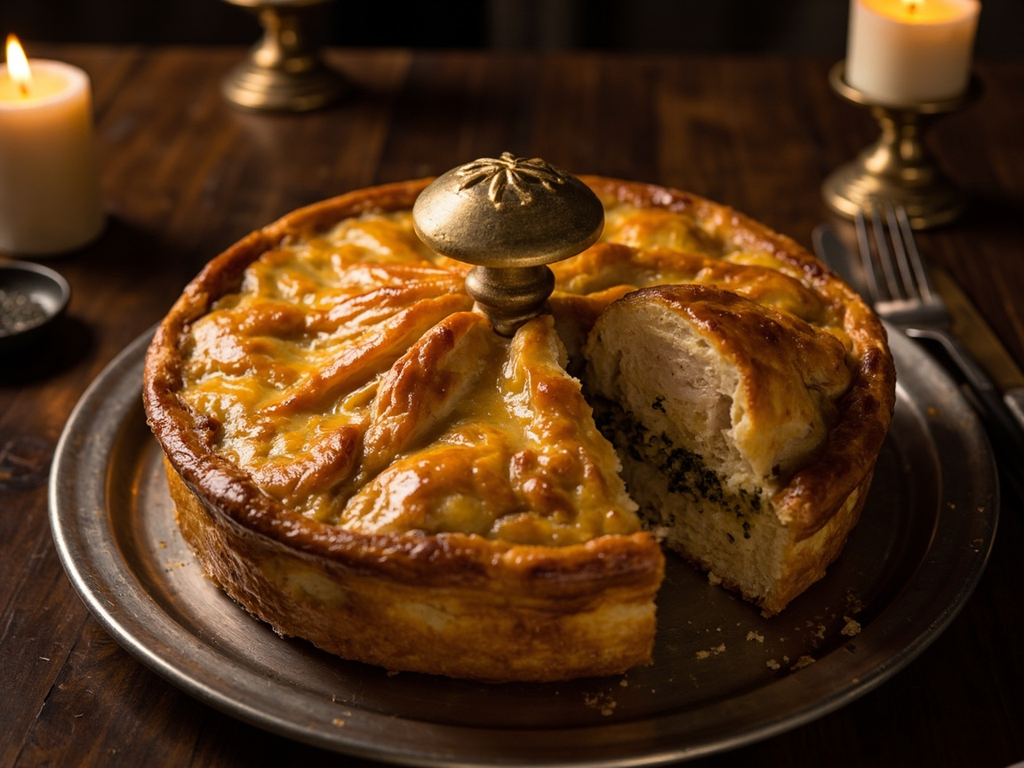
Herb-and-Verjus Capon Pie
Why this dish? Before his conversion, Pascal frequented the fashionable salons of Paris and Rouen; his father Étienne, a king's counselor, kept a table typical of the good robe bourgeoisie. The poultry pie in crust was the quintessential prestige dish of these Grand Siècle receptions.
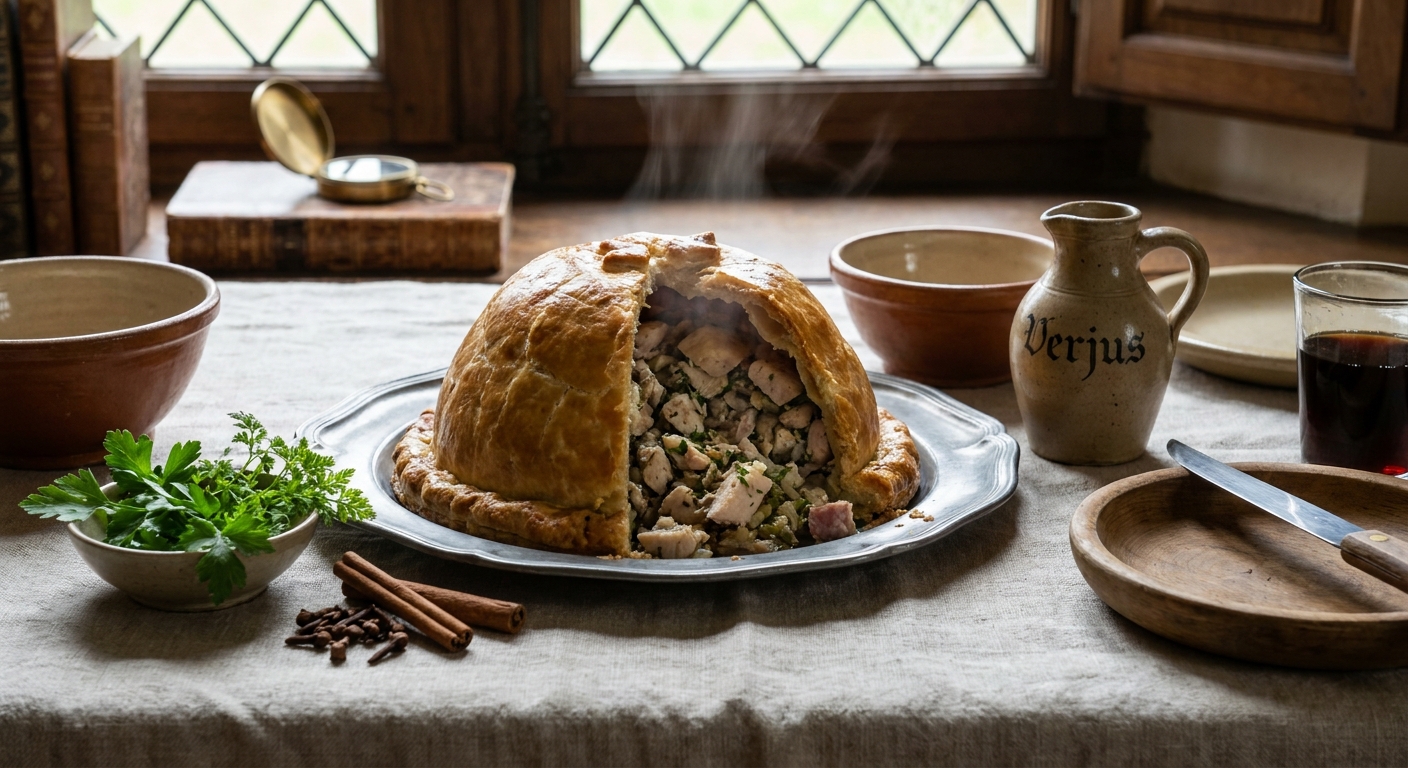
Fine poultry and herbs enclosed in a golden crust, enlivened with verjus and a hint of spices. Served whole in the center of the table, the crust cracked open so the fragrant steam escapes.
In the days when I still frequented the world and its diversions, we served this pie at our table on days of celebration. Take a fine, plump capon, cut it into small pieces, mix it with your fine herbs, a little bacon, and some spices that merchants bring back from the Levant. Enclose everything in a pastry, and upon leaving the oven, cut open the crust and pour in a dash of verjus: the rising steam is worth all compliments. I confess that I have since learned to do without it; but the memory is still pleasant to me.
- •Capon or poularde — the flesh of half (main filling)
- •Fresh bacon — a piece (moisture)
- •Fine herbs (parsley, chives, chervil) — a good handful (flavor)
- •Sweet spices (cinnamon, ginger, clove) — a pinch (lift)
- •Verjus — a dash (final souring)
- •Pastry (flour, butter, salt, water) — enough to line and cover (crust)
- •Egg yolks — two (binder and glaze)
Herb-and-Verjus Capon Pie
Fine poultry and herbs enclosed in a golden crust, enlivened with verjus and a hint of spices. Served whole in the center of the table, the crust cracked open so the fragrant steam escapes.
Why this dish? Before his conversion, Pascal frequented the fashionable salons of Paris and Rouen; his father Étienne, a king's counselor, kept a table typical of the good robe bourgeoisie. The poultry pie in crust was the quintessential prestige dish of these Grand Siècle receptions.
In the days when I still frequented the world and its diversions, we served this pie at our table on days of celebration. Take a fine, plump capon, cut it into small pieces, mix it with your fine herbs, a little bacon, and some spices that merchants bring back from the Levant. Enclose everything in a pastry, and upon leaving the oven, cut open the crust and pour in a dash of verjus: the rising steam is worth all compliments. I confess that I have since learned to do without it; but the memory is still pleasant to me.
Ingredients (period version)
- Capon or poularde — the flesh of half (main filling)
- Fresh bacon — a piece (moisture)
- Fine herbs (parsley, chives, chervil) — a good handful (flavor)
- Sweet spices (cinnamon, ginger, clove) — a pinch (lift)
- Verjus — a dash (final souring)
- Pastry (flour, butter, salt, water) — enough to line and cover (crust)
- Egg yolks — two (binder and glaze)
Ingredients
- Chicken breasts and thighs, free-range — 500 g (filling)
- Fresh pork belly — 100 g (moisture)
- Mixed parsley-chives-chervil — 1 bunch (flavor)
- Ground cinnamon, ginger, clove — 1 pinch each (lift)
- Verjus (or mild cider vinegar) — 2 tbsp (souring)
- Shortcrust pastry — 2 discs (500 g) (crust)
- Egg yolks — 2 (1 for glaze) (binder and glaze)
- Salt, pepper — to taste (seasoning)
Method
- Finely chop the chicken and pork belly into small dice, without overworking to a purée.
- Mix in the chopped herbs, spices, salt, pepper, and one egg yolk to bind the stuffing.
- Line a pie dish with one pastry disc, fill with the stuffing, pressing firmly.
- Cover with the second disc, seal the edges, cut a steam vent in the center, and glaze with beaten egg yolk.
- Bake for 40 to 45 minutes at 180°C (medium oven) until golden brown.
- Upon removal, pour the verjus through the vent and let rest 5 minutes before cracking the crust at the table.
How it was made : The pie in crust, along with the pâté, was the grand ceremonial dish of the Grand Siècle. The crust served both as a cooking vessel and a serving dish. The spiced sweet-savory flavor, inherited from the Middle Ages, was still very present in the early 17th century but began to recede in La Varenne's cuisine in favor of more straightforward flavors.
The contemporary twist : Serve as individual pies with a veil of verjus reduced to a syrup, in the style of a 'savory pithiviers' by a chef.
Sources : François Pierre de La Varenne, Le Cuisinier françois, 1651 · Le Pastissier françois, 1653
Blaise Pascal · Charactorium