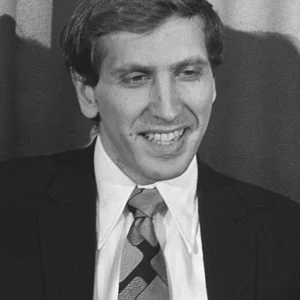

Bobby Fischer was an American chess player, considered one of the greatest in history. In 1972, he became world champion by defeating the Soviet Boris Spassky, putting an end to decades of Soviet domination of the game.
Bobby Fischer(1943 — 2008)
Bobby Fischer
États-Unis, Islande
5 min read
Frequently asked questions
Famous Quotes
« I don't believe in psychology, I believe in good moves.»
Key Facts
- Born in 1943 in Chicago, died in 2008 in Reykjavik (Iceland)
- Youngest international grandmaster in history at the time (1958, at age 15)
- United States champion at age 14 during the 1957-1958 season
- Won the World Chess Championship in 1972 against Boris Spassky in Reykjavik (the “Match of the Century”)
- Lost his title in 1975 by forfeit, for lack of agreement on the match conditions
Works & Achievements
Anthology game played at age 13, famous for a spectacular queen sacrifice.
Instructional manual that became a worldwide best-seller for learning chess.
Collection of annotated games, regarded as a classic of chess literature.
An 11-out-of-11 victory, a feat never repeated in this tournament.
First American to become world champion, ending Soviet dominance.
A time-control system adding time after each move, patented by Fischer and now standard.
A chess variant in which the starting position is drawn at random, to reduce the weight of memorized theory.
Anecdotes
In 1958, at just 15 years old, Bobby Fischer became the youngest international Grand Master in history at the time. No one so young had ever achieved this title, which instantly made him a worldwide chess star.
During the “Match of the Century” in Reykjavik in 1972, Fischer nearly didn't play at all: he arrived late, refused to play the first game, and demanded changes to the playing hall and the cameras. Henry Kissinger personally telephoned him to convince him to represent the United States against the USSR.
At age 13, Fischer played a game that became famous as “the Game of the Century” against Donald Byrne, in which he sacrificed his queen to build a dazzling combination. This victory by a teenager spread throughout the chess world.
At the 1963-1964 U.S. Championship, Fischer pulled off a feat never since equaled: he won all 11 games of the tournament, a perfect score of 11 out of 11 against the country's best players.
After his 1972 title, Fischer almost completely vanished from public life for twenty years. He refused to defend his title in 1975 and did not play another official game until 1992, again against Spassky.
Primary Sources
A collection annotated by Fischer himself of sixty of his games, in which he analyzes his strategic choices with unusual honesty, also acknowledging his mistakes.
A learning manual using the question-and-answer method, which became one of the best-selling chess books in history.
The American press portrayed the duel as a symbolic confrontation between West and East at the height of the Cold War.
Key Places
Birthplace of Bobby Fischer in 1943.
The borough where Fischer grew up and made a name for himself at a very young age in New York's chess clubs.
Site of the 1972 World Championship match against Spassky, and later the city where Fischer took refuge and died in 2008.
Site of the 1992 rematch against Spassky, held despite the international embargo.
City of the 1971 Candidates match where Fischer defeated Tigran Petrosian to earn the right to challenge the world champion.
Typical Objects

A board of 64 black and white squares on which the game is played. It was the playing field where Fischer expressed his strategic genius.

A set of 32 standardized pieces used in official competition. The king, queen, rooks, bishops, knights and pawns are the tools of battle on the board.

A double clock that measures each player's thinking time. In competition, managing your time is as crucial as choosing the right move.

A document on which each player records their moves in algebraic notation. It makes it possible to replay and analyze the game afterward.

Collections analyzing the opening phase of the game and its variations. Fischer studied them tirelessly and even gave his name to a famous variation.
School Curriculum
Vocabulary & Tags
Key Vocabulary
Tags
Daily Life
Morning
From his teenage years, Fischer devoted his mornings to studying chess: he analyzed games in Soviet journals that he learned to read in Russian. The game took up most of his days at the expense of everything else.
Afternoon
In the afternoon, he trained alone or faced opponents in New York's chess clubs. He could spend hours studying a single position or an opening variation.
Evening
In the evening, during tournaments, the official games were played, which could last five hours or more. Outside of competitions, Fischer led an increasingly solitary and withdrawn life.
Food
Concerned about his physical fitness to sustain the intense concentration of his games, Fischer watched his diet and played tennis and swam. He considered physical condition essential to chess performance.
Clothing
For his important matches, Fischer wore tailor-made suits, taking care of his public appearance. In private, especially in his later years, he adopted a much more unkempt look.
Housing
After a modest childhood in Brooklyn, Fischer led a nomadic life, staying in hotels or with acquaintances. He eventually settled in Reykjavik, Iceland, the country that offered him asylum.
Historical Timeline
Period Vocabulary
Liens externes & ressources
Références
Œuvres
La « Partie du siècle » contre Donald Byrne
1956
Bobby Fischer Teaches Chess
1966
My 60 Memorable Games
1969
Score parfait au championnat des États-Unis
1963
Titre de champion du monde face à Spassky
1972
Invention de l'horloge à incrément Fischer
1988
Promotion du Fischerandom (échecs 960)
1996