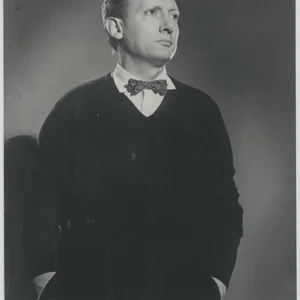

Argentine conductor and violinist of Italian origin (1915–2011), Carlo Felice Cillario made his mark in the operatic and symphonic repertoire. He conducted at the world's greatest opera houses, including the Royal Opera House in London and the Paris Opera.
Carlo Felice Cillario(1915 — 2007)
Carlo Felice Cillario
Italie, royaume d'Italie
8 min read
Frequently asked questions
Key Facts
- Born on 15 February 1915 in Alba, Italy
- Emigrated to Argentina, where he pursued his musical career
- Conducted at the Royal Opera House, Covent Garden, London during the 1960s and 1970s
- Collaborated with singers such as Montserrat Caballé and Luciano Pavarotti
- Died on 3 April 2011 in Sydney, Australia
Works & Achievements
A landmark studio recording made in London for the Decca label with soprano Joan Sutherland and baritone Gabriel Bacquier. This album stands as one of the most significant audio documents of Cillario's career and remains a benchmark recording for this opera buffa.
Memorable productions at the Royal Opera House featuring Joan Sutherland in the title role, acclaimed by the London press. These evenings helped firmly establish Cillario's international reputation as a specialist conductor of bel canto.
Cillario conducted numerous productions of La Traviata throughout his career, making this Verdi opera one of his signature titles. His readings, at once dramatically compelling and singer-friendly, became reference performances at the Teatro Colón and earned him a lasting loyalty among Argentine audiences.
Cillario was a highly regarded interpreter of Puccini, Tosca in particular — an opera he conducted across several continents. His productions, attentive to both the singers and the musical drama, made him a regular guest at the world's leading opera houses.
Cillario played a significant role in the development of opera in Australia by regularly conducting the Australian Opera Company following the inauguration of the Sydney Opera House in 1973. His expertise in the European lyric repertoire provided an essential artistic authority to this flourishing institution.
Anecdotes
Carlo Felice Cillario was born in Argentina in 1915 into a family of Italian immigrants with a deep passion for music. From childhood, he learned the violin and showed such remarkable talent that his family sent him to Italy to complete his training in Bologna, where he studied orchestral conducting and the operatic repertoire that would shape his entire career.
Cillario was one of the most regularly invited conductors at the Royal Opera House, Covent Garden, in London throughout the 1960s and 1980s. His mastery of the Italian operatic repertoire — Verdi, Puccini, Donizetti — earned him a reputation as one of the indispensable authorities on bel canto among British critics of the time.
He developed a memorable artistic partnership with the Australian soprano Dame Joan Sutherland, one of the greatest voices of the twentieth century. Together, they recorded Donizetti's *Don Pasquale* for the Decca label in 1966, alongside baritone Gabriel Bacquier — a recording that has remained a benchmark in the discography.
At the Teatro Colón in Buenos Aires, widely regarded as one of the most beautiful opera houses in the world for its exceptional acoustics, Cillario held a place of honor throughout his career. He helped make this institution a living bridge between European musical traditions and the cultural vitality of South America.
Cillario continued to conduct well past the age of seventy, displaying an energy and artistic rigor that earned the admiration of his colleagues. His journey — from the Argentine pampas to the world's greatest opera stages — embodied the vitality of the Italian diaspora in the musical life of the twentieth century.
Primary Sources
Carlo Felice Cillario, a conductor renowned for his profound knowledge of the bel canto repertoire, conducts tonight's production of Lucia di Lammermoor with Dame Joan Sutherland in the title role.
Carlo Felice Cillario, conductor; Joan Sutherland, soprano; Gabriel Bacquier, baritone; Nicola Monti, tenor; Fernando Corena, bass. Decca Records, London.
Mr Cillario brought to Covent Garden's production a sense of dramatic urgency and lyrical refinement rarely heard in this house; the audience rose to their feet at the final curtain.
Maestro Carlo Felice Cillario, the pride of Argentine opera worldwide, conducts tonight's season opening with Giuseppe Verdi's La Traviata.
Key Places
Cillario's birthplace and homeland, where he grew up in a community of Italian immigrants with a deep passion for music and opera. The cosmopolitan city of Buenos Aires gave him his first musical experiences and remained his home base throughout his life.
Regarded as one of the world's most beautiful opera houses for its exceptional acoustics, the Teatro Colón was Cillario's musical home. He conducted major productions from the international lyric repertoire there, contributing to the prestige of this landmark institution.
An international stage where Cillario established himself as one of the most celebrated opera conductors of the 1960s–1980s. He led memorable productions alongside the greatest voices of his era, including Dame Joan Sutherland.
The music school where Cillario honed his training in violin and orchestral conducting during his youth. Bologna, a city with a rich musical tradition dating back to the 17th century, gave him the foundations of the lyric repertoire and conducting technique.
One of the great European stages to which Cillario was regularly invited to conduct, helping to bring the Italian lyric repertoire to French audiences throughout the 1960s–1980s.
Typical Objects

The emblematic tool of the operatic conductor, the baton allowed Cillario to convey his musical intentions to the orchestra with precision. He favored a lightweight baton in pale wood, suited to the sustained tempos of the Verdian repertoire and the expressive gestures characteristic of opera.

Cillario's scores were covered in handwritten annotations in Italian and Spanish, reflecting his meticulous preparation. His markings for phrasing, dynamics, and rubato guided both the orchestra and the soloists throughout rehearsals.

Before devoting himself to conducting, Cillario was a trained violinist. His violin, the instrument of his formative years in Bologna, symbolized his origins as an orchestral musician and his intimate knowledge of string sound.

The conductor's formal evening attire — black tailcoat and white tie — was Cillario's stage costume for all his opera performances. It marked the ritual of the concert and the authority of the master of the pit.

The recordings made for the Decca label in the 1960s represent a precious sonic legacy of Cillario's career. These records, distributed worldwide, helped establish his international reputation and survive as documents of interpretive history.

Cillario knew by heart the libretti of the operas he conducted, particularly those of Verdi and Puccini. These Italian texts, often worn from repeated use, helped him understand the dramatic intentions of the singers and coordinate theatre and music.
School Curriculum
Vocabulary & Tags
Key Vocabulary
Daily Life
Morning
Cillario's mornings were devoted entirely to working on scores. An early riser — as was common among musicians of his generation — he would spend several hours studying the scores, marking tempos and dynamics, sometimes consulting old recordings to refine his interpretations. He drank strong black espresso, a habit carried over from his years of training in Italy.
Afternoon
Afternoons were reserved for rehearsals with the orchestra and soloists. Cillario placed particular importance on working closely with singers, respecting their vocal constraints while demanding absolute musical precision. Between rehearsals, he would read the international music press and correspond with the directors of major opera houses.
Evening
Evenings were for performances, or — on weeks without opera — for dinners with fellow musicians. After performances, he would often join the singers and artistic team for a late meal at a restaurant near the opera house, in keeping with the traditions of the operatic world.
Food
Of Italian heritage, Cillario maintained a deep attachment throughout his life to the cuisine of his ancestors: fresh pasta, risotto, and Italian wines were fixtures at his table. Living in Argentina, he also developed a taste for the country's signature grilled dishes — the celebrated *asados* — which brought family and friends together around the fire.
Clothing
On stage, Cillario invariably wore white-tie dress — tailcoat and white bow tie — the standard attire for conductors at the great opera houses of the twentieth century. In everyday life, he dressed with understated elegance, in a jacket and tie, reflecting a sensibility and upbringing that were deeply European.
Housing
Cillario divided his life between Buenos Aires, the city closest to his heart, and the great European musical capitals, where he stayed in furnished apartments or hotels during his engagements. In his Buenos Aires home, he was surrounded by his music library, his scores, and his record collection.