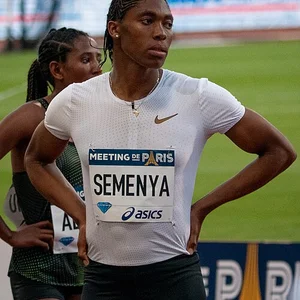

South African athlete specializing in the 800 metres, two-time Olympic champion (2012, 2016) and three-time world champion. Her career was marked by controversy over the eligibility rules tied to testosterone levels in intersex women in sport.
Caster Semenya(1991 — ?)
Caster Semenya
Afrique du Sud
6 min read
Frequently asked questions
Key Facts
- Born on 7 January 1991 in Ga-Masehlong (Limpopo Province, South Africa)
- World champion in the 800 m in Berlin in 2009, sparking controversy over sex verification testing
- Olympic gold medallist in the 800 m at the London 2012 and Rio 2016 Games
- In 2019, the Court of Arbitration for Sport (CAS) upheld World Athletics' regulation limiting testosterone, barring her from middle-distance events
- In 2023, the European Court of Human Rights ruled partially in her favour in her appeal against Switzerland
Works & Achievements
Her first major international victory, which revealed her to the entire world at the age of 18.
Silver upgraded to gold in 2017; her first Olympic title, won while serving as her country's flag bearer.
A silver medal later upgraded to gold, confirming her dominance over the distance.
The sporting peak of her career, with a time close to the African record.
A collection of world titles that make her one of the greatest specialists in the history of the distance.
Proceedings before the CAS, the Swiss Federal Tribunal and then the European Court of Human Rights, which became a global reference point on gender in sport.
A personal account in which she recounts her journey, her victories and her fight against the regulations on testosterone.
Anecdotes
In 2009, at just 18 years old, Caster Semenya won the 800 metres at the World Championships in Berlin with a crushing lead. The very next day, the International Association of Athletics Federations announced that it had subjected her to sex verification testing, triggering a worldwide scandal that would mark her entire career.
After months of suspension and examinations, Caster Semenya was allowed to compete again in 2010. On her return, South Africa welcomed her as a true national hero, and the government publicly defended her against what it considered humiliating treatment.
At the 2012 London Olympic Games, Caster Semenya was chosen to carry South Africa's flag during the opening ceremony, an immense honour. There she took silver in the 800 metres, a medal that would be upgraded to gold in 2017 after the disqualification for doping of the Russian winner Mariya Savinova.
In 2019, the Court of Arbitration for Sport upheld the World Athletics regulation requiring athletes with high levels of natural testosterone to take medication to lower it. Refusing this obligation, Caster Semenya was barred from defending her Olympic title and took the case all the way to the European Court of Human Rights.
Deprived of the 800 metres, Caster Semenya tried to reinvent herself over other distances such as the 5000 metres, which were not covered by the regulation, and even briefly attempted football. Her fight goes beyond sport: it has become a worldwide symbol of the debates surrounding gender, intersexuality and fairness.
Primary Sources
The federation confirmed that it had requested medical examinations at the end of the race, sparking heated controversy over the athlete's right to privacy.
The regulations on differences of sex development were found to be discriminatory, but this discrimination was deemed “necessary, reasonable and proportionate” to preserve fairness in the female category.
The Court held that the athlete had not been afforded sufficient institutional and procedural safeguards to assert her rights.
In it, Caster Semenya recounts her childhood in Limpopo, her discovery of sport and how she experienced the testing and controversies imposed on her body.
Key Places
Rural village in the north of South Africa where Caster Semenya grew up and began running, often barefoot.
Institution where Caster Semenya studied and trained, and which supported her athletic career.
Site of her resounding 800 m victory at the 2009 World Championships, the starting point of the controversies.
Setting of the 2012 Games where she was a flag-bearer and won the 800 m medal, later upgraded to gold.
Site of her Olympic 800 m title in 2016, the peak of her career on the track.
Swiss institution that ruled in 2019 on the dispute between Caster Semenya and World Athletics over the eligibility rules.
Typical Objects

Lightweight track-and-field shoes whose sole is fitted with metal spikes to grip the track. They are the basic tool of the middle-distance runner.

The supreme reward given to the winner of an Olympic Games event. Caster Semenya won two of them in the 800 metres.

A square of cloth or paper bearing the athlete's name or number, pinned to the jersey. It allows runners to be identified during the race.

A device that measures time to the hundredth or thousandth of a second, linked to photoelectric cells. It separates runners and validates records.

A multicoloured flag adopted in 1994 at the end of apartheid. Caster Semenya carried it at the head of the delegation at the London 2012 Games.

A small vial used during medical and anti-doping tests to measure, in particular, testosterone levels. This object lies at the heart of the controversies over the athlete's eligibility.
School Curriculum
Vocabulary & Tags
Key Vocabulary
Tags
Daily Life
Morning
A middle-distance athlete's day begins early with a morning workout: a warm-up jog, stretching, and sets of interval runs on the track. Tracking time and heart rate guides every session.
Afternoon
The afternoon is often devoted to strength training, technical work, and recovery (treatments, massages, physiotherapy). For Caster Semenya, medical and anti-doping tests were regularly added to this schedule.
Evening
The evening is for rest, balanced meals, and sleep, all essential for recovery. It is also time for family life, far from the pressure of competitions and the media.
Food
A top-level runner follows a controlled diet, rich in complex carbohydrates, lean proteins, fruits, and vegetables, with careful hydration. Calorie intake is adjusted to training loads.
Clothing
Day to day, technical outfits: a jersey, shorts or compression shorts, a tracksuit, and running shoes. In competition, the jersey in South Africa's colors, the race bib, and spikes.
Housing
Athletes at this level live near their training centers and stay in the Olympic Village or at hotels during major competitions. Caster Semenya shares her life in South Africa with her wife and their children.
Historical Timeline
Period Vocabulary
Liens externes & ressources
Références
Œuvres
Titre mondial du 800 m à Berlin
2009
Médaille d'or olympique du 800 m à Londres
2012
Titre mondial du 800 m à Daegu
2011
Médaille d'or olympique du 800 m à Rio
2016
Triple championne du monde du 800 m
2009-2017
Combat juridique pour le droit de courir
2018-2025
Autobiographie « The Race to Be Myself »
2023