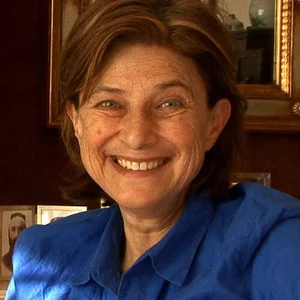

Belgian director and screenwriter (1950–2015), a major figure in feminist and experimental auteur cinema. Her magnum opus *Jeanne Dielman, 23, quai du Commerce, 1080 Bruxelles* (1975) was voted the greatest film of all time by Sight & Sound magazine in 2022.
Chantal Akerman(1950 — 2015)
Chantal Akerman
Belgique, France
9 min read
Frequently asked questions
Famous Quotes
« I wanted to show a woman doing ordinary gestures and, through those gestures, saying something extraordinary.»
« I don't make films about women. I make films with women.»
Key Facts
- Born on June 6, 1950, in Brussels into an Ashkenazi Jewish family, survivors of the Holocaust on her mother's side
- Shot her first short film *Saute ma ville* in 1968, at age 18, already marking her subversive style
- Directed *Jeanne Dielman* in 1975 at age 25 — a 3h21 film centered on the repetitive gestures of a housewife
- *Jeanne Dielman* ranked #1 among the greatest films of all time by Sight & Sound in 2022 (the first film directed by a woman to reach that position)
- Died on October 5, 2015, in Paris at the age of 65, leaving a filmography of more than 40 works
Works & Achievements
First short film made at age 18, in which Akerman herself plays a young woman who methodically destroys her apartment. Already present: the dark humor, the domestic space as a cage, and the silent violence against the female condition.
Experimental film shot in New York in a run-down hotel, composed of silent, fixed shots of corridors and residents. An early manifesto of her aesthetic of waiting, duration, and architectural space.
Her first feature film in which Akerman also acts, a narrative fragmented into three parts exploring solitude, desire, and female sexuality with a candor unprecedented for the time.
A 3-hour-21-minute masterpiece showing in real time the life of a Belgian widow over three days. Voted the greatest film of all time by Sight & Sound in 2022, it is a founding work of feminist cinema and cinematic minimalism.
A poetic and melancholic road movie following a Belgian filmmaker who travels across Europe by train, moving between chance encounters and solitude. A semi-autobiographical film about exile, identity, and the difficulty of truly inhabiting a place or a relationship.
A documentary filmed in Central Europe after the fall of the Berlin Wall, composed of long, contemplative shots of people waiting in the cold. A turning point toward museum video installations and the question of collective memory.
Her final film, a portrait of her mother Natalia filmed in her Brussels apartment with a small digital camera. A moving testament to transmission, the Holocaust, and the mother-daughter bond, released a few months before Akerman's death.
Anecdotes
At 15, Chantal Akerman discovers *Pierrot le Fou* by Jean-Luc Godard in a Brussels cinema. The aesthetic shock is a revelation: she decides on the spot to become a filmmaker. She borrows her father's camera and shoots her first short film, *Saute ma ville*, at only 18 years old.
*Jeanne Dielman, 23, quai du Commerce, 1080 Bruxelles* (1975), a three-hour-and-twenty-one-minute film, was shot with an all-female crew when Akerman was only 24. The film shows in real time the domestic gestures of a woman over three days — peeling potatoes, doing the dishes, preparing dinner — without ever cutting shots to move things along faster.
During her stay in New York in the early 1970s, Akerman frequented the Anthology Film Archives founded by Jonas Mekas and discovered American experimental cinema (Michael Snow, Stan Brakhage). This encounter with the New York avant-garde was decisive: she adopted the long fixed shot as a fundamental aesthetic principle, refusing all ellipsis where real duration says more than editing.
In 2022, seven years after her death, the British magazine *Sight & Sound* conducted its decennial survey among more than 1,600 critics and film professionals from around the world. *Jeanne Dielman* came in first place — ahead of Hitchcock's *Vertigo* and Orson Welles's *Citizen Kane*. It was the very first time, since the ranking was created in 1952, that a film directed by a woman had been voted the greatest film of all time.
Akerman's mother, Natalia, an Auschwitz survivor, is a central figure throughout her entire body of work. The director devoted her last film, *No Home Movie* (2015), to her, shot with a small digital camera in her mother's apartment in Brussels. The film was released a few months after Natalia's death, and a few weeks before Akerman's own passing: it reads as a double farewell.
Primary Sources
I did not want to make a feminist film in the militant sense. I wanted to show domestic work in its exact duration, without speeding it up or dramatizing it, so that the viewer could experience it in its true reality.
My mother and I didn't say much to each other, but we were there, together. And maybe that — being there together — is what I spent my life filming.
The long, fixed shot is not a filmmaker's laziness. It is a gaze that respects the real time of life, one that does not cheat with the duration of what is shown on screen.
Filming, for me, is always a way of searching for something I cannot yet name. Perhaps a way of being in the world, or of trying to be.
Key Places
Akerman's birthplace and the central setting of *Jeanne Dielman*, whose exact address appears in the title. Brussels, with its bourgeois apartments and rainy streets, forms the backdrop for several of her major works.
Akerman spent time there in the early 1970s and frequented Anthology Film Archives. Her encounter with American experimental cinema proved decisive in shaping her radical aesthetic of long, static shots.
The city where Akerman lived and worked for much of her adult life — screening her films, teaching, and moving in artistic circles. She died there on **October 5, 2015**.
The Centre national d'art et de culture Georges-Pompidou devoted a major retrospective to her in **2004**, recognizing the significance of her work at the crossroads of auteur cinema and contemporary visual arts.
Akerman briefly studied filmmaking there before leaving, convinced that learning came more from practice than from formal schooling. She then set off for New York and made her first films entirely on her own terms.
Typical Objects

Akerman shot most of her early films on 16mm with this lightweight, portable camera — the tool of choice for independent and experimental cinema in the 1970s. The affordable format allowed her to work with small crews, often entirely female.

A mechanical film editing table on which Akerman assembled her films alongside her trusted editor Francine Sandberg. Editing was for her a creative act as fundamental as shooting: it was at the editing table that the exact duration of each shot was decided.

In *Jeanne Dielman*, the potato-peeling scene runs for more than four minutes in real time, without a single cut. This everyday object, filmed in its full duration, becomes a political symbol of the condition of women confined to invisible domestic labor.

Akerman prepared her shoots in notebooks where she recorded camera angles, planned durations, and her thoughts on space. These documents reveal her rigorous thinking about cinematic time — long before the camera was ever set up.

From the 1990s onward, Akerman embraced digital video and created installations exhibited in museums and galleries across multiple simultaneous screens. This setup allowed her to explore the exhibition space as a new kind of cinema.

Akerman led a nomadic life between Brussels, Paris, New York, and Tel Aviv. The suitcase — a recurring object in her world and her films — symbolizes the permanent rootlessness and the question of belonging that run throughout her entire body of work.
School Curriculum
Vocabulary & Tags
Key Vocabulary
Daily Life
Morning
Akerman often worked at night and started her day late. In the morning, she drank black coffee, read, and took notes in her notebooks before beginning her creative work. Her daily life was marked by the deliberate irregularity of an independent artist with no imposed routine.
Afternoon
The afternoon was devoted to screenings, production meetings, or long editing sessions with her collaborators. On a shoot, she guided her small crew — often entirely female — with precise instructions on shot duration and camera position, refusing any ellipsis where real time was required.
Evening
In the evenings, she enjoyed discussing cinema, literature, and philosophy with friends and collaborators in cafés in Paris or New York. A devoted cinephile, she was a regular at art-house cinemas and international film festivals.
Food
Akerman smoked heavily — cigarettes are visible in many photographs and interviews. During her years of precarious living in New York, her diet was simple and frugal. She had no particular interest in food, often living in the urgency of whatever project was underway.
Clothing
She favored a simple, functional style — jeans, sweaters, comfortable clothes that allowed her to move freely on set. She paid no attention to her public appearance in the conventional sense, preferring discretion over any form of self-presentation.
Housing
In New York in the early 1970s, she lived in shabby hotel rooms or makeshift apartments — an experience that directly fed into Hôtel Monterey. In Paris and Brussels, she lived in modest apartments cluttered with books, video cassettes, and filming equipment.
Historical Timeline
Period Vocabulary
Liens externes & ressources
Références
Œuvres
Saute ma ville
1968
Je, tu, il, elle
1974