 flip
flipVenison Pie in a Crust for the Ride
Venison Pie in a Crust for the Ride
Why this dish? As a war leader of the French armies in Italy, Charles d'Amboise fought at Agnadello (1509) and led long campaigns in Lombardy. On the road, the nobility carried pies with a thick crust that sealed and preserved the meat for several days.
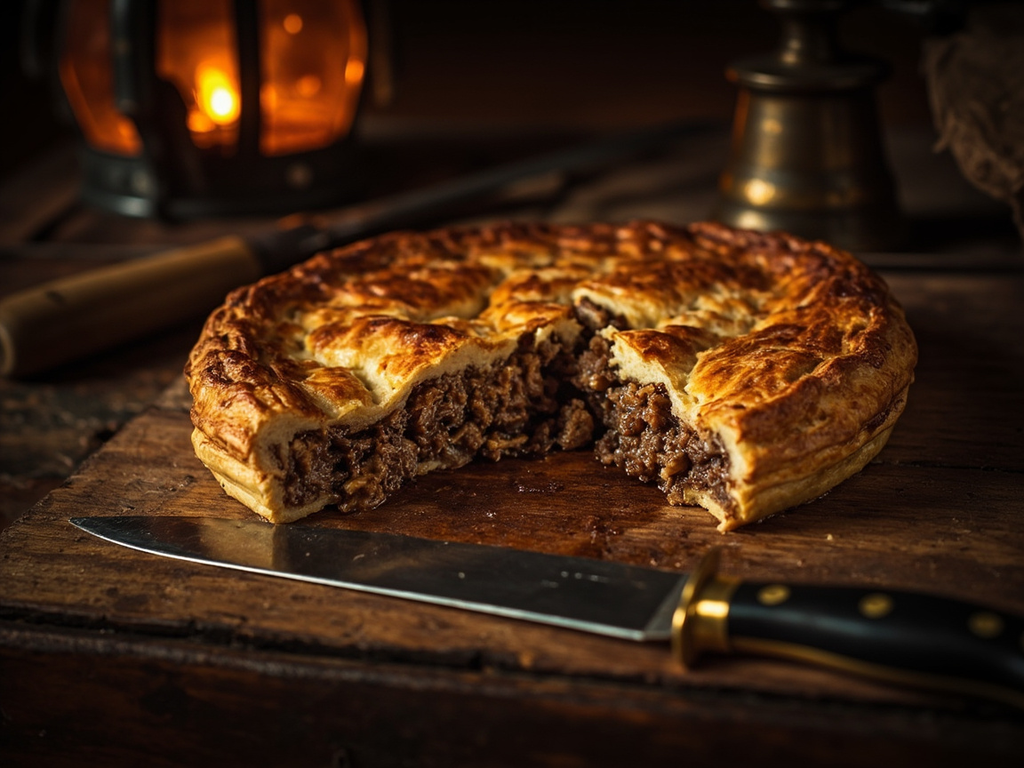
A spiced forcemeat of venison and pork, enclosed in a firm baked crust. The dense crust protects the meat and allows it to be carried in the saddle during campaign. Sliced cold, on the pommel or under the tent.
On a ride through the roads of Lombardy, no cook follows us, and a captain's stomach cannot wait. So I have these pies prepared before leaving in a strong crust: venison and pork flesh well chopped, salted, peppered, and spiced, closed in a thick paste that holds in the oven. The crust is not for delicacy—it is the casket that keeps the flesh sound for three or four days. We break it under the tent, cut with a knife, and eat cold without fire or smoke that would betray our camp.
- •Venison flesh — good portion (filling)
- •Fat pork flesh — half the venison (moisture and fat)
- •Salt — generous (preservation)
- •Pepper, ginger, grains of paradise — by hand (spices)
- •Flour and water for strong paste — as needed (keeping crust)
Venison Pie in a Crust for the Ride
A spiced forcemeat of venison and pork, enclosed in a firm baked crust. The dense crust protects the meat and allows it to be carried in the saddle during campaign. Sliced cold, on the pommel or under the tent.
Why this dish? As a war leader of the French armies in Italy, Charles d'Amboise fought at Agnadello (1509) and led long campaigns in Lombardy. On the road, the nobility carried pies with a thick crust that sealed and preserved the meat for several days.
On a ride through the roads of Lombardy, no cook follows us, and a captain's stomach cannot wait. So I have these pies prepared before leaving in a strong crust: venison and pork flesh well chopped, salted, peppered, and spiced, closed in a thick paste that holds in the oven. The crust is not for delicacy—it is the casket that keeps the flesh sound for three or four days. We break it under the tent, cut with a knife, and eat cold without fire or smoke that would betray our camp.
Ingredients (period version)
- Venison flesh — good portion (filling)
- Fat pork flesh — half the venison (moisture and fat)
- Salt — generous (preservation)
- Pepper, ginger, grains of paradise — by hand (spices)
- Flour and water for strong paste — as needed (keeping crust)
Ingredients
- Ground venison (roe deer, wild boar) — 500 g (filling)
- Ground pork shoulder — 250 g (moisture and fat)
- Salt — 12 g (seasoning and preservation)
- Pepper, ginger, melegueta pepper — 1 tsp total (spices)
- Flour — 400 g (crust)
- Lard or butter — 150 g (crust)
- Hot water — 150 ml (crust (hot water pastry))
- 1 egg — 1 (glaze and seal)
Method
- Mix venison, pork, salt, and spices; let the filling rest in the fridge for 1 hour.
- Make a firm hot water pastry: melt lard in hot water, pour over salted flour, knead quickly into a smooth, pliable dough.
- Line a springform pan (or shape a box by hand) with 2/3 of the dough.
- Pack in the filling, cover with remaining dough, seal edges, cut a steam vent, and glaze with egg.
- Bake at 180°C for 1 hour 15 minutes. Cool completely: the pie keeps and is sliced cold.
How it was made : Thick-crust pies ('pâté en pot', 'pâté de garde') served as both packaging and dish: the dense crust, sometimes not meant to be eaten, protected the meat. Maestro Martino and *Le Viandier* detail these large pieces. Salt and spices, antiseptic, extended preservation—valuable on military campaign.
The contemporary twist : Pour a little port jelly through the vent while the pie is still warm for a festive 'pâté-croûte', sliced clean and shiny.
Sources : Maestro Martino da Como, Libro de arte coquinaria (c. 1465) · Le Viandier de Taillevent (14th-15th c.)
Charles d'Amboise · Charactorium