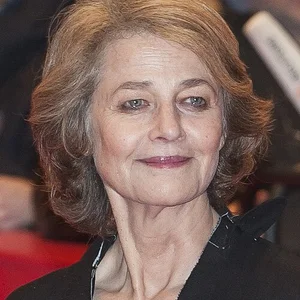

A British actress born in 1946, Charlotte Rampling established herself as one of the most distinctive figures in European cinema. Based in France, she collaborated with the greatest directors and embodied a certain idea of rebellious elegance.
Charlotte Rampling(1946 — ?)
Charlotte Rampling
France, Royaume-Uni
8 min read
Frequently asked questions
Key Facts
- Born on 5 February 1946 in Sturmer, Essex, England
- International breakthrough with Liliana Cavani's 'The Night Porter' (1974)
- Musical collaboration with Jean-Michel Jarre on the album 'Electronica 1' (2015)
- Nominated for an Academy Award for her performance in Andrew Haigh's '45 Years' (2015)
- Recipient of an honorary César Award in 2001 for lifetime achievement
Works & Achievements
Luchino Visconti's film about the decadence of a German industrial family under Nazism. This role in a prestigious Italian production marked Charlotte Rampling's entry into European art cinema.
Liliana Cavani's controversial film exploring the sadomasochistic relationship between a concentration camp survivor and her former tormentor. The role that defined her image as an actress who refuses moral complacency.
Woody Allen's film in which Charlotte Rampling plays a former companion of the fictional director. Her presence signaled international recognition beyond European cinema alone.
Alan Parker's thriller starring Mickey Rourke, in which she plays an ambiguous character blending voodoo and film noir. The film confirmed her ability to move across genres while maintaining an enigmatic screen presence.
François Ozon's film in which she plays a British crime novelist on a working retreat in Provence. A major critical and commercial success that brought her a new international audience.
Andrew Haigh's film in which she portrays a woman whose forty-five-year marriage begins to unravel after the discovery of a secret from the past. The role earned her the BAFTA for Best Actress and an Academy Award nomination.
The highest distinction in French cinema, awarded at the César ceremony, recognizing her unique place as a British actress at the heart of the French and European film industry.
Anecdotes
Charlotte Rampling is the daughter of Godfrey Rampling, Olympic gold medalist in the 4×400 metres relay at the 1936 Berlin Games and RAF officer. Growing up with such a heroic and celebrated father left a deep mark on her personality, caught between admiration and the drive to forge her own identity, far from the conventions of post-war England.
In 1974, she accepted the lead role in Liliana Cavani's controversial film 'The Night Porter', which explores the disturbing relationship between a Nazi camp survivor and her former torturer. The film triggered an international scandal, but Rampling defended her choice with a conviction that cemented her reputation as an actress who refuses any form of artistic censorship.
Having settled in Paris in the 1970s, Charlotte Rampling married electronic music composer Jean-Michel Jarre in 1978. The marriage lasted nearly twenty years and rooted her firmly in French cultural life. She mastered the French language so thoroughly that she regularly appeared in French-language productions.
In 2016, during the #OscarsSoWhite controversy over the lack of Black nominees at the Academy Awards, Charlotte Rampling publicly stated that the boycott seemed to her like 'anti-white racism'. Her comment sparked sharp international backlash, and she apologized a few days later, admitting she had misunderstood the issue.
At 68, she won the BAFTA for Best Actress for Andrew Haigh's '45 Years' (2015), in which she plays a woman whose marriage unravels over the course of a few days. This late-career recognition crowned a body of work built on artistic integrity rather than the pursuit of mainstream popularity.
Primary Sources
I have never tried to please. What interests me is the truth of a character, even if that truth unsettles. Art-house cinema gave me a freedom I would never have found in Hollywood.
France adopted me, and I gave back that love by staying. It is here that I truly learned what cinema was — not a spectacle, but an art.
For a long time I was labelled as the provocative actress, the femme fatale. Those labels both opened doors and closed others. But I regret none of my choices.
Working with François Ozon on Swimming Pool was rediscovering what I love about French cinema: ambiguity, the unspoken, the body as language.
Key Places
Charlotte Rampling's birthplace in 1946, in the rural, middle-class setting of post-war England. Her father, a military officer, instilled in her a strict upbringing and a drive for excellence.
The city where Charlotte Rampling settled from the 1970s onward and where she has spent most of her professional and personal life. Her Parisian apartment sits at the heart of her existence as a Franco-British artist.
Charlotte Rampling is a recurring presence at the Cannes Film Festival, the central showcase of European art cinema, where her films have been screened and where she has given many memorable press conferences.
Rome's legendary Cinecittà studios provided the setting for several collaborations with Italian directors, most notably Luchino Visconti on 'The Damned' — it was here that Charlotte Rampling discovered European cinema in all its formal ambition.
The city where her career began in the 1960s, shooting her first films amid the energy of Swinging London, before she turned toward continental European cinema.
Typical Objects

Charlotte Rampling is known for her meticulous preparation: her scripts are covered in handwritten notes and questions about her character's psychology, reflecting an intellectual approach to acting.

In many films from the 1970s and 1980s, the cigarette accompanies her characters as an emblem of their complexity and deliberate freedom — a symbol of an era when smoking was still a cinematically loaded gesture.

Having lived between two cultures since the 1970s, Charlotte Rampling embodies the movement of European artists who cross national borders to create — her dual administrative identity reflects a dual cultural belonging.

Settled in Paris, she moved in circles where jazz and contemporary music were ever-present, particularly through her marriage to Jean-Michel Jarre, whose composition studio was at the heart of their life together.

Like many artists of her generation, she kept personal filmed archives — a testament to an era when film was the only medium for preserving private memories before the digital age.

The outfit worn in this iconic scene — officer's cap, black gloves — became one of the defining images of 1970s cinema, evoking both the aesthetics of provocation and a reflection on the memory of Nazism.
School Curriculum
Vocabulary & Tags
Key Vocabulary
Tags
Daily Life
Morning
In her Parisian apartment, Charlotte Rampling starts her day late — evenings of screenings and society dinners often run long. She reads the French and British press, drinks a black coffee, and goes through her correspondence of scripts. Reading is part of her morning routine, nurturing a literary culture that feeds her acting.
Afternoon
Afternoons are devoted to rehearsals or shoots, depending on the season. Between projects, she walks through the streets of the 6th arrondissement, visits contemporary art galleries, and attends private screenings. Encounters with other artists — painters, musicians, filmmakers — form the social fabric of her Parisian daily life.
Evening
Parisian evenings in artistic and cultural circles are at the heart of her social life: premieres, dinners at directors' or gallerists' homes, Jean-Michel Jarre concerts during their years of marriage. She is known for her direct, uncompromising conversation, refusing the idle chatter of society events.
Food
Shaped by French cuisine since her early Parisian years, Charlotte Rampling favors a simple Mediterranean diet — fresh vegetables, fish, French cheeses. Meals are moments of conviviality, not ostentation, rooted in the tradition of sitting down at the table with care and without rushing.
Clothing
Her style embodies minimalist French elegance: tailored cuts, fine fabrics (silk, thin wool), a palette of blacks, off-whites, and grays. She wears the creations of major French fashion houses but shuns flashiness — a silhouette always recognizable, built around the line rather than the accessory.
Housing
Settled in a Haussmann-era apartment on the Left Bank of Paris, she lives surrounded by books, works of art, and objects brought back from her shoots across Europe. The interior combines French bourgeois comfort with a pronounced taste for contemporary art, reflecting a life at the crossroads of several European cultures.
Historical Timeline
Period Vocabulary
Visual Style
Esthétique du cinéma d'auteur européen : clair-obscur dramatique, photographie en haute contraste, beauté austère et intérieurs parisiens élégants forment le vocabulaire visuel de l'univers de Charlotte Rampling.
Sound Ambience
Ambiance sonore du cinéma d'auteur européen : Paris, les plateaux de tournage italiens et le Festival de Cannes composent le paysage sonore de Charlotte Rampling, mêlant intimité créative et effervescence culturelle.