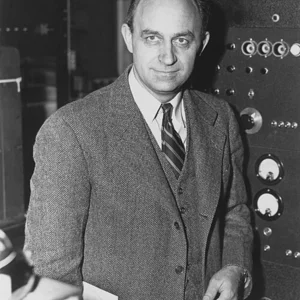

Sino-American theoretical physicist born in 1922, awarded the Nobel Prize in Physics in 1957 alongside T.D. Lee for the discovery of parity violation in weak interactions. Co-author of Yang-Mills theory, a cornerstone of the standard model of particle physics.
Chen-Ning Yang
Chen-Ning Franklin Yang
États-Unis, République populaire de Chine, Taïwan, république de Chine
8 min read
Frequently asked questions
Famous Quotes
« Einstein's general theory of relativity is the greatest scientific achievement of the 20th century.»
Key Facts
- Born on September 22, 1922, in Hefei (Anhui), China
- Nobel Prize in Physics 1957 with T.D. Lee for the discovery of parity violation
- Formulation of Yang-Mills theory in 1954, a foundation of the standard model
- Professor at the Institute for Advanced Study in Princeton, then at Stony Brook University
- Returned to China in 2003 to join Tsinghua University
Works & Achievements
A groundbreaking paper co-written with Robert Mills, introducing non-Abelian gauge fields. Long overlooked, it became the mathematical foundation of the Standard Model of particle physics and a cornerstone of modern physics.
A theoretical paper challenging the conservation of parity in weak interactions and proposing experiments to test it. This work earned Yang and Lee the Nobel Prize in Physics as early as 1957.
Work in statistical mechanics with T.D. Lee on phase transitions, introducing the Lee-Yang theorem on the distribution of zeros of the partition function — a result still in use today.
In this paper, Yang discovers a fundamental relation in many-body quantum mechanics, later recognized as the Yang-Baxter equation — a pillar of integrable physics, knot theory, and exactly solvable systems.
An annotated collection of his major papers, offering a unique autobiographical perspective on the development of twentieth-century theoretical physics as seen by one of its leading figures.
Anecdotes
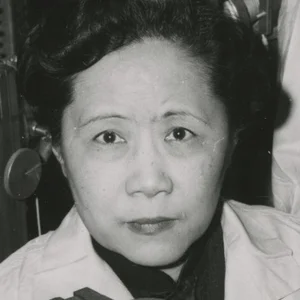
In 1956, Yang and Lee published a paper challenging the conservation of parity in weak interactions — a law every physicist had considered absolute. Wolfgang Pauli, himself a Nobel laureate, wrote to a colleague that he was convinced Yang and Lee were wrong, even refusing to follow the proposed experiment. A few months later, Chien-Shiung Wu's experiment spectacularly confirmed their prediction, and the Nobel Prize was awarded to them the very next year.
In 1954, Yang presented the Yang-Mills theory at a seminar at the Institute for Advanced Study in Princeton. Pauli, seated in the audience, interrupted him repeatedly: 'What is the mass of these gauge particles?' Yang, unable to resolve this fundamental problem at that stage, suspended his presentation under the puzzled gazes of those present. It was not until twenty years later, through the Higgs mechanism, that this question found an answer — retrospectively validating all of Yang's work.
In 1957, Yang and Lee received the Nobel Prize in Physics barely a year after the publication of their theoretical paper — one of the shortest gaps in Nobel history between a theoretical prediction and its recognition. Yang was only 35 at the time, making him one of the youngest Nobel laureates in physics in history.
Yang is the son of Ke-Chuan Yang, a distinguished mathematician who introduced him to mathematics from childhood. During World War II, as Japan invaded China, Yang continued his studies at the National Southwestern Associated University (Lianda) in Kunming — a provisional institution founded by refugee professors, operating under difficult conditions but with a rare intensity of intellectual life.
In 2003, at the age of 81, Yang decided to leave the United States and settle permanently in China, at Tsinghua University in Beijing. This symbolic return of a Nobel laureate to his home country was hailed as a powerful statement in support of China's scientific development, and Yang dedicated his final decades there to training a new generation of physicists.
Primary Sources
It is pointed out that the usual principle of invariance under isotopic spin rotation is not consistent with the concept of localized fields. The possibility of having invariance under local isotopic spin rotations is explored.
The question of parity conservation in beta decays and in hyperon and meson decays is examined. Possible experiments are suggested which might test parity conservation in these interactions.
The law of conservation of parity was almost universally accepted. The experimental evidence for this law consisted, however, only of phenomena in which either gravitational, electromagnetic, or strong interactions played the dominant role.
The paper presents exact results for the ground state energy and the S-matrix for a one-dimensional system of bosons with repulsive delta-function interactions, introducing what would become the Yang-Baxter equation.
Yang himself comments on his major papers, offering an exceptional retrospective view on the development of twentieth-century theoretical physics and the intellectual circumstances surrounding his discoveries.
Key Places
Birthplace of Chen-Ning Yang, where he was born on October 1, 1922, into an academic family — his father, Ke-Chuan Yang, was a mathematician.
A wartime university established during the Second Sino-Japanese War, where Yang pursued his higher education from 1938 to 1944 under difficult conditions but in an intellectually vibrant environment, alongside some of China's finest scientific minds who had taken refuge there.
Yang earned his doctorate here in 1948 under Edward Teller, working in close proximity to Enrico Fermi. It was here that he deepened his theoretical physics and first met T.D. Lee.
This prestigious research institute was Yang's intellectual home from 1949 to 1966, where he worked alongside Einstein and Oppenheimer. Here he developed the Yang-Mills theory and co-authored the landmark paper on parity violation.
Yang founded and directed the Institute for Theoretical Physics here starting in 1966, building Stony Brook into a globally recognized center that today bears his name.
Since 2003, Yang has lived and taught here following his symbolic return to China, actively contributing to the development of Chinese physics research and the training of a new generation of scientists.
Typical Objects
An iconic tool of the theoretical physicist in the 1950s, the blackboard was Yang's thinking space, where he developed his gauge field theories, symmetry calculations, and presented his results at Princeton seminars.
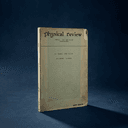
The leading American physics journal, in which Yang published his landmark papers, including the Yang-Mills theory in 1954 and the paper on parity violation in 1956.
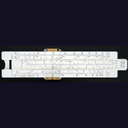
A universal analog calculation instrument found in every pre-computer laboratory, used for the quick numerical estimates essential to checking orders of magnitude in theoretical physics.
📷 CC BY-SA 3.0 · Wikimedia Commons ↗
Yang recorded his theoretical developments in detailed notebooks; his handwritten notes bear witness to the rigorous progression of his mathematical thinking, from first intuitions through to final formulations.

Although a theorist, Yang collaborated with experimentalists using bubble chambers and particle accelerators to visualize and test his predictions on parity violation.

The letters exchanged between Yang, Lee, Pauli, and other leading physicists are an invaluable source, revealing the intense scientific debates of the era surrounding the fundamental symmetries of nature.
School Curriculum
Vocabulary & Tags
Key Vocabulary
Tags
Daily Life
Morning
Yang starts his day early, going through the latest scientific articles received by mail from Physical Review and reports from international conferences. He eats a simple breakfast before walking to the Institute for Advanced Study, using the quiet of Princeton to let his theoretical intuitions take shape.
Afternoon
The afternoon is devoted to intense research: Yang spends hours at the blackboard, working through his symmetry calculations and discussing ideas with collaborators Robert Mills or T.D. Lee. He attends weekly seminars where physicists from around the world present their latest findings, and where debates can grow heated.
Evening
In the evening, Yang returns home for dinner with his family. He reads works on mathematics and the philosophy of science, keeps up an extensive scientific correspondence with colleagues in Europe and America, and finds renewal in literature and classical music.
Food
Yang follows a Sino-American diet, enjoying Chinese food prepared at home. At Princeton, he sometimes has lunch in the Institute cafeteria with colleagues, where informal scientific discussions often stretch well beyond the meal.
Clothing
Yang dresses in the strict American academic style of the 1950s: dark suit, white shirt, and tie for seminars and conferences. In his office during daily work, he wears a jacket — often dusted with chalk marks — with pen and notebook always within reach.
Housing
In Princeton, Yang lives in a typical postwar American suburban house, close to the Institute for Advanced Study. The home blends a well-stocked scientific library, works of Chinese culture, and a quiet family life, far from the bustle of major cities.
Historical Timeline
Period Vocabulary
Visual Style
Esthétique académique américaine des années 1950, entre rigueur mathématique des tableaux noirs et tensions de la Guerre froide, mêlant héritage culturel chinois et modernité scientifique occidentale.
Sound Ambience
L'atmosphère sonore des grandes universités américaines des années 1950-1960 : la craie sur les tableaux de séminaires de physique, le bourdonnement des accélérateurs de particules, et la Guerre froide en toile de fond.
Liens externes & ressources
Références
Œuvres
Conservation of Isotopic Spin and Isotopic Gauge Invariance (théorie Yang-Mills)
1954
Question of Parity Conservation in Weak Interactions (avec T.D. Lee)
1956
Statistical Theory of Equations of State and Phase Transitions (théorème de Lee-Yang)
1952
Some Exact Results for the Many-Body Problem (équation de Yang-Baxter)
1967
Selected Papers 1945–1980 With Commentary
1983