 flip
flipGlobi with Cheese and Honey
Globi with Cheese and Honey
Why this dish? Globi, fresh cheese and semolina fritters fried and drizzled with honey, were the sweet treat of festive days in Rome. For a Christian community that celebrated in sobriety, these little sweet balls shared during a feast (like a Sunday agape) brought joy without the lavishness of imperial banquets.
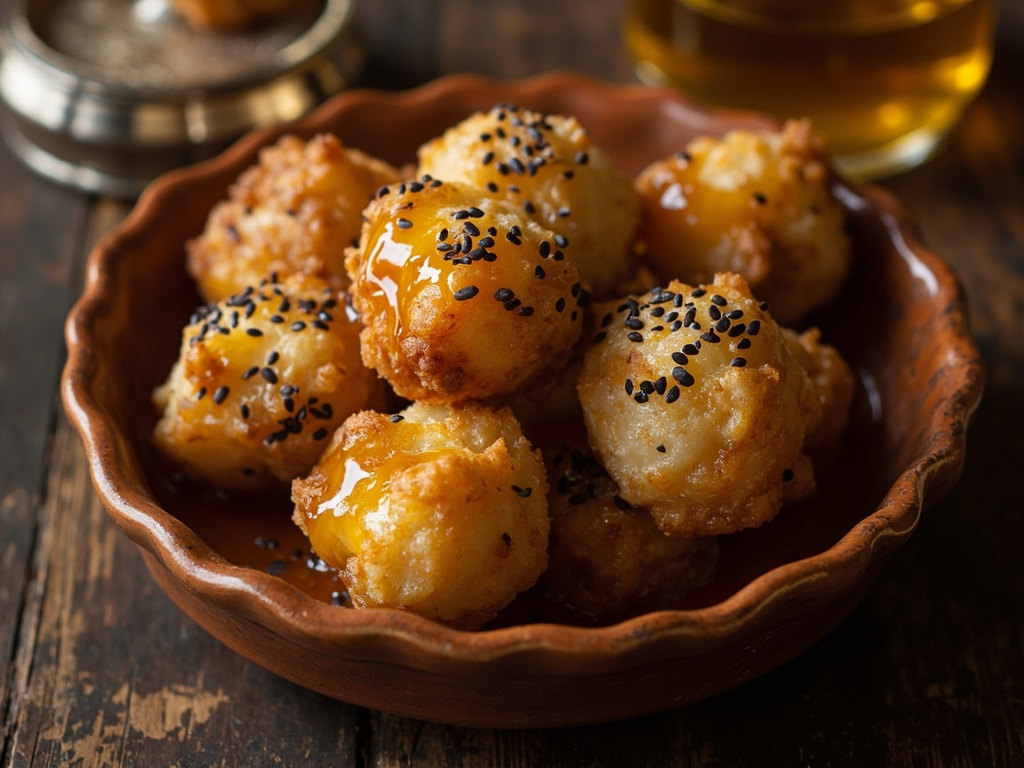
Small balls of ricotta and semolina, fried until golden, rolled in warm honey and sprinkled with poppy seeds. Crispy on the outside, melting on the inside.
Here is something to delight children and elders! Cato himself, that austere old Roman, left us the recipe: mix fresh cheese with fine flour, roll small balls, and throw them into boiling fat. When they are golden, bathe them in honey and sprinkle with poppy seeds. Eat them warm, my friend, for that is when they are best — and save some for your neighbor.
- •Fresh cheese — equal parts with semolina (soft base)
- •Fine flour or semolina (alica) — equal parts (binder)
- •Lard or oil — for frying (frying medium)
- •Honey — generous (coating)
- •Poppy seeds — for sprinkling (decoration)
Globi with Cheese and Honey
Small balls of ricotta and semolina, fried until golden, rolled in warm honey and sprinkled with poppy seeds. Crispy on the outside, melting on the inside.
Why this dish? Globi, fresh cheese and semolina fritters fried and drizzled with honey, were the sweet treat of festive days in Rome. For a Christian community that celebrated in sobriety, these little sweet balls shared during a feast (like a Sunday agape) brought joy without the lavishness of imperial banquets.
Here is something to delight children and elders! Cato himself, that austere old Roman, left us the recipe: mix fresh cheese with fine flour, roll small balls, and throw them into boiling fat. When they are golden, bathe them in honey and sprinkle with poppy seeds. Eat them warm, my friend, for that is when they are best — and save some for your neighbor.
Ingredients (period version)
- Fresh cheese — equal parts with semolina (soft base)
- Fine flour or semolina (alica) — equal parts (binder)
- Lard or oil — for frying (frying medium)
- Honey — generous (coating)
- Poppy seeds — for sprinkling (decoration)
Ingredients
- Well-drained ricotta — 250 g (soft base)
- Fine semolina — 250 g (binder)
- Neutral oil for frying — 1 liter (frying medium)
- Honey — 150 g (coating)
- Poppy seeds — 2 tbsp (decoration)
- Pinch of salt — 1 (balance)
Method
- Mix the ricotta, semolina, and salt until a homogeneous dough forms; let rest for 15 minutes.
- Shape small walnut-sized balls with wet hands.
- Heat the oil to 170°C and fry the globi in small batches until golden and puffed.
- Drain on a cloth, then roll immediately in slightly warmed honey.
- Sprinkle with poppy seeds and serve warm.
How it was made : Cato the Elder, in his agricultural treatise (2nd century BC), gives the precise recipe for globi: equal parts cheese and alica (spelt), fried in hot fat, then rolled in honey and sprinkled with poppy seeds. It was a popular, ancient sweet, present on Roman tables of all classes.
The contemporary twist : Arrange the globi in a pyramid on a plate, drizzled with a final stream of warm honey — the Roman ancestor of loukoumades and zeppole, served as a sharing dessert.
Sources : Cato the Elder, De Agricultura, 79 · Apicius, De Re Coquinaria
Clement of Rome · Charactorium