 flip
flipSteamed vegetarian momos
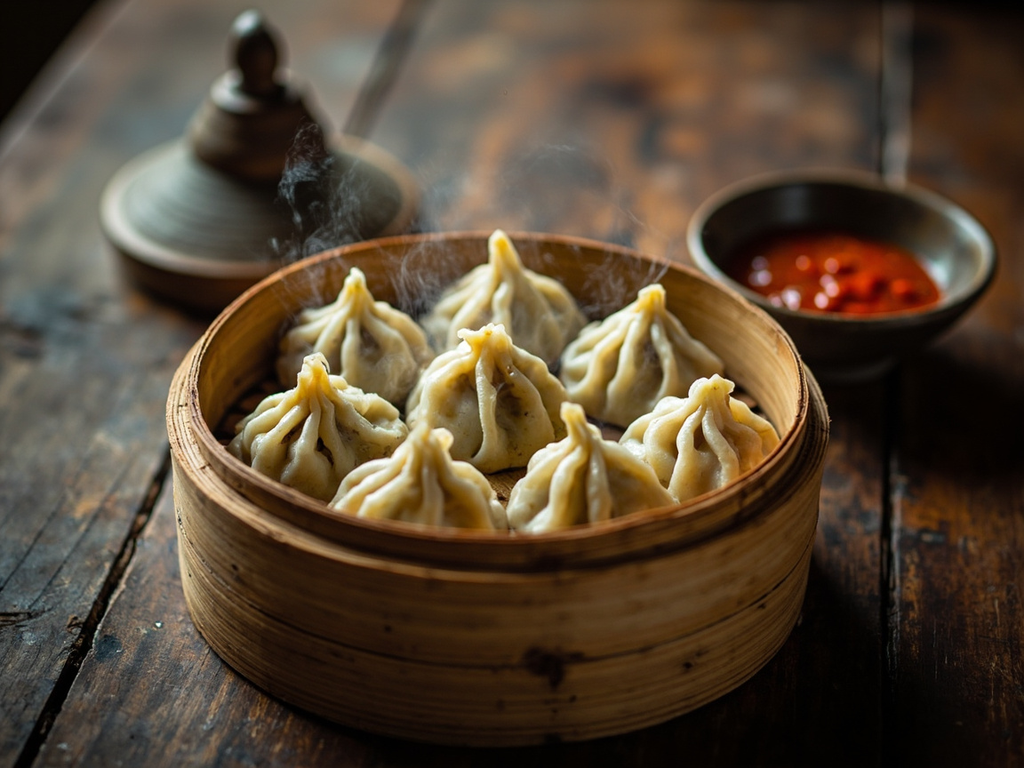
Steamed vegetarian momos
Why this dish? Vegetarian since the 1960s out of faithfulness to the Buddhist principle of non-violence, the Dalai Lama shares meatless momos, a version that adorns festive meals of the Tibetan exile community in Dharamshala.
Small hand-pleated dumplings stuffed with vegetables and fresh cheese, steamed: the quintessential dish for celebration and reunion, shaped together as a family.
Ah, momos! On feast days, the whole household sits together: one rolls out the dough, another prepares the filling, and nimble fingers pleat the edges one after another. I have not eaten meat for a long time — out of respect for all life that suffers — so mine are filled with vegetables and cheese, and they are just as joyful to share. Make plenty, because no one stops at just one! It is in these simple gestures, side by side, that true warmth is born.
- •Wheat flour — for the dough (wrapper)
- •White radish and cabbage — chopped (filling)
- •Fresh Tibetan cheese (chura) — crumbled (savory binder)
- •Onion and ginger — chopped (aroma)
- •Yak butter or oil — a little (tenderness)
- •Salt — to taste (seasoning)
Steamed vegetarian momos
Small hand-pleated dumplings stuffed with vegetables and fresh cheese, steamed: the quintessential dish for celebration and reunion, shaped together as a family.
Why this dish? Vegetarian since the 1960s out of faithfulness to the Buddhist principle of non-violence, the Dalai Lama shares meatless momos, a version that adorns festive meals of the Tibetan exile community in Dharamshala.
Ah, momos! On feast days, the whole household sits together: one rolls out the dough, another prepares the filling, and nimble fingers pleat the edges one after another. I have not eaten meat for a long time — out of respect for all life that suffers — so mine are filled with vegetables and cheese, and they are just as joyful to share. Make plenty, because no one stops at just one! It is in these simple gestures, side by side, that true warmth is born.
Ingredients (period version)
- Wheat flour — for the dough (wrapper)
- White radish and cabbage — chopped (filling)
- Fresh Tibetan cheese (chura) — crumbled (savory binder)
- Onion and ginger — chopped (aroma)
- Yak butter or oil — a little (tenderness)
- Salt — to taste (seasoning)
Ingredients
- All-purpose flour — 300 g (dough)
- Warm water — 150 ml approx. (dough)
- Finely shredded cabbage — 200 g (filling)
- Grated carrot — 1 (filling)
- Chopped onion — 1 (filling)
- Fresh grated ginger — 1 tsp (aroma)
- Fresh cheese (like paneer or firm ricotta) — 150 g (binder)
- Neutral oil — 2 tbsp (tenderness)
- Salt and pepper — to taste (seasoning)
Method
- Mix flour and warm water to form a soft dough, knead for 5 minutes, cover, and let rest for 30 minutes.
- For the filling, mix cabbage, carrot, onion, ginger, crumbled cheese, oil, salt, and pepper.
- Roll out the dough thinly and cut into discs about 8 cm in diameter.
- Place a spoonful of filling in the center of each disc, then pinch and pleat the edges to close into a small pouch or half-moon.
- Arrange the momos in an oiled steamer basket, not touching, and steam for 12-15 minutes.
- Serve hot, optionally with a spicy dipping sauce.
How it was made : The momo travels across the entire Himalaya; in Tibet, it was often reserved for festivals and guests because wheat flour, which grows poorly at high altitudes, was more precious than barley. They were steamed in stacked bamboo baskets, and shaping them was a collective, convivial activity.
The contemporary twist : Serve the momos with a spicy sepen (tomato-chili) sauce, and pleat a few in flower shapes for the festive platter.
Sources : Tsering Wangmo & Zara Houshmand, Lhasa Moon Tibetan Cookbook
Dalai Lama · Charactorium