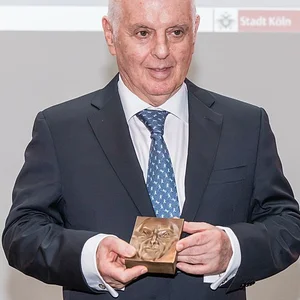

Pianist and conductor born in Buenos Aires in 1942, Daniel Barenboim is one of the leading figures in classical music worldwide. Music Director of the Berlin Opera and co-founder of the West-Eastern Divan Orchestra, he is also an advocate for peace in the Middle East.
Daniel Barenboïm(1942 — ?)
Daniel Barenboim
Espagne, Argentine, Israël, État de Palestine
8 min read
Frequently asked questions
Famous Quotes
« Music is the only thing that can unite peoples who do not speak to one another.»
« Playing music together means learning to listen to each other.»
Key Facts
- Born on November 15, 1942, in Buenos Aires, Argentina
- Gives his first public recital at the age of 7
- Co-founds the West-Eastern Divan Orchestra in 1999 with Edward Said, bringing together Israeli and Arab musicians
- Music Director of the Berlin State Opera (Staatsoper) since 1992
- Receives Palestinian citizenship in 2008, a symbol of his commitment to peace
Works & Achievements
Founded with Palestinian intellectual Edward Said, this orchestra brings together young Israeli, Palestinian, and Arab musicians. It has become a global symbol of intercultural dialogue through music.
A landmark recording of all nine Beethoven symphonies, praised for its depth and interpretive coherence. Barenboim has completed several Beethoven cycles throughout his career.
One of the definitive interpretations of Beethoven's 32 sonatas, revealing both their architectural rigor and emotional depth.
Barenboim is one of the leading Wagnerian conductors of his generation. His performances of the Ring Cycle at Bayreuth and Berlin are considered authoritative in the opera world.
A collection of conversations on the relationship between music, society, and politics. Translated into many languages, this book is a key reference on the artist's engagement with public life.
A series of five radio lectures in which Barenboim develops his musical philosophy and his relationship with the world, presented in an accessible way for a general audience.
An academic institution founded in Berlin to train young musicians from the Middle East and the Mediterranean. It embodies the legacy of the West-Eastern Divan's ideals and stands as one of Barenboim's most enduring contributions.
Anecdotes
At just seven years old, Daniel Barenboim gave his first public recital in Buenos Aires in 1950. His talent was so evident that his family moved to Israel in 1952 to allow him to receive high-level musical training. He was quickly recognized as one of the greatest child prodigies of his generation.
In 1954, at the age of twelve, Barenboim met the legendary cellist Pablo Casals in Italy. This encounter was formative: Casals, exiled in protest against the Franco regime, passed on to the young pianist the idea that music is inseparable from moral responsibility. This lesson would guide his entire career.
In 2001, during a concert with the Staatskapelle Berlin in Israel, Barenboim proposed to play a work by Richard Wagner as an encore — a composer whose music is informally banned in Israel because of his antisemitism and its appropriation by the Nazis. Part of the audience strongly objected, but those who wished to remain heard the prelude to Tristan und Isolde, sparking a national debate on memory, censorship, and art.
In 1999, in Weimar, Germany, Barenboim co-founded with Palestinian intellectual Edward Said the West-Eastern Divan Orchestra, bringing together young Israeli, Palestinian, and Arab musicians around classical music. The name is borrowed from Goethe's collection of poems and symbolizes the dialogue between West and East. This artistic and political act was celebrated worldwide.
In 2004, at the Wolf Prize ceremony at the Knesset, Barenboim delivered a courageous speech in which he questioned the contradictions of the Israeli state in light of its own 1948 Declaration of Independence. This text, read publicly before members of parliament, earned him both sharp criticism and widespread international admiration.
Primary Sources
Music is not a flight from reality but, on the contrary, a deeper penetration into it. It allows us to understand what cannot be expressed in words.
We believe that coexistence is possible, not because it is easy, but because it is necessary. The orchestra is a metaphor: different individuals learning to listen to one another.
I would like to ask you today: is it possible to reconcile the Jewish desire for a homeland with the equality and rights of the Arab minority? The Declaration of Independence of 1948 promises this, but the reality is quite different.
I was not seeking to hurt anyone. I thought we could begin a conversation about what memory means, and about what music means to a society.
Key Places
Daniel Barenboim's birthplace, where he gave his first public recital at age seven in 1950. It represents his Latin American and Jewish cultural roots.
The city where the Barenboim family settled in 1952. Barenboim developed his musical training there and maintained a lifelong connection to the Israeli music scene.
Barenboim has served as its music director since 1992. This Berlin institution, one of the most prestigious in Europe, is the heart of his conducting career.
A city symbolic of German culture (Goethe, Schiller) where the West-Eastern Divan Orchestra was founded in 1999. The choice was deliberate: Weimar embodies both European humanism and the memory of Nazism (the Buchenwald concentration camp lies nearby).
Barenboim gave a landmark concert here in 2003, in the midst of the Second Intifada, demonstrating through action his commitment to peace and Israeli-Palestinian cultural dialogue.
An academy founded in 2015 and inaugurated in 2019, dedicated to training young musicians from the Middle East and the Mediterranean in the spirit of dialogue championed by Barenboim and Edward Said.
Typical Objects

Barenboim has always performed on Steinway grand pianos, the instrument of reference for the classical and Romantic repertoire. His relationship with the keyboard is described as deeply symbiotic — sound being, for him, an extension of his musical thought.

As a conductor, Barenboim leads with a slim, lightweight baton, favouring broad and expressive gestures. He is renowned for conducting entirely from memory, without a score — a sign of his total command of the works he performs.

Like all great interpreters, Barenboim works from scores annotated in his own hand — markings for phrasing, dynamics, and agogics. His archives bear witness to a profoundly analytical musical mind.

Barenboim's discography is vast: complete cycles of Beethoven's and Bruckner's symphonies, Beethoven's piano sonatas, Wagner's operas. His recordings are used as pedagogical references in conservatories around the world.

On stage, Barenboim wears the traditional black tailcoat of concert conductors and pianists, a symbol of the formal protocol of the classical music world. Off stage, he is known for a much more relaxed personal style.

Beethoven's work lies at the heart of Barenboim's artistic vision; he has recorded all nine symphonies on multiple occasions and regards the Ninth as a universal humanist manifesto.
School Curriculum
Vocabulary & Tags
Key Vocabulary
Tags
Daily Life
Morning
Barenboim starts his days early, working at the piano from the first hours of the morning. He practices the pieces on his program with extreme concentration, often without a score in order to memorize and internalize every detail. He also devotes time to reading orchestral scores, contemplating tempi and phrasing.
Afternoon
Afternoons are dedicated to rehearsals with the orchestra or working sessions with soloists. Barenboim is renowned for his exacting standards: he stops musicians to refine nuances, collective sound, and the group's breathing. He also engages in intellectual exchanges with philosophers, writers, and political figures, true to his belief that music is inseparable from thought.
Evening
Evenings are devoted to concerts — either as a pianist or as a conductor. After the concert, Barenboim often takes part in receptions or discussions with the audience and fellow musicians. He is known for his remarkable physical stamina, able to move seamlessly from concerts to international travel.
Food
On tour, Barenboim follows a balanced diet tailored to the physical demands of performing. He enjoys Mediterranean cuisine and shared meals with friends and colleagues as moments of conviviality and conversation, in keeping with his vision of communal life — one he also champions on stage.
Clothing
On stage, Barenboim wears the traditional black tailcoat of concert conductors and pianists, in accordance with the codes of the classical music world. In his daily life, he favors relaxed and comfortable attire, reflecting his straightforward personality and lack of concern for appearances.
Housing
Barenboim lives primarily in Berlin, the city at the heart of his professional activity since the 1990s. He also has ties to Paris, Buenos Aires, and Israel. His apartments reflect the life of a musician in perpetual touring: music libraries, scores, and a grand piano at the center of the living room.