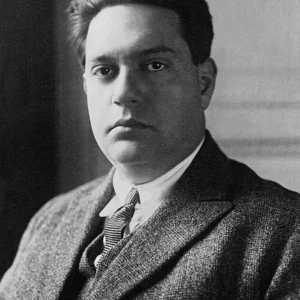

French composer born in Aix-en-Provence in 1892, member of the Groupe des Six. He developed polytonality and drew inspiration from American jazz and Latin American music to create a prolific body of work of more than 400 opus.
Darius Milhaud(1892 — 1974)
Darius Milhaud
France
8 min read
Frequently asked questions
Famous Quotes
« Music must be everyday nourishment, like bread.»
« I am a French composer, Provençal and Jewish.»
Key Facts
- Born on September 4, 1892 in Aix-en-Provence.
- Founding member of the Groupe des Six alongside Honegger, Poulenc, and Auric (1920).
- Composed 'La Création du monde' (1923), the first jazz ballet in classical music.
- Went into exile in the United States during World War II (1940–1947), teaching at Mills College.
- Died on June 22, 1974 in Geneva, leaving behind more than 440 numbered works.
Works & Achievements
A ballet-pantomime with Brazilian and jazz flavors, built on a collage of tangos and maxixes, staged by Jean Cocteau. An emblematic piece of the Roaring Twenties, it embodies the provocative playfulness of the Group of Six.
A suite of twelve piano dances inspired by the neighborhoods of Rio de Janeiro, offering melancholic yet rhythmic reflections of Milhaud's time in Brazil. One of his most frequently performed works, often heard in its orchestrated version.
A one-act ballet with a libretto by Blaise Cendrars and sets by Fernand Léger, recounting the creation of the world according to African myths. The first work of the French classical tradition to fully embrace jazz.
A work for orchestra, choruses, and narrators set to a text by Aeschylus adapted by Paul Claudel. An ambitious piece depicting Greek violence and tragedy through a harmonic language already distinctly his own.
A grand opera in two parts with a libretto by Paul Claudel, blending film projections, choruses, and orchestra. A monumental work symbolizing Milhaud's musical ambition and his enduring collaboration with the poet-diplomat.
An orchestral suite in eight movements built on folk melodies from the old Provençal tradition, collected by André Campra. A tribute to his southern roots, colored by nostalgia and local character.
Milhaud composed eighteen string quartets — a record in twentieth-century music. Some are designed to be performed separately or simultaneously, reflecting his taste for polyrhythm and experimentation.
Anecdotes
In 1917, Milhaud traveled to Brazil as secretary to the ambassador Paul Claudel. In the streets and cafés of Rio de Janeiro, he discovered the choro and the maxixe, popular Brazilian music forms with bewitching syncopated rhythms. The experience transformed his writing radically: from it he drew the Saudades do Brasil and the ballet Le Bœuf sur le Toit, a joyful, offbeat piece that caused a scandal in Paris in 1920.
In 1922, during a trip to the United States, Milhaud and Jean Cocteau spent their nights in Harlem listening to jazz in African American clubs. Milhaud was captivated by this raw, improvisational, polyrhythmic sound. A year later, he composed La Création du Monde: for the first time in history, a French concert ballet incorporated the saxophone, muted trumpet, and jazz syncopation within a sophisticated symphonic framework.
In January 1920, the critic Henri Collet published an article in the journal Comoedia titled “The Five Russians, the Six Frenchmen, and Erik Satie.” Overnight, Milhaud, Poulenc, Honegger, Auric, Durey, and Tailleferre found themselves dubbed “Les Six” without ever having asked for it. Gathered around Cocteau, they shared a taste for light music, humor, and a rejection of Wagnerism and Debussyism.
From the 1930s onward, Milhaud was afflicted by chronic rheumatoid arthritis, which forced him to compose and conduct from a wheelchair. Far from slowing his creativity, he continued to produce with astonishing energy: he composed on trains, on planes, and in hotel rooms, accumulating more than 400 opus numbers over the course of his career.
When France was occupied in 1940, Milhaud, who was Jewish, fled to the United States with his family. He taught at Mills College in Oakland, California, where he shaped an entire generation of American composers, including Dave Brubeck, the future jazz legend. After the war, he divided his life between Paris and Oakland, teaching in both countries simultaneously.
Primary Sources
I have always composed with ease and speed. Music is for me like a physical necessity. I could not live without composing every day.
In Rio, I heard for the first time real jazz — not the kind played in European dance halls, but the kind played by Black musicians. It seemed to me as though a door was opening onto an unknown musical world.
Brazilian music left a deep mark on me. That blend of melancholy and gaiety, those singular rhythms — I feel they will nourish my work for a long time to come.
Polytonality is not an artificial device. It is the logical outcome of a harmonic writing that seeks to layer several independent sonic planes, much as one might layer colors in a painting.
Key Places
Milhaud's birthplace, to which he remained deeply attached throughout his life. The landscapes of Provence inspired several of his works, including the *Suite provençale* (1936).
Milhaud enrolled there in 1909 and was trained by the foremost French masters of the era. He would later teach there himself upon returning from his American exile, from 1947 to 1971.
A formative stay in 1917–1918 alongside Paul Claudel: Milhaud discovered the *choro*, the *maxixe*, and Afro-Brazilian rhythms that would leave a lasting mark on his musical language.
During his 1922 American trip, Milhaud spent his nights listening to jazz in Harlem's clubs. This experience was the direct inspiration for *La Création du Monde*, the first jazz ballet in the French art-music tradition.
Milhaud's place of American exile during the Second World War (1940–1947), where he taught and shaped a generation of American composers, including jazz musician Dave Brubeck.
The city where Milhaud settled in his final years and where he died on **22 June 1974**. His remains were repatriated and interred in Aix-en-Provence.
Typical Objects

Milhaud composed with legendary speed and abundance, filling dozens of sheets a day. His music paper, always within reach, bore witness to his inexhaustible creativity.

An essential tool in his compositional work, Milhaud used the piano to test his polytonal harmonies before orchestrating them, even when his pieces were conceived for large ensembles.

In the 1920s, the gramophone made it possible to listen to American jazz recordings imported from across the Atlantic. Milhaud used it to study the rhythms and timbres of jazz that would go on to influence *The Creation of the World*.

Struck by rheumatoid arthritis as early as the 1930s, Milhaud composed and conducted the bulk of his career from a wheelchair. He turned it into a symbol of his creative resilience, never allowing illness to interrupt his work.

The absolute landmark of his output, this score weaves together alto saxophone, trombone, muted trumpet, and jazz double bass within a rigorously crafted compositional language. It passed between Milhaud, librettist **Blaise Cendrars**, and the choreographer as they prepared the **1923** ballet.

Milhaud was one of the most widely traveled composers of his era: Brazil, the United States, Europe. His suitcase always carried his music paper, allowing him to compose aboard trains and transatlantic ocean liners.
School Curriculum
Vocabulary & Tags
Key Vocabulary
Daily Life
Morning
Milhaud rose early and began composing in the first hours of the morning, believing this was when his mind was clearest. He worked at his desk or at the piano, quickly filling several sheets of music paper — sometimes completing an entire piece before lunch.
Afternoon
Afternoons were devoted to rehearsals, meetings with performers, librettists, or painters, and lively discussions in Parisian cafés with Cocteau, Satie, and the other members of Les Six. From the 1930s onward, his arthritis confined him to a wheelchair, yet he continued to conduct orchestras from his chair.
Evening
Evenings were often musical and social affairs: ballet premieres, concerts, gallery openings. Milhaud was a regular presence at concert halls and literary salons. During his American exile, he also listened to jazz broadcasts on the radio, keeping a close ear on developments in popular music.
Food
Coming from a bourgeois Provençal family, Milhaud had a fondness for the cooking of southern France: olives, herbes de Provence, slow-simmered dishes. His stays in Paris and abroad introduced him to Brazilian and American cuisines, but the Provençal table remained for him an emotional link to his childhood.
Clothing
In the tradition of Parisian composers and artists of the interwar years, Milhaud wore a three-piece suit, tie, and hat for formal occasions. His stout frame and jovial face made him an instantly recognizable figure backstage at theaters and concert halls.
Housing
Milhaud lived for many years in a Parisian apartment at the heart of an artistic neighborhood where painters, poets, and musicians gathered. During his American exile, he occupied faculty housing at Mills College. His final years were spent in an apartment in Geneva, before his ashes were returned to his native Provence.