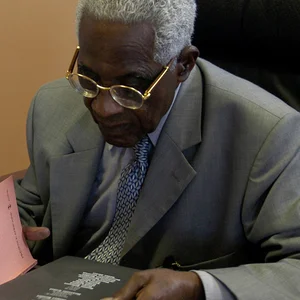
Senegalese-Guinean writer and historian (1932–2021), Djibril Tamsir Niane is celebrated for collecting and transcribing the epic of Sundiata Keita. His major work, Sundiata: An Epic of Old Mali (1960), helped bring recognition to African oral traditions.
Djibril Tamsir Niane(1932 — 2021)
Djibril Tamsir Niane
Guinée, Sénégal
8 min read
Frequently asked questions
Key Facts
- Born in 1932 in Conakry (French Guinea)
- Publication of Sundiata: An Epic of Old Mali in 1960, a founding work of modern African literature
- Director of the National Archives and National Library of Guinea in the 1960s
- Major contribution to the General History of Africa published by UNESCO
- Died in 2021, leaving an essential body of work on medieval African civilizations
Works & Achievements
Niane's masterpiece, transcribing and translating into French the epic tale of Sundiata Keita, founder of the Mali Empire. Translated into some twenty languages, it became a worldwide reference in African literature and a school textbook in many countries.
Niane's first major academic study, cross-referencing oral traditions and Arabic sources to reconstruct the history of the Mali Empire. It established the methodological foundations of his historiographical work.
A textbook written for African secondary schools, offering a history of West Africa told from an African perspective — a deliberate break from the textbooks inherited from the colonial era.
Niane edited and contributed to this globally authoritative volume, reconstructing the great medieval African civilizations. It cemented his standing as a pioneer of international African historiography.
A study of the Mandinka kingdom of Gabu (present-day Guinea-Bissau), extending his research into the civilizations that inherited the Mali Empire's legacy and their influence across West Africa.
Anecdotes
In the 1950s, Djibril Tamsir Niane traveled to the Hamana region of Guinea to meet the griot Mamadou Kouyaté. This guardian of oral memory recited to him in Mandinka the epic of Sundiata Keita, the founding king of the Mali Empire in the 13th century. Niane meticulously transcribed this story, passed down from generation to generation, knowing he was performing a major act of cultural preservation.
The publication of *Sundiata: An Epic of Old Mali* in 1960 coincided with the Year of Africa, during which seventeen African countries gained independence. This timing was no coincidence: Niane wanted to offer the newly liberated peoples of Africa a work affirming the richness and antiquity of their civilizations, against the colonial arguments that denied the existence of a genuine African history.
In 1978, UNESCO entrusted Djibril Tamsir Niane with editing Volume IV of its *General History of Africa*, covering the continent from the 12th to the 16th century. This project brought together African, European, and American historians to rewrite the history of the continent with Africa at the heart of the narrative. The publication of this volume in 1984 marked a decisive milestone in the international academic recognition of African historiography.
Niane taught at the University of Dakar (now Cheikh Anta Diop University) from the 1960s onward. He watched his book *Sundiata* gradually adopted as a textbook in secondary schools across many French-speaking African countries. For him, having younger generations read this epic meant restoring a sense of pride and identity that colonization had sought to erase.
During his fieldwork, Niane applied a rigorous method: he recorded griots, cross-referenced divergent versions from different storytellers, and compared oral traditions with medieval Arabic sources such as Ibn Battuta and Al-Umari. He thus demonstrated that African oral tradition, far from being mere legend, constitutes a serious and verifiable historical source.
Primary Sources
I am a griot. I am Djeli Mamadou Kouyaté, son of Bintou Kouyaté and Djeli Kedian Kouyaté, master of the art of eloquence. Since time immemorial the Kouyatés have been in the service of the Keïta princes of Manding.
Oral tradition is a fully legitimate historical source. Griots, as custodians of collective memory, transmit verifiable facts that archaeology and Arab sources allow us to confirm and place in time.
The history of West Africa does not begin with the arrival of Europeans. Powerful, well-organized empires — such as Ghana, Mali, and Songhai — flourished and exerted their influence long before the fifteenth century.
African civilizations of this period are not isolated phenomena; they are part of a worldwide system of exchanges, trade routes, and cultural interactions linking the Sahara, the Sudan, and the forest zones.
Key Places
Capital of Guinea and birthplace of Djibril Tamsir Niane. It was in this city that he grew up under French colonial rule, an experience that shaped his awareness of the stakes of African history and identity.
Region of Guinea where, in the 1950s, Niane met the griot Mamadou Kouyaté and collected for the first time the complete account of the epic of Sundiata Keita, founder of the Mali Empire.
Site of the ancient capital of the Mali Empire in the 13th century, now straddling the border between Guinea and Mali. A central location in the epic of Sundiata, it symbolizes the greatness of Mande civilization that Niane helped bring back to light.
City where Niane taught at Cheikh Anta Diop University from the 1960s onward and conducted his historical research on medieval African empires until his death in 2021.
It was at the Présence Africaine publishing house in Paris that *Sundiata: An Epic of Old Mali* was published in 1960. Paris was at that time the intellectual heart of the Négritude movement and the Francophone African diaspora.
Liens externes & ressources
Références
Œuvres
Soundjata ou l'épopée mandingue
1960
Recherches sur l'Empire du Mali au Moyen Âge
1959
Histoire de l'Afrique occidentale (avec Jean Suret-Canale)
1961
Africa from the Twelfth to the Sixteenth Century (UNESCO General History of Africa, vol. IV)
1984
Histoire des Mandingues de l'Ouest : le Royaume du Gabou
1989