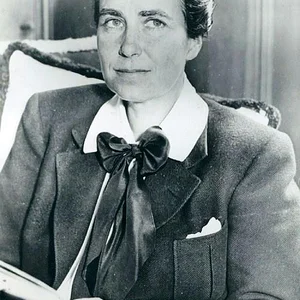

The only active female director working within the major Hollywood studios of the 1920s–1940s, Dorothy Arzner made around twenty films. A pioneer of women's cinema, she was the first woman admitted to the Directors Guild of America.
Dorothy Arzner(1897 — 1979)
Dorothy Arzner
États-Unis
8 min read
Frequently asked questions
Key Facts
- 1897: born in San Francisco, daughter of a restaurant owner frequented by actors
- 1927: directs her first film, Fashions for Women, for Paramount
- 1929: directs The Wild Party, the first sound film by a female director
- 1936: joins the Directors Guild of America, the first woman admitted
- 1943: retires from directing after a diagnosis of pneumonia; teaches film at UCLA until 1963
Works & Achievements
Arzner's first feature film for Paramount Pictures. It marks the official entry of a woman behind the camera at a major Hollywood studio.
Clara Bow's first sound film; historically notable because Arzner invented the boom microphone system here to free actors from the constraints of a fixed microphone, revolutionizing sound recording.
A portrait of a pioneering aviator played by Katharine Hepburn, who sacrifices everything for her freedom. Regarded in retrospect as one of the first feminist films in American cinema.
A major critical success adapted from a stage play; Arzner sharply explores the alienation of a woman obsessed with her home at the expense of her human relationships.
Arzner's masterpiece, famous for a scene that has become iconic in feminist film studies: the heroine turns to face the male audience to denounce the objectifying gaze it directs at the dancers.
Arzner's final film as director, a wartime thriller starring Merle Oberon. Health problems forced her to interrupt the shoot, bringing her directing career to an end.
Anecdotes
Dorothy Arzner began her Hollywood career in 1919 as a simple typist at Paramount Pictures, typing out scripts by hand. Refusing to stay confined to that role, she taught herself film editing and became one of the studio's finest editors, before securing her promotion to director by threatening to leave and work for a competitor.
In 1929, during the filming of *The Wild Party*, Clara Bow's first sound film, Arzner invented the boom microphone by attaching a microphone to the end of a long fishing pole. This ingenious solution freed the actors from having to stay close to microphones hidden in the sets, revolutionizing sound recording in cinema.
Dorothy Arzner wore masculine attire at all times — jacket, trousers, tie — at a time when this was highly unusual for a woman in Hollywood circles. Far from hiding it, she fully embraced this style, which became her visual signature and contributed to her natural authority on film sets.
In 1936, the Directors Guild of America (DGA) was founded to defend directors' rights against the major studios. Dorothy Arzner was the first — and for a long time the only — woman admitted to this professional union, a remarkable distinction in a field entirely dominated by men.
After retiring from directing in 1943, Arzner did not disappear from cinema: she taught filmmaking at UCLA (University of California, Los Angeles) for many years, training a new generation of filmmakers. Among her students was Francis Ford Coppola, the future director of *The Godfather*.
Primary Sources
“I always thought of myself as a director, period. But then I realized the distinction mattered, because I was the only one — and that said something about Hollywood, not about me.”
“Miss Arzner brings to this production a sharp visual intelligence and a command of the new sound techniques that few directors of her generation can match.”
Dorothy Arzner, founding member of the Directors Guild of America — the first woman admitted when the guild was established in 1936.
“When I went to work, I took no interference from anybody. A director has to have complete authority on the set — and I had it, from the first day.”
Key Places
Dorothy Arzner's birthplace, born on January 3, 1897. She spent her childhood here before moving to Los Angeles to begin her career in film.
The heart of Arzner's career from 1919 to 1932: she started there as a typist, rose to become a highly regarded film editor, then a director, establishing herself at one of Hollywood's most powerful studios.
The studio where Arzner made some of her most significant films, including *Christopher Strong* (1933) and *Dance, Girl, Dance* (1940), after leaving Paramount.
The university where Arzner taught filmmaking during the 1960s and 1970s, passing on her expertise to a new generation of filmmakers, including Francis Ford Coppola.
A town in the California desert where Dorothy Arzner retired for the final years of her life. She died there on October 1, 1979, at the age of 82.
Typical Objects

A ubiquitous tool on film sets of the 1920s–1940s, the megaphone allowed directors to guide their actors from a distance amid the noise of a shoot. Arzner wielded it with an authority her crews recognized immediately.

A machine for viewing and cutting 35 mm film frame by frame. It was on this device that Arzner honed her expertise as an editor — a decisive skill that made her an unusually precise director in the handling of narrative rhythm.

A hands-on innovation Arzner improvised during the shoot of *The Wild Party* (1929): by attaching a microphone to the end of a long fishing rod, she invented the principle of the boom operator, a technique adopted worldwide ever since.

Arzner consistently wore men's suits on set, asserting her authority in an industry where credibility was associated with masculinity. This sartorial style became her visual signature and a symbol of her independence.

Like all professional directors of the era, Arzner worked from scripts densely covered in handwritten notes, recording her shot-breakdown choices, acting directions, and the technical constraints of each setup.

The standard studio camera in Hollywood during the 1930s–1940s — heavy and imposing. Mastering this equipment and understanding its optical constraints was essential for any director working in the age of the major studios.
School Curriculum
Vocabulary & Tags
Key Vocabulary
Tags
Daily Life
Morning
Arzner arrived on set early in the morning, often before her actors and part of her crew. She reviewed the day's shooting schedule with her director of photography, adjusting camera positions and lighting setups planned during the previous day's prep. Her masculine attire — jacket, trousers, tie — was already buttoned up, a sign that the workday had begun.
Afternoon
Afternoons were devoted to shooting in the studio's interior sets or on the backlot. Arzner directed her actors with precision but without harshness, placing more emphasis on character psychology than on showy performance. Breaks were used to review continuity, consult the shot breakdown, and anticipate the challenges of the following day.
Evening
Arzner would return home to her life partner, choreographer Marion Morgan, with whom she lived for nearly forty years in complete discretion. Her evenings were spent reading new scripts, annotating technical breakdowns, or receiving collaborators to prepare upcoming projects. She kept well away from Hollywood's social scene.
Food
Arzner's eating habits were simple and practical: coffee and sandwiches on set during long shooting days, more structured meals at home. None of her contemporaries' accounts mention any particular taste for fine food — the dinner table was for her a moment of rest, not ceremony.
Clothing
Her look was a true professional signature: carefully tailored masculine suits, white shirt, tie, sometimes a beret. This deliberate sartorial choice gave her immediate authority on set, in an industry where credibility was traditionally associated with masculinity. She never wore a dress in a professional context.
Housing
Dorothy Arzner and Marion Morgan lived in a comfortable house in Los Angeles, in the residential neighborhoods favored by film industry professionals. Their home served as both a private refuge and an informal workspace, where Arzner received screenwriters and producers in a personal setting very different from the cold, hierarchical atmosphere of the major studios.
Historical Timeline
Period Vocabulary
Liens externes & ressources
Références
Œuvres
Fashions for Women
1927
Craig's Wife
1936
Dance, Girl, Dance
1940