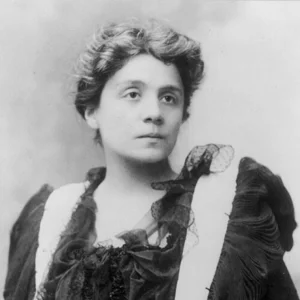

Nicknamed “La Duse,” this Italian tragedienne (1858–1924) revolutionized dramatic art through a style of unprecedented inner truth, free of makeup and theatrical effects. Legendary rival of Sarah Bernhardt, she embodied the heroines of Ibsen and D’Annunzio on the greatest stages of Europe and America.
Eleonora Duse(1858 — 1924)
Eleonora Duse
royaume de Sardaigne, royaume d'Italie
9 min read
Frequently asked questions
Famous Quotes
« To move others, the actor must not be moved himself.»
« The theatre will be saved only by those who devote their entire lives to it.»
Key Facts
- Born on October 3, 1858, in Vigevano (Lombardy) into a family of traveling performers
- International triumph from the 1880s onward, notably in Hedda Gabler and La Dame aux camélias
- Tumultuous relationship with Gabriele D’Annunzio (1894–1904), for whom she premiered several plays
- Iconic rival of Sarah Bernhardt: the two actresses toured London simultaneously in 1895
- Died on April 21, 1924, in Pittsburgh during her final American tour, at the age of 65
Works & Achievements
Play by Alexandre Dumas fils, in the role of Marguerite Gautier, which became one of her signature performances. It was precisely in this role that she directly faced off against Sarah Bernhardt in London in 1895, sparking a historic debate about two opposing conceptions of theatrical acting.
Duse was one of the first great actresses to bring Ibsen's repertoire to European stages, playing Nora with a psychological truthfulness that captivated audiences. Her interpretation helped spread Scandinavian naturalist theatre across Southern Europe and the Americas.
The title role of Ibsen's play, considered one of her greatest interpretive achievements. Duse embodied Hedda's frustration and inner violence with an economy of means that astonished critics accustomed to grand melodramatic flourishes.
A play written especially for Duse by D'Annunzio, with whom she was having an affair. She plays Silvia Settala, a woman torn between art and love — a subject that resonated painfully with her own life at the time.
Her portrayal of Rebecca West, a complex character pulled between desire, guilt, and idealism. London critics considered this performance one of the greatest of Duse's career, a pinnacle of psychological naturalism in theatre.
The play with which Duse made her return to the stage after twelve years away. Her portrayal of Ellida, a woman haunted by a mysterious call from the sea, was hailed as a major artistic event across Europe.
Anecdotes
Eleonora Duse was the only great actress of her era to perform without makeup. Where Sarah Bernhardt applied heavy greasepaint to sculpt her face under the footlights, La Duse appeared on stage with her real face, her naturally graying hair, her visible wrinkles. Critics, astonished, reported that she seemed capable of blushing or turning pale at will, through the sheer force of her inner emotion.
Her rivalry with Sarah Bernhardt is one of the most famous in theater history. In 1895, both actresses performed the same play — La Dame aux camélias — in London during the same week, at different theaters. Audiences crossed the city from one theater to the other to compare. The critic George Bernard Shaw came down in favor of La Duse: “Bernhardt acts for the audience, Duse acts for the character.”
Her turbulent affair with the writer Gabriele D'Annunzio lasted a decade and felt like a shipwreck both artistically and romantically. D'Annunzio wrote several plays for her — including La Gioconda and Francesca da Rimini — but publicly betrayed her by drawing on their relationship in his novel The Flame (1900), in which he depicted her as an aging woman being abandoned. Wounded, Duse nonetheless continued to champion his work.
In 1909, exhausted and disillusioned with the theater world, Duse announced her definitive retirement at age 51. She spent twelve years in near-isolation. But in 1921, ruined by the First World War which had destroyed her savings, she returned to the stage for a farewell tour across Europe and America. She died of pneumonia in Pittsburgh on April 21, 1924, during this tour, at age 65 — on stage until the very end.
Duse was the first great actress to embrace the repertoire of Henrik Ibsen, then considered scandalous. By performing Nora in A Doll's House and Hedda Gabler, she brought to the stage women who refused their social condition — a revolutionary message for the bourgeois audiences of the Belle Époque. Her interpretation of Ellida in The Lady from the Sea, in 1921, on her great comeback, drew standing ovations across Europe.
Primary Sources
Duse's technique is nothing but a complete abandonment of technique. She does not try to move you by pretending to be moved: she moves you because she is truly in the state of the character she is playing.
I want to die on stage or while travelling — not in a bed. The theatre is my only home, and movement my only health.
I wrote this play for the hands of Eleonora Duse, for those hands of a great artist who know how to express everything without the lips needing to speak.
Duse revealed to me what I had sensed without being able to articulate: the actor does not imitate, he lives. She had no visible technique, and that is precisely what was her supreme technique.
Madame Duse achieves something we had never seen: she makes you forget that there is a stage, wings, an audience. You feel you are witnessing a truth, not a performance.
Key Places
Eleonora Duse's birthplace, where she was born on October 3, 1858, in a railway carriage while her actor parents were on tour in the region. She spent little time there, as her early years were those of a nomadic childhood within a travelling theatre troupe.
A small town in the Treviso region that Duse adopted as her spiritual retreat and primary residence during her years of withdrawal (1909–1921). She is buried there in the Sant'Anna cemetery; her home is today a place of remembrance.
One of the Italian theatres where Duse built her national reputation in the 1880s. The Florentine stage, demanding and culturally discerning, was an essential springboard before her major international tours.
The city of her first American tour in 1893, where she triumphed in the great Broadway theatres. American audiences, less accustomed to European theatrical conventions, were particularly receptive to her naturalistic, unaffected style of acting.
The city where Eleonora Duse died on April 21, 1924, of pneumonia, during her final American farewell tour. She was still performing just days before her death, refusing to cancel performances despite her illness.
The artistic capital of the Belle Époque where Duse performed regularly and where her rivalry with Sarah Bernhardt played out before the eyes of the international press. Paris was also the setting for encounters with the leading literary and artistic figures of the era.
Typical Objects

Unlike the baroque opulence of her contemporaries, Duse wore intentionally austere costumes, often designed to erase the boundary between the woman and the character. Her stage costumes sought not visual effect but psychological truth.

Duse worked on her roles by densely annotating the manuscripts of plays — notes on inner rhythm, silences, hidden intentions. These annotated manuscripts, preserved at the National Library of Rome, testify to a rigorous and deeply intellectual approach to preparation.

Like all great actresses of her era, Duse traveled with an imposing trunk containing costumes, personal belongings, and correspondence. She spent much of her life in trains and hotel rooms, the trunk being her only home.

The correspondence between Duse and D'Annunzio — several hundred letters — constitutes an exceptional record of their artistic and romantic relationship. In them, Duse lays bare her doubts, her generosity, and the pain inflicted by the writer's repeated betrayals.

Duse suffered from fragile health — chronic bronchitis, exhaustion — and regularly used a chaise longue in her dressing room to rest between acts. She said that silence and solitude before taking the stage were just as important as the performance itself.

In the pre-cinematic era, major theatrical tours were announced by lithographed posters plastered across town. Duse's posters, far more restrained than Bernhardt's, made no bid for glamour — they bore her name alone, by then enough to fill any house.
School Curriculum
Vocabulary & Tags
Key Vocabulary
Daily Life
Morning
Duse rose late, having often performed the evening before. She began her day with a long period of silence and reading — poetry, philosophy, correspondence. She answered her many letters in the morning, maintaining an intense exchange with writers, directors, and friends from around the world.
Afternoon
The afternoon was devoted to rehearsals, readings of new texts, and discussions with playwrights and theater directors. Duse disliked authoritarian rehearsal styles; she preferred to explore roles through inner improvisation and dialogue with her fellow actors, seeking the truth of the character rather than theatrical effect.
Evening
On performance nights, Duse withdrew to her dressing room and refused all visitors. Unlike the actresses of her day who spent long stretches applying makeup, she used that time to prepare herself inwardly, in silence. After the show she was often exhausted, frequently declining receptions and society dinners to go home and rest.
Food
Her fragile health and chronic bronchitis required her to eat lightly. She avoided heavy meals before performing, making do with broths, fruit, and bread. On tour, she often struggled with unfamiliar cuisines and the difficulty of finding food suited to her needs.
Clothing
In everyday life, Duse dressed with a deliberate simplicity that stood in sharp contrast to the extravagance of her era. She wore loose, dark dresses, avoiding tight corsets and the lavish ornamentation fashionable during the Belle Époque. This choice of dress was an extension of her rejection of theatrical artifice: she wanted the body to remain free and expressive.
Housing
Her life was that of a nomad — hotels, rented houses, temporary apartments in the cities she toured. Her true refuge was the villa in Asolo, in the Veneto, a modest house surrounded by gardens where she retreated between tours to tend to her health and rediscover silence. She never accumulated luxury, living with an elegant simplicity that reflected her devotion to what was essential.
Historical Timeline
Period Vocabulary
Liens externes & ressources
Références
Œuvres
La Dame aux camélias (La Signora delle camelie)
1880-1909
Maison de poupée (Casa di bambola) d'Ibsen
1891
Hedda Gabler d'Ibsen
1898
La Gioconda de Gabriele D'Annunzio
1899
Rosmersholm d'Ibsen
1906
La Dame de la mer (La donna del mare) d'Ibsen
1921