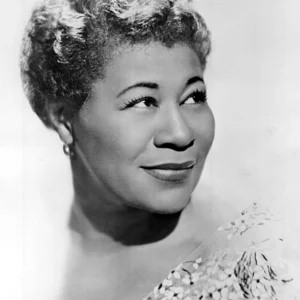

Ella Fitzgerald (1917–1996) is considered one of the greatest jazz singers of all time. Nicknamed the “First Lady of Song,” she revolutionized jazz singing through her mastery of scat and the exceptional range of her voice.
Ella Fitzgerald(1917 — 1996)
Ella Fitzgerald
États-Unis
9 min read
Frequently asked questions
Famous Quotes
« Just don't give up trying to do what you really want to do. Where there is love and inspiration, I don't think you can go wrong.»
« The only thing better than singing is more singing.»
Key Facts
- 1917: born in Newport News, Virginia
- 1934: wins an amateur contest at the Apollo Theatre in Harlem, launching her career
- 1938: records A-Tisket, A-Tasket, which becomes a national hit
- 1958: first Black woman to win a Grammy Award
- 1996: dies in Beverly Hills after a career spanning more than 60 years
Works & Achievements
Co-written by Ella with Van Alexander, based on a children's nursery rhyme, this song was Ella's first major commercial hit, selling over one million copies. It exemplifies her ability to make vocal jazz both accessible and widely appealing.
The first in a series of eight albums dedicated to the great composers of the Great American Songbook, recorded for Verve Records. This landmark album established Ella as the definitive interpreter of American standards and revived the reputation of Cole Porter's work.
A duo album with Louis Armstrong, recorded the same year as the Cole Porter Songbook. Regarded as one of the most perfect jazz records ever made, it captures the exceptional musical chemistry between the two legends.
A live recording of the Berlin concert on February 13, 1960, famous for Ella's scat improvisation on "Mack the Knife" after forgetting the lyrics. The album won two Grammy Awards and remains an extraordinary document of her genius for vocal improvisation.
Recorded in collaboration with Duke Ellington himself, this two-volume album stands among the finest entries in the Songbook series. It is a unique celebration of Ellington's work, performed with a rare delicacy and musical intelligence.
A cycle of twelve albums dedicated to eight major composers (Cole Porter, Rodgers & Hart, Duke Ellington, Irving Berlin, George and Ira Gershwin, Harold Arlen, Jerome Kern, and Johnny Mercer). This monumental body of work is considered the modern definition of the American standard and remains an absolute touchstone in the history of twentieth-century music.
Anecdotes
In November 1934, the young Ella, aged 17, stepped onto the stage of the famous Apollo Theater in Harlem for amateur night. She had come to dance, but intimidated by two competitors, she decided at the last moment to sing instead. The audience, initially hostile, was won over in seconds: she took first prize and, according to witnesses, the ovation simply would not stop.
In 1938, Ella co-wrote with Van Alexander a song inspired by a children's nursery rhyme, 'A-Tisket, A-Tasket'. The record sold over a million copies within a few months, becoming the hit of the summer. Ella was just 21 years old and became overnight one of the most famous singers in the United States.
Ella Fitzgerald was renowned for her scat singing, a technique where the voice imitates an instrument by improvising nonsense syllables. During a concert in Berlin in 1960, she forgot the lyrics to 'Mack the Knife' mid-song and improvised in scat for several minutes, making up humorous lyrics on the spot. The recording went on to win two Grammy Awards.
Despite her worldwide fame, Ella Fitzgerald bore the full brunt of American racial segregation. In 1955, at Houston airport, she and her band were stopped and searched without cause by customs agents. Her impresario Norman Granz, outraged, threatened legal action and secured their release — but the incident made clear that even the “First Lady of Song” was not immune to everyday racism.
For years, the management of the Mocambo, an upscale nightclub in Los Angeles, refused to book Ella Fitzgerald on the grounds that she was “not glamorous enough.” In 1954, Marilyn Monroe, a great admirer of Ella’s, personally called the owner and promised to sit at a front-row table every night if Ella was booked. Management agreed, the Mocambo sold out every night, and Ella never again struggled to find bookings at major venues.
Primary Sources
"I don't think of my voice as anything special. I just sing what I feel. If people like it, that's wonderful. If they don't, I sing anyway."
Live recording from February 13, 1960 at the Deutschlandhalle in Berlin, capturing in real time Ella's scat improvisation when she forgets the lyrics — an exceptional audio document of her vocal genius.
"I signed Ella not only because she is the greatest singer in the world, but because no one should travel, eat, and sleep in conditions beneath human dignity because of the color of their skin. I will never accept that."
"The only thing better than singing is more singing."
"Man, woman, or child, Ella is the greatest. She can do things with her voice that no instrumentalist can fully imitate. She is a natural miracle."
Key Places
Birthplace of Ella Fitzgerald, born on April 25, 1917. Located in a Southern state still deeply marked by segregation, Newport News symbolizes the difficult conditions in which she grew up before moving to Yonkers, New York.
It was on the Apollo's stage that Ella's career began in November 1934, during the legendary Amateur Night. This iconic Harlem venue remains the symbol of discovery for the greatest African-American artists of the 20th century.
Ella Fitzgerald performed here on numerous occasions as part of Norman Granz's Jazz at the Philharmonic. Her concerts at Carnegie Hall cemented her place among the greatest artists on the world music stage, well beyond jazz alone.
Site of the February 13, 1960 concert immortalized on the album *Ella in Berlin: Mack the Knife*. It was here that Ella improvised her famous scat after forgetting the lyrics — a recording that earned her two Grammy Awards.
Ella Fitzgerald settled here in 1955 after Norman Granz signed her to Verve Records, based in Los Angeles. She spent the last decades of her life there, despite the initial discrimination she faced at the city's upscale clubs and hotels.
Typical Objects

An icon of jazz studios and stages from the 1940s to the 1960s, this high-quality microphone was essential for Ella to capture every nuance of her voice. She used it both in the studio during her Verve recordings and on stage at Carnegie Hall.

Ella worked with renowned arrangers such as Nelson Riddle and Billy May. The annotated scores from her Songbooks bear witness to a meticulous collaboration between the singer and the orchestrators to bring out the best in every melody.

The LP format, introduced in 1948, allowed Ella to record complete, cohesive albums. The Songbooks, released in this format, have become absolute benchmarks of the worldwide jazz discography.

On stage, Ella wore long, elegant gowns, often made by New York designers. Her sartorial elegance stood in stark contrast to the segregated policies of hotels that sometimes refused to let her through the door.

Ella spent months on the road, crossing the United States and Europe as part of Norman Granz's Jazz at the Philharmonic. The suitcase was the defining object of her nomadic life as a professional musician.

Ella Fitzgerald won thirteen Grammy Awards over the course of her career, including a Grammy Lifetime Achievement Award in 1967. These trophies represent the official recognition of a music industry long dominated by white artists.
School Curriculum
Vocabulary & Tags
Key Vocabulary
Tags
Daily Life
Morning
During her long tours with Jazz at the Philharmonic, Ella often slept until mid-morning after concerts that ran late into the night. She ate a light breakfast in her hotel room — when she was allowed to stay in one — or at a neighborhood restaurant, using those quiet hours to read her mail and reply to fans.
Afternoon
Afternoons were devoted to rehearsals with the orchestra and working sessions with her accompanist. Ella carefully studied scores with her arrangers, marked her notes on the sheet music, and adjusted tempos and keys to suit her voice. She also enjoyed walking through the cities she visited, exploring markets and working-class neighborhoods.
Evening
Evenings belonged to the stage. Ella got ready in her dressing room, slipped on her concert gown, and ran through a few vocal warm-ups. Her concerts often lasted more than two hours, filled with scat improvisations and playful exchanges with the audience. After the show, she would sometimes join fellow musicians for informal jam sessions that could stretch on until dawn.
Food
Ella Fitzgerald had a well-known passion for Southern comfort food: fried chicken, macaroni and cheese, homemade pies. She struggled with her weight throughout her life, a subject she addressed with humor in interviews. On the road, she sought out small African-American family restaurants that reminded her of the cooking she grew up with in Harlem.
Clothing
On stage, Ella wore long, elegant gowns — often in silk or adorned with sequins — made by New York dressmakers. In everyday life, she preferred comfortable, practical outfits suited to travel by plane and tour bus. Unlike some singers of her era, she made no effort to project an extravagant personal style off stage.
Housing
Early in her career, Ella lived in modest conditions in Harlem, often sharing lodgings with other musicians. After her breakthrough in the 1940s, she was able to move into comfortable apartments in New York. From 1955 onward, she lived in Beverly Hills, California, in a house she purchased with earnings from her Songbooks — even as luxury hotels in tour cities still sometimes turned her away.