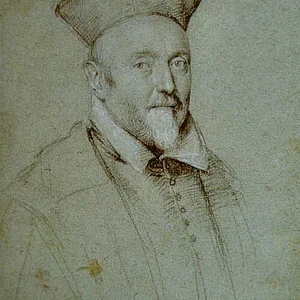

Italian cardinal (1549–1626), diplomat and influential patron of Baroque Rome. He was Caravaggio's first major patron, housing him in his palace and commissioning several of his key works. Close to Galileo, he also had a keen interest in science and music.
Francesco Maria Del Monte
Francesco Maria Bourbon del Monte Santa Maria
république de Venise
8 min read
Frequently asked questions
Key Facts
- Born in 1549 in Venice, died in 1626 in Rome
- Appointed cardinal in 1588 by Pope Sixtus V
- Housed Caravaggio in his Palazzo Madama in Rome around 1595–1600 and commissioned the Saint Matthew cycle of paintings for the church of San Luigi dei Francesi
- Maintained a correspondence with Galileo and took an interest in the natural sciences and alchemy
- Diplomatic representative of the Medici family to the Holy See for several decades
Works & Achievements
The first major painting Del Monte commissioned from Caravaggio, depicting young musicians in antique costume. Now in the Metropolitan Museum of Art in New York, this work marks the beginning of a historic artistic collaboration between the cardinal and the painter.
Del Monte had this intimate painting made for his private apartments, reflecting his deep love of music. Two versions exist; the one in the Hermitage in Saint Petersburg is the most celebrated.
The only ceiling painting Caravaggio ever produced, created for the alchemical *studiolo* of the Palazzo Madama. The work reflects Del Monte's interest in science and hermetic symbolism tied to the three realms — air, water, and earth.
A major diplomatic intervention by Del Monte with the Medici to secure Galileo his professorship at the University of Padua. This support gave the scholar the conditions he needed to pursue the research that led to his landmark astronomical discoveries.
Acting as a diplomat representing both papal and Medicean interests, Del Monte played an active role in the negotiations that ended the conflict between France and Savoy, asserting the Church's role as arbiter of peace in Europe.
Throughout his career, Del Monte assembled a collection of artworks, scientific instruments, and exceedingly rare books that made his palace one of the most active and forward-looking cultural centers in Baroque Rome.
Anecdotes
In 1595, Francesco Maria Del Monte noticed the exceptional talents of a young Lombard painter named Michelangelo Merisi, known as Caravaggio, who was struggling to make a living from his art on the streets of Rome. The cardinal offered him refuge in his palace and commissioned several paintings from him, thereby launching a career that would revolutionize Baroque painting.
Del Monte maintained a genuine friendship with the scholar Galileo. In 1592, he used his influence with the Medici to help the scientist secure a chair in mathematics at the University of Padua, enabling him to pursue the research that would transform our understanding of the cosmos.
The Palazzo Madama, the cardinal's Roman residence, was a true cultural salon where artists, musicians, scientists, and diplomats mingled. Del Monte regularly organized concerts and learned discussions there, making it one of the most active intellectual hubs in late sixteenth-century Rome.
Del Monte commissioned from Caravaggio a one-of-a-kind ceiling painting for his alchemical *studiolo*: “Jupiter, Neptune and Pluto.” This remarkable work illustrates his taste for learned symbolism and his combined interest in science and Hermetic philosophy.
As the Medici's representative in Rome, Del Monte played a key diplomatic role during the negotiations of the Treaty of Lyon in 1601, which ended the conflict between France and Savoy. His dual role as churchman and seasoned diplomat perfectly illustrates the versatility of the great cardinals of the Counter-Reformation.
Primary Sources
The cardinal recommends Caravaggio in these terms: 'I send you by this painting, made by a singularly gifted young man residing in my household, what I have been able to obtain from his hand in this kind of painting.'
Repeated mentions of expenses related to the upkeep of the painter Michelangelo da Caravaggio, housed and fed at the cardinal's expense at the Palazzo Madama.
Galileo refers to Del Monte's patronage: 'Cardinal del Monte has shown me such great goodwill and has so warmly recommended my person to the Most Serene Lords that I could never be sufficiently grateful to him.'
The inventory drawn up after the cardinal's death in 1626 lists musical instruments, scientific instruments (telescopes, armillary spheres), and a significant collection of paintings, including several works by Caravaggio.
Key Places
Del Monte's official residence in Rome, this palace was the hub of his activity as a patron of the arts. Caravaggio lived there for several years and produced some of his most celebrated works within its walls, including *Jupiter, Neptune and Pluto* for the ceiling of the studiolo.
The birthplace of Francesco Maria Del Monte in 1549. The Republic of Venice was at that time one of the great cultural and political powers of Italy, an influence that would lastingly shape the taste and formation of the future cardinal.
Del Monte spent part of his youth in this city, which had been one of the great centers of the Italian Renaissance under the protection of the Duke of Montefeltro and later the Della Rovere family.
The site of many official ceremonies in which Del Monte took part in his capacity as cardinal. The construction of the new basilica in the sixteenth century symbolized the renewed power of the Catholic Church in the triumphant age of the Counter-Reformation.
The city of the Medici, whose permanent representative in Rome Del Monte served as. He maintained the diplomatic link between the papacy and the powerful Tuscan family, making Florence an essential anchor of his entire career.
Typical Objects

The most visible insignia of cardinalatial rank, this wide red hat with multiple tassels symbolized Del Monte's dignity and power. It was worn during major Roman ceremonies and processions, signaling his authority throughout the city.

Del Monte was a discerning music lover who kept musicians playing in his palace. The lute, the emblematic instrument of the Renaissance and early Baroque, appears at the heart of the paintings he commissioned from Caravaggio, such as *The Lute Player*.

Passionate about science, Del Monte owned optical instruments and astronomical measuring devices. His friendship with Galileo and his interest in astronomy found expression in celestial observations and learned discussions held in his *studiolo*.

An active diplomat in the service of the Medici, Del Monte maintained an extensive correspondence with Florence and the courts of Europe. His letters are today a precious historical source on art and politics in Baroque Rome.

Like every cardinal of the period, Del Monte was required to recite the Divine Office daily from this liturgical book. Religious practice structured his days just as much as his diplomatic duties and artistic passions.

Candlelight was ubiquitous in the Roman palaces of the seventeenth century. Del Monte commissioned from Caravaggio paintings of striking chiaroscuro effects, directly inspired by the flickering artificial light he lived with every evening.
School Curriculum
Vocabulary & Tags
Key Vocabulary
Daily Life
Morning
Del Monte began his day with the recitation of the liturgical hours (lauds and terce), then received secretaries and messengers bearing dispatches from Florence or the European courts. He dictated his diplomatic correspondence before official audiences filled the rest of his schedule.
Afternoon
Afternoons were devoted to visits from artists and scholars, diplomatic audiences, and work in his *studiolo*, where he enjoyed handling musical and scientific instruments. Caravaggio would often come to show him the progress of his commissions, and lively discussions would follow on the composition and lighting of the paintings.
Evening
Evenings at the Palazzo Madama were frequently enlivened by chamber concerts bringing together professional musicians and gifted amateurs. Del Monte invited poets, philosophers, and prelates for learned conversations by candlelight, blending art, politics, and scholarship in a setting typical of the Roman elite at the dawn of the seventeenth century.
Food
Like the great prelates of his rank, Del Monte ate hearty meals of roasted meats, fish on the lean days prescribed by the Church, fresh pasta, and Mediterranean vegetables. Wine from the pontifical vineyards and fresh fruit from the palace gardens rounded out a diet that was both flavorful and in keeping with his religious obligations.
Clothing
In public, Del Monte wore the red cassock and purple mantle of a cardinal — powerful markers of his place in the ecclesiastical hierarchy. In private, he dressed more simply but always in fine fabrics — silk, damask, or velvet — befitting the dignity of his office and the refined Italian fashion of the early seventeenth century.
Housing
The Palazzo Madama, situated in the heart of Rome near the Pantheon, was a magnificent residence with vast halls adorned with frescoes and tapestries. Del Monte had fitted out a personal *studiolo* for his experiments and collections, as well as comfortable apartments where he housed Caravaggio for several years, a true patron living under the same roof as his painter.
Historical Timeline
Period Vocabulary
Liens externes & ressources
Références
Œuvres
Soutien à la carrière universitaire de Galilée
1592
Négociations du traité de Lyon
1601
Constitution de la collection du Palazzo Madama
1588-1626