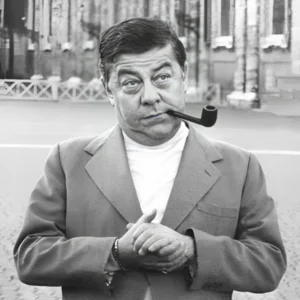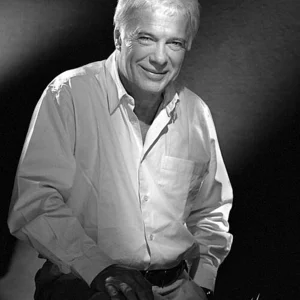

Guy Bedos (1934-2020) was a French comedian, actor, and music-hall performer, born in Algiers. Famous for his stage sketches, notably as a duo with Sophie Daumier, he was also a committed left-wing figure, blending humor and political satire.
Guy Bedos(1934 — 2020)
Guy Bedos
France
5 min read
Frequently asked questions
Key Facts
- Born on 15 June 1934 in Algiers into a pied-noir family
- Formed a famous comedy duo with Sophie Daumier in the 1960s (the sketch “La Drague”)
- Wrote his material with Jean-Loup Dabadie, blending humor with social and political criticism
- Performed many politically engaged one-man shows at the Olympia and in theaters from the 1970s-1980s onward
- Died on 28 May 2020 in Paris
Works & Achievements
A classic of the comedy duo, written by Jean-Loup Dabadie, about the awkwardness of flirting.
A satirical one-man show that established Bedos as a biting observer of French society.
Satirical sketches skewering the political figures of the Fifth Republic.
Roles in plays and films that broadened his career as an actor.
Final shows crowning a career of nearly fifty years in the performing arts.
Anecdotes
Guy Bedos was born in Algiers in 1934 and grew up in French Algeria. This *pied-noir* childhood deeply shaped his humour and his convictions: he never forgot colonial violence nor the Algerian War, subjects he would approach with gravity throughout his life.
In the 1960s and 1970s, he formed a famous comic duo with the actress **Sophie Daumier**. Their sketch “La Drague” (Chatting Someone Up), written with **Jean-Loup Dabadie**, became a classic of café-théâtre, playing on the awkwardness of budding romance.
His collaboration with the writer and screenwriter **Jean-Loup Dabadie** was essential: Dabadie wrote many of his finest pieces, proving that behind the stage comedy lay the real craft of an author.
A self-declared left-winger, Bedos turned his shows into satirical soapboxes. He lampooned politicians of every stripe and never hid his opinions, even at the risk of stirring up controversy.
He is the father of the actor and director **Nicolas Bedos**, extending a family tradition of performance and writing. Guy Bedos died in Paris in 2020, at the age of 86.
Primary Sources
Bedos delivers his satirical monologues on the political and social events of the 1970s, blending laughter and indignation.
Bedos looks back on his childhood in Algiers and the wrenching experience of decolonization, a recurring theme in his public confidences.
A comic dialogue about the hesitations and blunders of a first romantic approach, which became emblematic of the duo.
Key Places
Birthplace of Guy Bedos in 1934, cradle of his pied-noir childhood and the source of his reflections on colonization.
Legendary Parisian music-hall venue where Bedos staged his great satirical shows.
City where Guy Bedos spent most of his career and where he died in 2020.
Key venues of the comedy revival of the 1960s-1970s, where the one-man-show style came into its own.
Typical Objects

The central tool of the one-man show, it lets a comedian alone on stage project their voice and set the rhythm of their satirical monologues.

A simple seat set beneath the spotlights, a symbol of the bareness of the solo performer who has only their words for a backdrop.

The sketches written with Jean-Loup Dabadie, reworked until every word was just right, reveal the author's craft behind the comedy.

An elegant but discreet jacket and shirt, Bedos's stage attire drew all attention to his face and his words.

The follow spot isolated the artist in the darkness, an essential device of the café-théâtre and the music hall.
School Curriculum
Vocabulary & Tags
Key Vocabulary
Daily Life
Morning
A writer as much as a stage performer, Bedos often devoted his mornings to reading the press and following political news — the raw material for his sketches. He would annotate, clip out articles, and jot down ideas for lines.
Afternoon
The afternoon was set aside for writing and memorizing, alone or with his partner **Jean-Loup Dabadie**, polishing a text until every word was just right and rehearsing the rhythm of a monologue.
Evening
Evening brought the time for the stage: music hall, café-théâtre, or a grand venue like the **Olympia**, facing an audience he made laugh and think all at once, right up to the late-night curtain calls.
Food
A Parisian by adoption, he happily shared the meals and long café conversations that shaped the lives of the artists of his time, between bistros and brasseries.
Clothing
On stage as in town, Bedos cultivated an understated elegance — a well-cut jacket, a crisp shirt — leaving all the room to the expressiveness of his face and the power of his words.
Housing
He lived in **Paris**, at the heart of the cultural and theatrical world, close to the venues and café-théâtres where the capital's artistic life played out.
Historical Timeline
Period Vocabulary
Liens externes & ressources
Références
Œuvres
La Drague (sketch, avec Sophie Daumier)
1967
Je craque (spectacle)
1975
Bonjour Monsieur le ministre (monologues politiques)
années 1970-1980
Adieux à la scène
2013