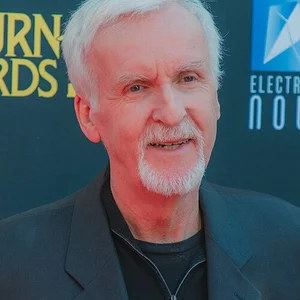

Canadian director born in 1954, James Cameron is the creator of iconic films such as Terminator, Titanic, and Avatar. A passionate deep-sea explorer, he dove to the depths of the Mariana Trench in 2012.
James Cameron(1954 — ?)
James Cameron
Canada, Nouvelle-Zélande
9 min read
Frequently asked questions
Key Facts
- 1984: direction of The Terminator, which launched his international career
- 1997: Titanic wins 11 Oscars and becomes the highest-grossing film in history at the time
- 2009: Avatar revolutionizes 3D cinema and surpasses Titanic at the worldwide box office
- 2012: solo descent into the Mariana Trench (10,908 m) aboard the Deepsea Challenger submarine
- His films have grossed over $6 billion worldwide
Works & Achievements
Cameron's breakthrough film, a low-budget science-fiction movie featuring a killer robot from the future. It launched Arnold Schwarzenegger to stardom and established Cameron on the international scene.
The sequel to Ridley Scott's Alien, widely considered superior to the original. Cameron showcases his mastery of relentless action and dramatic tension, earning two technical Academy Awards.
An underwater science-fiction film that pioneered the first morphing digital effects in cinema history. It foreshadows both Avatar's technological ambitions and Cameron's lifelong passion for deep-sea exploration.
A film that revolutionized world cinema with the first photorealistic computer-generated effects (the liquid-metal T-1000). It won 4 technical Academy Awards and remains a landmark in visual innovation.
An epic recreation of the 1912 ocean liner disaster, weaving a fictional love story with documentary-level historical accuracy. It became the highest-grossing film in history at the time of its release and won 11 Academy Awards, including Best Picture and Best Director.
A groundbreaking science-fiction film presenting the fictional planet Pandora in digital 3D. It surpassed Titanic at the worldwide box office with $2.9 billion and sparked a lasting revival of 3D projection in cinemas.
A scientific and technical feat: Cameron descended alone to a depth of 10,908 meters, collecting scientific data and footage for National Geographic and the Woods Hole Oceanographic Institution. It was the third crewed descent into the trench, and the first ever solo dive.
Anecdotes
When James Cameron submitted the Terminator screenplay to producers in 1984, he was so broke that he sold the script rights for a symbolic dollar, on the sole condition that he be allowed to direct the film himself. This risky gamble was the starting point of one of the most influential careers in world cinema.
To prepare for Titanic (1997), Cameron made no fewer than 33 dives to the actual wreck of the ocean liner, at a depth of 3,800 meters in the North Atlantic. This obsession with authenticity allowed him to reconstruct the ship with remarkable historical precision, but considerably inflated the film's budget, which exceeded 200 million dollars.
In March 2012, Cameron descended alone aboard his submersible Deepsea Challenger to the deepest point in the oceans: the Mariana Trench, at a depth of 10,908 meters. He thus became the third person in history to reach that location, and the first to do so in a solo dive, collecting scientific samples for the National Geographic Society.
Avatar (2009) is a project Cameron had been nurturing since 1994, but he had to wait more than ten years before he could make it: the technology needed to create the Na'vi characters in motion capture and the landscapes of Pandora simply did not yet exist. He himself contributed to the development of the 3D cameras and animation software that would eventually make the film possible.
During the filming of Titanic in 1997, around fifty members of the technical crew fell victim to an unexplained case of food poisoning: phencyclidine (PCP) had been introduced into the soup served at the set's catering facility. Cameron himself was affected but refused to halt the shoot, illustrating his reputation as a director who pushes his teams to the absolute limit.
Primary Sources
"I'm the king of the world!" Echoing the iconic line from his own film, Cameron proclaimed these words from the stage of the Shrine Auditorium on March 23, 1998, after winning the Academy Award for Best Director and Best Picture for Titanic.
"Exploration and creativity are two sides of the same coin. When I dove to the wreck of the Titanic, it wasn't just to make a movie — it was to understand. Curiosity is the engine." Cameron describes how his passion for deep-sea exploration fueled his entire artistic and scientific approach.
"After 2 hours and 36 minutes of descent, I reach the bottom. It is pitch black; the pressure is 1,100 times that of the surface. I can barely see anything, but I know that no one has been here since Don Walsh and Jacques Piccard in 1960. This solitude is both terrifying and magnificent."
"I wrote this script in 1994. Back then, I knew what I wanted to show, but the technology didn't exist. So I waited. I took part in developing the tools. Now, we can bring Pandora to life."
"Samples collected in the Mariana Trench during the Deepsea Challenger dive reveal an unexpected microbial biodiversity at these extreme depths. These findings open new perspectives on the limits of life and, perhaps, on the possibility of life in the oceans of other planets."
Key Places
The world capital of cinema, where Cameron based his production company Lightstorm Entertainment and developed his projects. It is from here that his enormous-budget films and technical innovations were orchestrated.
The site of the Titanic shipwreck, at a depth of 3,800 meters, where Cameron dove 33 times between 1995 and 2001 while preparing his film. These expeditions gave him unique expertise in deep-sea diving and underwater filmmaking.
The deepest point in the world's oceans at 10,908 meters, which Cameron reached alone on March 26, 2012, aboard the *Deepsea Challenger*. This historic dive earned him recognition as an explorer by the international scientific community.
The filming and post-production base for *Avatar* and its sequels, created in collaboration with the visual effects studio Weta Digital, founded by Peter Jackson. The lush natural surroundings of the area inspired the landscapes of Pandora.
A small forestry town in northern Ontario where James Cameron was born on **August 16, 1954**, and spent his childhood. This remote, wild region nurtured his early curiosity for nature, science, and exploration.
Typical Objects

A dual digital camera system co-developed by Cameron to shoot in stereoscopic relief. This revolutionary tool was at the heart of making Avatar and transformed the technical standards of world cinema.

A 7.3-meter, single-occupant green and yellow submarine custom-built for Cameron by an Australian team. It can reach the greatest ocean depths and is equipped with 3D cameras specially developed to film in the darkness of the abyss.

Cameron is known for drawing his own storyboards shot by shot, sometimes over several months before filming begins. These detailed panels serve as the visual bible for the entire production team.

Essential protective equipment for extreme dives, designed to withstand colossal pressure. Cameron has made dozens of dives to the wreck of the Titanic and into the deep ocean using this type of gear.

A suit covered in reflective markers worn by the actors of Avatar so that their movements and expressions could be captured digitally. This technology allows human actors to be transformed into 2.70-meter-tall Na'vi characters.

A digital workstation used in post-production to assemble, color-grade, and retouch a film's footage. Cameron was involved in developing digital post-production software tools as early as the 1990s.
School Curriculum
Vocabulary & Tags
Key Vocabulary
Tags
Daily Life
Morning
During pre-production, Cameron rises very early and dedicates his mornings to reviewing shooting plans and storyboards he has often drawn himself. He is known for setting a relentless work pace for his crews, starting production meetings at dawn to make the most of every hour on set.
Afternoon
Afternoons on a Cameron set are technical marathons: he personally oversees every shot, steps in on set design, consults with special effects designers, and does not hesitate to dive into a tank himself to check underwater shooting conditions. During ocean expeditions, the afternoon is devoted to inspecting submersible equipment and attending scientific briefings.
Evening
Evenings are frequently extended by dailies screenings, which Cameron reviews in meticulous detail with his editing team. His reputation as a perfectionist means he routinely imposes 18-to-20-hour days on certain productions — most notably on *Titanic*, where clashes with the studio erupted over budget and schedule overruns.
Food
Cameron has been vegan since the mid-2010s and is a vocal advocate for a plant-based diet. He has stated that this choice reflects both environmental and health considerations, in keeping with his commitment to protecting the oceans and marine biodiversity.
Clothing
On set, Cameron favors functional workwear: jeans, a t-shirt or shirt, usually a cap and sunglasses. During deep-sea expeditions, he wears a thermal wetsuit or a deep-diving suit suited to the extreme conditions of the ocean floor.
Housing
Cameron lives on a large estate in California, but also spends long stretches in New Zealand during the *Avatar* productions, where he has settled with his family. He also owns a vegan farm in New Zealand, consistent with his environmental commitments and his vision of a sustainable lifestyle.
Historical Timeline
Period Vocabulary
Liens externes & ressources
Références
Œuvres
Plongée solitaire dans la fosse des Mariannes (Deepsea Challenger)
26 mars 2012