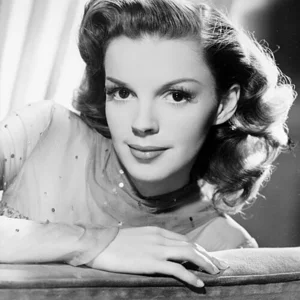

Judy Garland (1922-1969) was an American actress and singer, and one of Hollywood's most iconic figures. She rose to fame at 17 in The Wizard of Oz (1939), becoming the defining star of Hollywood's golden age of musical cinema. Her extraordinary voice and tragic life story made her a symbol of 20th-century popular culture.
Judy Garland(1922 — 1969)
Judy Garland
États-Unis
9 min read
Frequently asked questions
Famous Quotes
« Always be a first-rate version of yourself, instead of a second-rate version of somebody else.»
« I've always taken 'The Wizard of Oz' very seriously, you know.»
Key Facts
- 1922: Born Frances Ethel Gumm in Grand Rapids, Minnesota
- 1939: Played Dorothy in The Wizard of Oz, a worldwide hit featuring the iconic song Over the Rainbow
- 1954: Nominated for the Academy Award for Best Actress for A Star Is Born
- 1961: Legendary concert at Carnegie Hall, widely considered one of the greatest live performances in history
- 1969: Died in London at the age of 47
Works & Achievements
Musical film directed by Victor Fleming in which Judy Garland plays Dorothy. Her first major film role earned her a special honorary Academy Award and the film remains one of the most-watched movies in American cinema history.
Musical film directed by Vincente Minnelli, who would later become her husband. A critical and popular success, it cemented Judy Garland's status as one of Hollywood's greatest musical actresses.
Musical film directed by George Cukor in which Judy Garland delivers a critically acclaimed performance. Nominated for the Academy Award for Best Actress, the film marked her triumphant comeback after years of personal struggles.
Stanley Kramer's dramatic film about the Nuremberg trials. Judy Garland plays a brief but memorable dramatic role that earned her an Academy Award nomination for Best Supporting Actress, showcasing her versatility as an actress.
Double album recorded at the legendary concert of April 23, 1961. It won five Grammy Awards in 1962, including Album of the Year, and remains one of the most important live recordings in American popular music.
Song written by Harold Arlen and E.Y. Harburg, performed in The Wizard of Oz. It won the Academy Award for Best Original Song and was named the greatest song of the 20th century by the American Film Institute in 2001.
Anecdotes
During the filming of The Wizard of Oz in 1938–1939, MGM producers forced Judy Garland, then 16 years old, to follow a strict diet and gave her amphetamines to keep up with the long shooting days, then sleeping pills so she could rest. This practice, common among major Hollywood studios of the era, destroyed her health and locked her into a drug dependency she never escaped.
The song 'Over the Rainbow,' performed by Judy Garland in The Wizard of Oz, nearly ended up on the cutting room floor — MGM executives felt it was too slow for the film's pace. It was ultimately saved thanks to the persistence of composer Harold Arlen and director Victor Fleming. It won the Academy Award for Best Original Song in 1940 and became one of the most celebrated songs of the 20th century.
Judy Garland's concert at Carnegie Hall in New York on April 23, 1961 is considered one of the greatest live performances in American history. The resulting album, 'Judy at Carnegie Hall,' won five Grammy Awards in 1962, including Album of the Year — an extraordinarily rare honor for a female artist at the time.
Judy Garland was one of the first major Hollywood stars to become an icon of the LGBT+ community. Her funeral in New York on June 27, 1969 coincided with the Stonewall Riots, the spark that ignited the gay liberation movement. Many historians believe that the collective grief surrounding her death contributed to the outburst of anger that night.
MGM required Judy Garland to wear a corset and chest binders to appear younger and slimmer on screen, even though she was already a teenager. The studio also controlled her romantic relationships and private life through strict contracts. Garland later testified that she felt like 'a machine' inside an industrial system that exploited child prodigies with no legal protections whatsoever.
Primary Sources
I was born at the age of twelve on a Metro-Goldwyn-Mayer lot. I was not a child star. I was an adult star who happened to be a child.
They had me on a treadmill. I had to look a certain way, sing a certain way, be a certain age. I was never allowed just to be myself.
Whatever you do, don't let them change who you are. Hollywood will try. But your voice, your real voice, is the only thing that's truly yours.
Miss Garland performed with such authority and passion that the Carnegie Hall audience rose to its feet again and again. It was not merely a concert; it was a communion.
Key Places
Judy Garland's birthplace, where she was born on June 10, 1922. Her childhood home is now a museum dedicated to her memory.
The place where Judy Garland signed her first contract at age 12 and filmed her greatest movies, including The Wizard of Oz. These studios embody the Hollywood studio system of the golden age — the same system that made and broke her career.
The site of her legendary concert on April 23, 1961, widely regarded as one of the greatest live musical events of the 20th century. That night, Judy Garland triumphed before a standing audience for over two hours.
Judy Garland performed multiple times at the London Palladium and found a devoted, passionate audience in England. It was in London that she died on June 22, 1969, in her Chelsea apartment.
A landmark of American vaudeville where Judy Garland gave a series of triumphant concerts in 1951, marking her return to the stage after her dismissal from MGM and cementing her legend as a survivor.