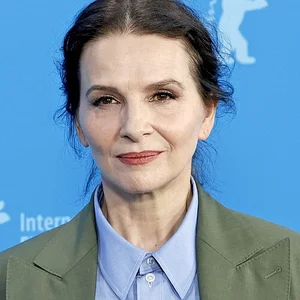

French actress born in 1964 in Paris, a leading figure in world arthouse cinema. She is the first actress to have won the César, the BAFTA, and the Academy Award in the same year (1997) for *The English Patient*, then the Best Actress prize at Cannes for *Certified Copy* (2010).
Juliette Binoche(1964 — ?)
Juliette Binoche
France
8 min read
Frequently asked questions
Key Facts
- Born on March 9, 1964, in Paris, daughter of a film director and an actress
- Brought to prominence by Jean-Luc Godard in *Hail Mary* (1985) and by Leos Carax
- Triple winner in 1997: César, BAFTA, and Academy Award for Best Supporting Actress for *The English Patient*
- Best Actress award at the 2010 Cannes Film Festival for *Certified Copy* by Abbas Kiarostami
- International career working with directors such as Kieślowski, Haneke, Godard, Inarritu, and Kiarostami
Works & Achievements
Her first major film role, in this André Téchiné film awarded at Cannes. Her performance revealed an exceptional actress and launched her onto the French cinema scene.
A Leos Carax film in which she plays a painter who is losing her sight. An epic three-year shoot, it became a cult classic of French cinema in the 1990s.
The first installment of Krzysztof Kieślowski's trilogy on republican values. Her role as a woman devastated by grief earned her the César for Best Actress and the Golden Lion at Venice.
Anthony Minghella's film adapted from Michael Ondaatje's novel. Her performance earned her the Oscar, BAFTA, and César for Best Supporting Actress in the same year — an unprecedented achievement in cinema history.
A Lasse Hallström film in which she plays a wandering chocolatier in a conservative French village. A worldwide success and an Oscar nomination for Best Actress.
A psychological thriller by Michael Haneke exploring guilt and French colonial memory. Awarded at Cannes, it is considered a landmark work of contemporary European cinema.
An Abbas Kiarostami film shot in Tuscany in three languages. Her remarkably subtle performance earned her the Best Actress Prize at the Cannes Film Festival.
Anecdotes
In 1997, Juliette Binoche achieved a unique feat in cinema history: she won the César, the BAFTA, and the Oscar for Best Supporting Actress in the same season for Anthony Minghella's The English Patient. She thus became the first actress to claim all three major awards in a single year, a record that reflects her simultaneous prominence in French, British, and American cinema.
For The Lovers on the Bridge (1991), Leos Carax had a full-scale replica of the famous Parisian bridge built in Lansargues, in the Hérault, since it was impossible to close the real monument in Paris. The shoot lasted three years and nearly collapsed financially on several occasions, yet it gave Juliette Binoche one of her most unforgettable roles — that of a painter who is gradually losing her sight.
Juliette Binoche is also a painter, a passion she has nurtured since adolescence. In 2008, she co-created and performed in the show In-I with British-Bangladeshi choreographer Akram Khan, weaving her own canvases into a performance that blended contemporary dance and visual art, presented in the world's most prestigious venues.
In 2010, Iranian director Abbas Kiarostami invited her to shoot Certified Copy in Tuscany, in three different languages — French, English, and Italian. Binoche's performance, of remarkable subtlety, earned her the Best Actress Prize at the Cannes Film Festival, making her one of the rare actresses to have triumphed at both the Oscars and on the Croisette.
In 2022, Juliette Binoche presided over the jury of the 75th Cannes Film Festival — the very festival that had crowned one of her most important films twelve years earlier. This appointment cemented her status as a global ambassador for auteur cinema, recognized by both French and international institutions.
Primary Sources
At the ceremony on March 24, 1997, Juliette Binoche expressed her surprise and gratitude, thanking Anthony Minghella and declaring that this award belonged to everyone who had contributed to the film.
Juliette Binoche discusses her working method: she refuses to revisit her earlier films before taking on a new role, believing that one must start from scratch, in a state of complete vulnerability, in order to be fully present to a new character.
The jury, presided over by Tim Burton, awarded the Best Actress prize to Juliette Binoche for her role in Abbas Kiarostami's *Certified Copy*, highlighting the complexity and precision of her performance across three languages.
The press kit introduces Julie, the widow of a celebrated composer, who attempts to rebuild her life by severing all ties with her past. Kieślowski describes Binoche as capable of conveying intense emotions with a rare economy of means.
Juliette Binoche was honored for her performance in *Three Colors: Blue*, a national recognition that doubled the Golden Lion she had won at Venice for the same film just months earlier.
Key Places
Juliette Binoche's birthplace, where she grew up, studied at the Conservatoire, and filmed several landmark movies. Paris remains the center of her artistic and personal life.
Juliette Binoche has presented many films in competition here, won the Best Actress award in 2010 for *Certified Copy*, and presided over the jury in 2022.
Home of the Academy Awards ceremony, where Juliette Binoche received her Oscar for Best Supporting Actress for *The English Patient* in March 1997.
The Italian region where Abbas Kiarostami shot *Certified Copy* in 2010; the landscapes around Arezzo and the Tuscan countryside provide the film's intimate and philosophical backdrop.
The village where Leos Carax had a full-scale replica of Paris's Pont-Neuf built for the filming of *The Lovers on the Bridge* (1991), one of the most extraordinary feats in French cinema history.
Typical Objects

Juliette Binoche is known for working intensely on her scripts, annotating them and discussing them at length with directors before and during shoots.

A painter since her teenage years, she regularly uses brushes and canvases to express herself outside of cinema; her works have been exhibited in galleries and incorporated into stage performances.

A symbol of filmmaking, the clapperboard marks the start of each take and enables audio-visual synchronization; it is the iconic tool of every professional film set.

The gilded metal statuette awarded by the Academy of Motion Picture Arts and Sciences embodies Hollywood recognition; Binoche won one in 1997 for *The English Patient*.

The French award presented by the Académie des arts et techniques du cinéma symbolizes excellence as recognized by the national film industry; Binoche won it in 1994 for *Three Colors: Blue*.

Costumes designed specifically for her roles help shape her characters; in *The English Patient*, the outfits worn by nurse Hana reflected the austerity and dedication demanded by a wartime setting.

Set photographers have captured Juliette Binoche at work on countless shoots, helping to build the public image of an actress who is both committed and exacting.
School Curriculum
Vocabulary & Tags
Key Vocabulary
Daily Life
Morning
During filming, Juliette Binoche often rises at dawn to reach the set. She devotes the first hours to preparing her scenes, discussing the day's intentions with the director, and sitting through hair and makeup sessions essential to building her character.
Afternoon
Filming afternoons are shaped by takes, rehearsals, and the long waits that are a hallmark of cinema work. Away from the set, she reads scripts, paints, and prepares upcoming projects; her artistic curiosity draws her toward dance, visual arts, and literature.
Evening
Evenings are often spent memorizing the next day's lines or, during festivals, attending screenings, panel discussions, and meetings with international audiences. She regularly takes part in masterclasses where she shares her vision of the actor's craft with younger generations.
Food
Juliette Binoche follows a balanced diet rooted in French culinary tradition. While filming *Chocolat*, she explored the craft of chocolate-making with genuine curiosity, describing the experience as deeply sensory and enriching for her artistic creativity.
Clothing
On screen, her costumes are carefully designed to reflect the period and social standing of each character. In public life and at festivals, she readily wears European designers, contributing to the image of understated elegance associated with French auteur cinema.
Housing
Juliette Binoche divides her time between Paris — her home city, where her deepest ties remain — and the many filming locations she visits around the world. Hers is the life of an international, nomadic artist who nonetheless proudly claims her French roots and European cultural identity.
Historical Timeline
Period Vocabulary
Liens externes & ressources
Références
Œuvres
Trois couleurs : Bleu
1993