 flip
flipBaked Criollo Empanadas
Baked Criollo Empanadas
Why this dish? Empanadas are the dish of Argentine reunions, the one you prepare in quantity when friends drop by. For an exiled Cortázar, they embodied the Buenos Aires table recreated in Paris, the taste of home folded by hand and shared while talking late into the night.
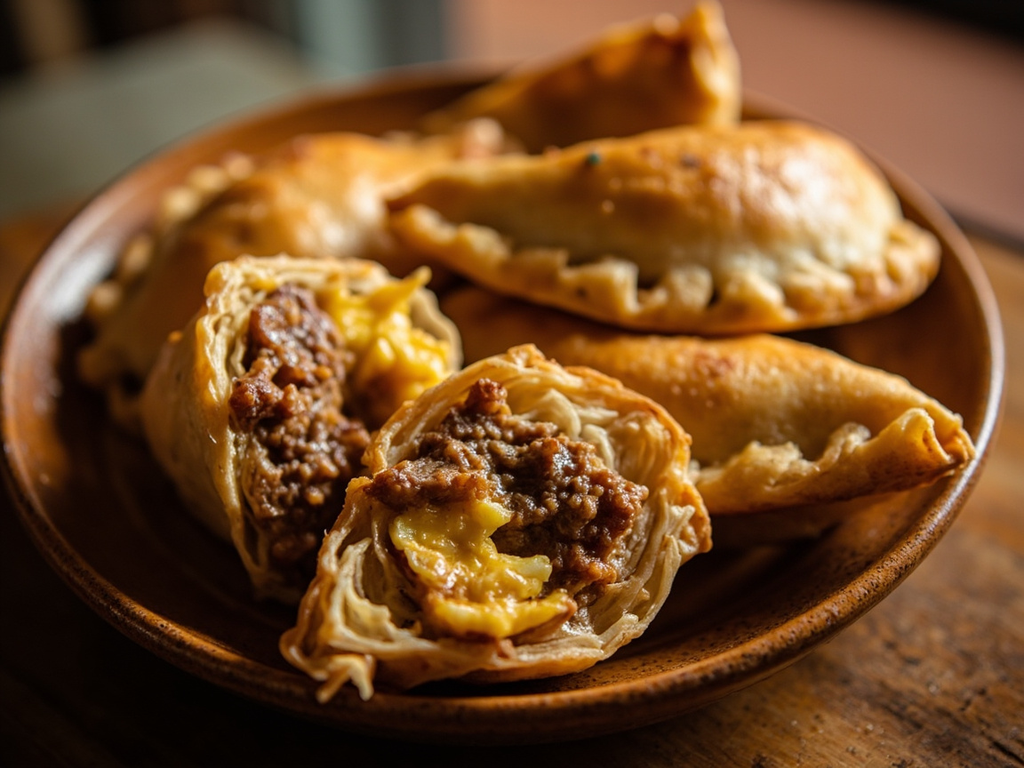
Small pastry turnovers filled with knife-chopped beef, melted onions, cumin, and paprika, sometimes enhanced with olives, hard-boiled egg, and raisins. The edge is sealed with a repulgue, a braid that signs the filling and the skill of whoever made them.
Here there's no argument: the filling is cut with a knife, no machine-ground meat that releases water and leaves you sad. You sauté the onion until it surrenders, add cumin, paprika, and let it cool overnight — that's grandmother's secret. The repulgue you do with your fingers, everyone has their own signature, and if you put an olive inside, warn people, because more than one tooth has been broken in the joy of an empanada.
- •Beef — knife-chopped, generous (filling)
- •Onions — twice the volume of meat (melting base)
- •Cumin and sweet paprika — to taste (criollo spices)
- •Beef fat or lard — for the dough and cooking (fat)
- •Wheat flour — for the dough (wrapping)
- •Olives, hard-boiled eggs, raisins — according to province (optional filling)
Baked Criollo Empanadas
Small pastry turnovers filled with knife-chopped beef, melted onions, cumin, and paprika, sometimes enhanced with olives, hard-boiled egg, and raisins. The edge is sealed with a repulgue, a braid that signs the filling and the skill of whoever made them.
Why this dish? Empanadas are the dish of Argentine reunions, the one you prepare in quantity when friends drop by. For an exiled Cortázar, they embodied the Buenos Aires table recreated in Paris, the taste of home folded by hand and shared while talking late into the night.
Here there's no argument: the filling is cut with a knife, no machine-ground meat that releases water and leaves you sad. You sauté the onion until it surrenders, add cumin, paprika, and let it cool overnight — that's grandmother's secret. The repulgue you do with your fingers, everyone has their own signature, and if you put an olive inside, warn people, because more than one tooth has been broken in the joy of an empanada.
Ingredients (period version)
- Beef — knife-chopped, generous (filling)
- Onions — twice the volume of meat (melting base)
- Cumin and sweet paprika — to taste (criollo spices)
- Beef fat or lard — for the dough and cooking (fat)
- Wheat flour — for the dough (wrapping)
- Olives, hard-boiled eggs, raisins — according to province (optional filling)
Ingredients
- Beef chuck, knife-chopped — 500 g (filling)
- Onions — 3 large, sliced (melting base)
- Ground cumin — 1 tsp (spice)
- Sweet paprika — 1 tbsp (spice and color)
- Empanada dough discs (or homemade flour/lard/water dough) — 24 discs (wrapping)
- Green olives, 2 hard-boiled eggs, raisins — to taste (filling)
- 1 egg yolk — for glazing (finish)
Method
- Sauté the onions over low heat in fat until translucent, add the knife-chopped meat and sear quickly.
- Season with cumin, paprika, and salt; let cool completely (ideally overnight) so the filling holds together.
- Fill each disc with a spoonful of filling, a piece of hard-boiled egg, an olive, and a few raisins.
- Moisten the edge, fold into a half-moon, and seal with a braided repulgue.
- Brush with egg yolk and bake at 200 °C for 15–18 minutes until golden.
How it was made : Each Argentine province has its empanada: Salta's is juicy and spicy, Buenos Aires's is milder with raisins and egg. Baked or fried in fat, they were once cooked in the clay ovens (horno de barro) of criollo patios, in whole batches to feed the entire table.
The contemporary twist : Mark each repulgue with a different shape to code the filling (beef, chicken, cheese) — an edible alphabet that would have amused the author of *Hopscotch*.
Julio Cortázar · Charactorium