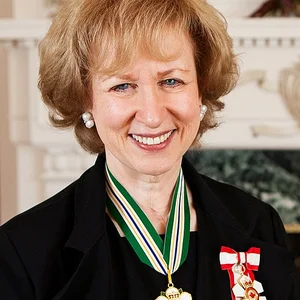

Kim Campbell is a Canadian politician, the first woman to hold the office of Prime Minister of Canada in 1993. A member of the Progressive Conservative Party, she led the country for a few months before being defeated in the federal election.
Kim Campbell(1947 — ?)
Kim Campbell
Canada
9 min read
Frequently asked questions
Key Facts
- 1947: Born in Port Alberni, British Columbia
- 1993: Becomes the first female Prime Minister of Canada
- 1993: Leads the Progressive Conservative Party following Brian Mulroney's resignation
- October 1993: The Conservative Party suffers a historic defeat in the federal election, reducing its seats from 156 to 2
- After 1993: Diplomatic career, notably as Consul General of Canada in Los Angeles
Works & Achievements
As Minister of Justice, Kim Campbell steered Bill C-17 into law, strengthening firearms control across Canada. This reform, passed in the wake of the 1989 Montréal École Polytechnique massacre, stands as one of her most enduring legislative contributions.
Still serving as Minister of Justice, she introduced legislation redefining sexual assault offences and restricting the use of a victim's sexual history as evidence in court. The reform was widely praised by feminist organizations as a major step forward.
The first and only term of a woman at the head of the Canadian federal government. Though brief, it symbolizes a glass ceiling shattered in Canadian politics and has inspired generations of women in public life.
An autobiographical work in which Kim Campbell reflects on her career, Canadian political culture, and the specific obstacles women face in politics. The book is regarded as an important document on female leadership.
At the helm of this organization bringing together former democratic heads of state and government, Kim Campbell worked to strengthen democratic institutions worldwide. The role extended her commitment to ethical governance well beyond Canada.
Anecdotes
In June 1993, Kim Campbell became Prime Minister of Canada by winning the leadership of the Progressive Conservative Party following Brian Mulroney's resignation. She was the first woman to hold this position in Canadian history. Her victory was hailed as a powerful symbol of political openness in a country that had never entrusted the reins of the federal government to a woman.
Kim Campbell holds the unenviable record of the shortest prime ministerial term in twentieth-century Canada: she governed for only 132 days. In the October 1993 election, the Progressive Conservatives collapsed spectacularly, falling from 156 seats to just 2. It stands as one of the most crushing electoral defeats in Canadian political history.
Before becoming Prime Minister, Kim Campbell had already achieved two historic firsts: she was the first woman to serve as Minister of Justice and Attorney General of Canada (1990), and then the first woman to serve as Minister of National Defence (1993). By holding that last portfolio, she also became the first woman within NATO to head a defence ministry.
During the 1993 election campaign, Kim Campbell remarked that a campaign was not the right time to debate complex social policy. The comment was immediately ridiculed by her opponents, helped undermine her image, and fuelled the narrative of a leader out of touch with the concerns of ordinary citizens.
After her defeat, Kim Campbell did not disappear from public life. She was appointed Consul General of Canada in Los Angeles, then became Secretary General of the Club de Madrid, an organization bringing together former heads of state and government dedicated to strengthening democracy around the world. She has remained a respected international voice on questions of democratic governance.
Primary Sources
I was not seeking power for its own sake, but I believed that I had something to offer Canada at a critical moment in its history. I wanted to show that it was possible to do politics differently.
Today, a new page is being written in the history of Canada. Together, we will build a country worthy of its promises — a Canada that is open, just, and competitive in the world.
An election is no time to discuss serious issues. You can't have a debate on the nature of Canadian social programs in 47 days.
Justice must be accessible to all Canadians, regardless of their background, their language, or their economic situation. My role is to ensure that the law truly serves equity.
Key Places
Birthplace of Kim Campbell, born on March 10, 1947. A small industrial town on Vancouver Island, it embodies the modest roots and western Canadian background from which the future Prime Minister emerged.
Kim Campbell earned her bachelor's degree in political science here in 1969, and briefly taught at the university. It was in this academic environment that her political thinking and interest in governance took shape.
On Parliament Hill, along the Ottawa River, Kim Campbell served as a Member of Parliament, then as a Cabinet minister, and finally as Prime Minister. It was here that she made her mark on history, from 1988 to 1993.
The official residence of the Governor General of Canada, Rideau Hall is where Kim Campbell was sworn in as Prime Minister on June 25, 1993, in accordance with Canadian constitutional protocol.
The official residence of the Prime Minister of Canada, where Kim Campbell lived during her 132-day tenure in the summer and autumn of 1993. She was the first woman to reside there as head of government.
The federal electoral district Kim Campbell represented in the House of Commons from 1988. This urban, cosmopolitan Vancouver riding symbolizes her strong ties to western Canadian politics.
Typical Objects

A tradition inherited from the British system, the red leather box contains confidential documents and urgent files that Canadian ministers take home to work on in the evenings. Kim Campbell accessed it daily during her tenure as Minister of Justice, Minister of National Defence, and then as Prime Minister.

This foundational text repatriated by Pierre Elliott Trudeau stood at the heart of Kim Campbell's work as Minister of Justice. She was responsible for ensuring that all legislation complied with the Canadian Charter of Rights and Freedoms contained within it.

Signed by Brian Mulroney and entering into force in January 1994, NAFTA had been finalized under the Campbell government. This trilateral treaty between Canada, the United States, and Mexico was one of the major economic files she inherited.

As the first female Prime Minister, Kim Campbell faced the question of the formal dress code — traditionally shaped around men. Her clothing choices — particularly her tailored suits — were scrutinized by the media, reflecting the specific challenges women encounter at the highest levels of power.

A symbol of Canadian parliamentary power in Ottawa, the dispatch box in the House of Commons is the place from which the Prime Minister defends government policy during Question Period. Campbell faced the opposition led by Jean Chrétien there on a daily basis.

As Minister of National Defence and then as Prime Minister, Kim Campbell received daily reports from the Canadian Security Intelligence Service (CSIS). These briefings on national security threats were a core responsibility — and one rarely held by a woman at the time.
School Curriculum
Vocabulary & Tags
Key Vocabulary
Tags
Daily Life
Morning
The Prime Minister begins her day very early, usually before 7 a.m., by reading national press reviews (Globe and Mail, La Presse, Ottawa Citizen) and classified intelligence briefings prepared by the Privy Council Office. An initial meeting with her chief of staff allows her to prioritize the day's agenda: preparation for Question Period in the House, Cabinet meetings, or sessions with foreign delegations.
Afternoon
The afternoon is dominated by Question Period in the House of Commons, a high-pressure political ritual in which the opposition attempts to destabilize the government. Kim Campbell must respond live, without notes, on every issue of the day. She then moves on to ministerial meetings, the signing of orders-in-council, and sessions with lobbyists and provincial representatives within the framework of Canadian federalism.
Evening
Evenings are often devoted to protocol obligations: official state dinners with foreign heads of government at Rideau Hall, diplomatic receptions, or Progressive Conservative Party events across the country. Kim Campbell must maintain a national presence while managing an imminent election campaign in 1993. She also prepares her files for the following day, often late into the night at 24 Sussex Drive.
Food
A Canadian Prime Minister's diet in 1993 is largely shaped by the official schedule: working lunches with ministers or journalists, and formal dinners featuring carefully composed menus showcasing Canadian products (Pacific salmon, Maritime lobster, Prairie meats). Outside official obligations, Kim Campbell favors simple, varied food reflecting her background as an active woman from the West Coast.
Clothing
Kim Campbell adopts a professional and understated style, built around well-tailored women's suits, often in classic tones (navy, burgundy, grey). As the first woman to hold several of these positions, her outfits receive far more media scrutiny than those of her male counterparts. She chooses clothing that asserts her authority without sacrificing a confident femininity, refusing to adopt an androgynous image in order to appear more credible.
Housing
Kim Campbell resides at 24 Sussex Drive, the official residence of the Prime Minister in Ottawa — a large Victorian mansion built in 1867 overlooking the Ottawa River. Despite its grand appearance, the house is well known for its aging infrastructure. She has household staff, RCMP (Royal Canadian Mounted Police) officers for her security, and a private office within the residence for working outside official hours.
Historical Timeline
Period Vocabulary
Liens externes & ressources
Références
Œuvres
Réforme de la loi sur les armes à feu (C-17)
1991
Réforme du Code criminel sur les agressions sexuelles
1992
Mandat de Premier ministre du Canada
25 juin – 4 novembre 1993
Time and Chance — Mémoires politiques
1996
Secrétaire générale du Club de Madrid
2001-2004