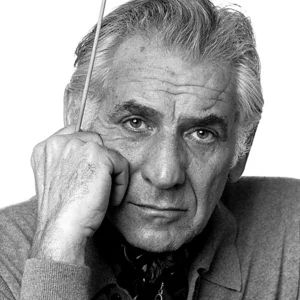

American composer and conductor (1918–1990), Leonard Bernstein led the New York Philharmonic and composed major works blending classical music and jazz. He is world-renowned for the musical West Side Story (1957).
Leonard Bernstein(1918 — 1990)
Leonard Bernstein
États-Unis
9 min read
Frequently asked questions
Famous Quotes
« To achieve great things, two things are needed: a plan, and not quite enough time.»
« Music can name the unnameable and communicate the unknowable.»
Key Facts
- Born on August 25, 1918, in Lawrence (Massachusetts), died on October 14, 1990, in New York
- Music Director of the New York Philharmonic from 1958 to 1969
- Composed West Side Story in 1957, a modern adaptation of Romeo and Juliet
- Hosted the Young People's Concerts on American television, bringing classical music to a wide audience
- Conducted the Berlin Wall fall concert on December 25, 1989, featuring Beethoven's Ninth Symphony
Works & Achievements
A Broadway musical inspired by Romeo and Juliet, transposed into the world of New York street gangs in the 1950s; a masterpiece that bridges Broadway, jazz, and classical music, known worldwide largely through the 1961 film (ten Academy Awards).
Bernstein's first symphony, inspired by the biblical Book of Jeremiah; it earned him the New York Music Critics Circle Award in 1944 and established his reputation as a serious composer beyond Broadway.
Inspired by W.H. Auden's poem of the same name, this symphony for piano and orchestra reflects the existential anxiety of the postwar era and the search for meaning that defined the generation of the 1940s.
A musical following three sailors on leave in New York City during World War II; Bernstein's first major stage success, blending humor, jazz energy, and infectious melody.
A satirical adaptation of Voltaire's tale in operetta form; the score, remarkable for its virtuosity and irony, has gone through many revisions and remains a cornerstone of the American repertoire.
A monumental work for singers, dancers, and orchestra commissioned for the opening of the Kennedy Center in Washington; it blends liturgical music, rock, blues, and jazz in a meditation on faith and doubt.
A series of educational concerts filmed for CBS with the New York Philharmonic, designed to explain classical music to young audiences; a landmark in music education that was broadcast in dozens of countries.
Anecdotes
On November 14, 1943, the young Bernstein — just 25 years old and serving as assistant conductor — stepped in at the last minute for an ailing Bruno Walter at the helm of the New York Philharmonic. With no prior rehearsal, he conducted a demanding program broadcast live on CBS national radio. The following day, The New York Times ran a front-page story about him: his career was launched in a single night.
The 1957 premiere of West Side Story was the fruit of an exceptional collaboration between Bernstein (music), Stephen Sondheim (lyrics), Arthur Laurents (book), and Jerome Robbins (choreography). The show transplants Romeo and Juliet to the streets of New York, set against rival gangs, and for the first time blended jazz, Latin dance, and classical music on a Broadway stage.
Between 1958 and 1972, Bernstein hosted the celebrated “Young People’s Concerts” on American television with the New York Philharmonic, broadcast on CBS to millions of viewers. With rare pedagogical gifts and infectious enthusiasm, he explained to children and teenagers what a symphony is, what ‘style’ means, and what jazz is. These programs are still regarded today as models of music education.
In December 1989, just weeks after the fall of the Berlin Wall, Bernstein conducted Beethoven’s Ninth Symphony in the reunified city, with musicians from both Germanys and several allied nations. In the Ode to Joy, he symbolically replaced the word ‘Freude’ (joy) with ‘Freiheit’ (freedom), as a tribute to the historic moment. The concert was broadcast in around twenty countries and remains one of the most moving events in the musical history of the 20th century.
Bernstein was known for his spectacular conducting style: he would leap, bend, and spin on the podium, to the point that some musicians said they had to watch him constantly to avoid losing the beat. Despite criticism from purists who found this style overly theatrical, his communicative energy captivated orchestras around the world and turned every concert into a genuine event.
Primary Sources
In this collection of essays and imaginary dialogues with a 'Melomane,' Bernstein argues that music is a universal language accessible to everyone, and explores the tension between 'serious' music and popular music, refusing to place either above the other.
In these six filmed lectures at Harvard University, Bernstein explores the connections between music and human language drawing on Chomsky's linguistics. He articulates his conviction that tonality is universal and that music can 'name the unnameable and communicate the unknowable.'
In the episode 'What is a Melody?'
Following his last-minute substitution on November 14, 1943, Bernstein wrote to his family describing the event and the excitement it generated in the American press, revealing his keen awareness that he had just experienced a decisive turning point in his career.
In this second collection of essays, Bernstein deepens his thinking on the relationships between classical music, jazz, and musical theater, making the case for an American art rooted in all of the country's cultural traditions.
Key Places
Home of the New York Philharmonic, of which Bernstein was music director from 1958 to 1969; it was here that he gave some of his most memorable concerts and recorded his televised Young People's Concerts.
Bernstein lived in this prestigious building on Central Park West, at the heart of New York cultural life; his apartment was the setting for legendary gatherings bringing together artists, intellectuals, and political figures.
Bernstein studied here from 1935 to 1939 and returned in 1973 to deliver the celebrated Norton Lectures ('The Unanswered Question'), filmed and broadcast on American television.
Summer music center of the Boston Symphony Orchestra where Bernstein studied under Serge Koussevitzky and to which he regularly returned as teacher and conductor, making Tanglewood one of his most cherished artistic residences.
It was in this Berlin concert hall that Bernstein conducted, on December 25, 1989, his historic performance of Beethoven's Ninth Symphony to celebrate the fall of the Wall, before an audience drawn from both newly reunified Germanys.