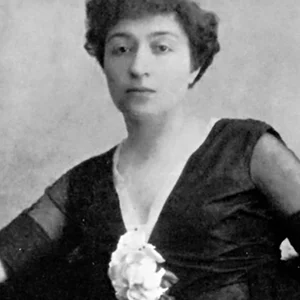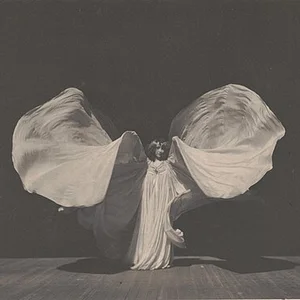

American dancer (1862–1928), pioneer of modern dance and stage lighting design. Her serpentine dance with silk veils lit by colored electric lights made her famous at the Folies Bergère in Paris from 1892 onward, turning her into an icon of the Belle Époque and Art Nouveau.
Loïe Fuller(1862 — 1928)
Loïe Fuller
États-Unis
10 min read
Frequently asked questions
Key Facts
- 1891: invents the serpentine dance in New York, combining silk veils and colored lighting
- 1892: triumphs at the Folies Bergère in Paris, becoming an international star
- 1900: has her own theater at the Paris Universal Exposition
- Files several patents for her innovations in stage lighting
- Inspires many Art Nouveau artists, including Toulouse-Lautrec and Auguste Rodin
Works & Achievements
Her founding work, created accidentally around 1891 and perfected for her Paris debut in 1892. Silk veils animated by wands and illuminated by colored spotlights create a hypnotic vision of flowing forms, simultaneously revolutionizing both dance and theatrical staging.
One of her most spectacular numbers, in which Fuller danced on a glass panel lit from below, creating the illusion of moving amid flames. This show required a complex technical setup and became one of her most celebrated signatures.
Luminous spectacles with atmospheric effects in which Fuller played with color gradients to evoke natural phenomena. These creations perfectly illustrated her ambition to fuse science, nature, and art into a total sensory experience.
An ambitious production blending dance, light, music, and symbolist staging around the theme of Salome, very much in vogue during the Belle Époque. This total spectacle had a lasting influence on avant-garde theater and the scenic research of the twentieth century.
Memoirs published first in French and then in English, in which Fuller recounts her American childhood, the accidental discovery of her dance, and her conquest of Paris. A valuable historical document on the artistic and scientific life of the Belle Époque, written in her own hand.
Loïe Fuller filed several patents in the United States to protect her inventions: rod systems built into costumes, colored electric lighting devices, and projections onto fabric. These patents bear witness to her unique genius at the crossroads of art and technology.
Anecdotes
Loïe Fuller discovered her famous dance by chance around 1891, during a theater rehearsal in New York. Wearing a long Indian silk skirt that was much too large for her, she improvised some movements and realized that the fabric, animated by her arms, created undulating, hypnotic shapes under the electric stage lights. Far from being embarrassed, she immediately understood that she had invented something revolutionary.
Passionate about science, Loïe Fuller collaborated with researchers to develop luminous materials for her costumes. She took an interest in work on phosphorescent salts and visited Marie Curie's laboratory to explore the possibilities of radioactivity — a visit that became legendary, even though Fuller prudently decided against incorporating radium into her performances.
A true pioneer of artistic copyright, Loïe Fuller filed numerous patents to protect her innovations: the hidden rods inside her veils to animate them, her colored lighting systems, her light projection effects. She fought countless legal battles against imitators who copied her acts, and often lost, as courts at the time did not yet recognize copyright over choreography.
Auguste Rodin was so captivated by Loïe Fuller's dances that he produced sketch after sketch trying to capture her moving silhouettes on paper, declaring that she was at once a woman, a butterfly, and a flame. Henri de Toulouse-Lautrec, for his part, created a celebrated series of lithographs depicting her, making her colorful, flowing forms emblematic of an entire era.
In 1900, at the Paris Universal Exhibition, Loïe Fuller received an exceptionally rare honor: having her own theater named after her on the exhibition grounds, designed by architect Henri Sauvage in the Art Nouveau style. On its stage she welcomed the young Isadora Duncan, whom she had met and decided to support, thus opening the doors of all of Europe to her.
Primary Sources
I was not dancing, I did not even know that I was moving in any particular way. I was simply responding to the music with my whole body, and the silk was responding to my body. It was only when I saw the faces of the audience that I understood something extraordinary had just taken place.
The invention relates to a costume for dancers consisting of a skirt of large dimensions whose lower edges are attached to rigid rods held in the dancer's hands, enabling her to create varied shapes and movements of great amplitude during the performance.
Miss Loïe Fuller achieved an extraordinary success with her silk dance. Never before had such an effect of light and movement been achieved on a Parisian stage: the entire house seemed hypnotized by those waves of color that were born and died in the darkness.
Electric light is my true paintbrush. Silk is my canvas. What I seek to paint is movement itself — not a body that moves, but movement made visible, like a thought one could see.
Key Places
Birthplace of Marie Louise Fuller, born on January 22, 1862. In a remarkable coincidence, the town already bore the name Fuller before her birth, which later earned her many jokes about a destiny that seemed written in advance.
The grand music-hall on the Boulevard Montmartre where Loïe Fuller made her French debut in November 1892 and achieved worldwide fame. She refined her light dances there over several seasons and created some of her most celebrated performances.
At the 1900 Universal Exposition, Loïe Fuller was one of the rare artists to have a theater bearing her name on the grounds, designed by architect Henri Sauvage in the Art Nouveau style. Millions of international visitors discovered her performances there.
Loïe Fuller settled permanently in Paris, the city where she was adored by artists and audiences alike, and established her creative studios there. She died on January 1, 1928, having devoted the greater part of her artistic life to the French capital.
It was in New York's theaters that Loïe Fuller developed and first performed her Serpentine Dance around 1891, before her departure for Paris, which would bring her worldwide fame and the recognition that America had not yet granted her.
Typical Objects

Dozens of meters of lightweight silk formed the fundamental costume-tool of Loïe Fuller. She chose her fabrics with extreme care for the way they captured and diffused light, and had them dyed using recipes she kept jealously secret.

Loïe Fuller concealed long rigid rods inside her skirts, held in her hands to extend her arms and sweep the veils into arcs, spirals, and waves. This patented system allowed her to create shapes impossible to produce with the human body alone.

Fuller was one of the first artists to use electricity as an artistic medium in its own right. She designed her own lighting effects and worked with engineers to create custom-built spotlights and colored filters.

Placed in front of the spotlights, these tinted plates transformed white light into colored beams that bathed Fuller's veils in shifting hues. She experimented with hundreds of color combinations to achieve her most dramatic effects.

Fuller used mirror rigs to multiply the images of her dance and create effects of infinite depth on stage. These innovations — spectacular for their time — were among her most jealously guarded patents and trade secrets.

Working with chemists, Fuller experimented with phosphorescent powders applied to her costumes to make them glow in the dark. This research eventually led her to the laboratory of Marie Curie, with whom she discussed the luminous properties of radioactive materials.
School Curriculum
Vocabulary & Tags
Key Vocabulary
Tags
Daily Life
Morning
Loïe Fuller began her day in her Parisian workshops, surrounded by seamstresses and assistants. She supervised the meticulous making and upkeep of her silk costumes, checked the shades of the fabrics, and ensured that the aluminum rods hidden inside the skirts were properly secured. She also dealt with a voluminous correspondence with her agents, theater directors, and the engineers working on her stage apparatus.
Afternoon
Afternoons were devoted to stage rehearsals — often long hours spent testing lighting effects with her technicians. Fuller operated the spotlights herself, adjusted the colored filters, and endlessly experimented with new combinations of light. She regularly received engineers and chemists to refine her phosphorescence effects, displaying a scientific curiosity rare for an artist of her era.
Evening
On performance nights, Fuller personally checked every spotlight and every veil before taking the stage. After the show, her dressing room became a salon where Rodin, Toulouse-Lautrec, scientists, and journalists came in succession to express their admiration. On nights without a performance, she frequented the brasseries and literary salons of artistic Paris, where she was universally recognized and celebrated.
Food
Leading an intensely physical life — her performances were genuine athletic feats, with her arms lifting dozens of meters of silk for long stretches at a time — Fuller had to maintain her energy and stamina. Having settled in Paris since the 1890s, she had adopted French cuisine and enjoyed convivial meals with the artists around her. Her European and American tours required her to adapt to very different cuisines, which she described with curiosity in her letters.
Clothing
Offstage, Loïe Fuller dressed with the practical elegance of the modern Belle Époque woman: blouses, long skirts, and the wide-brimmed hats typical of the period. Onstage, her equipment was unique in the world: dozens of meters of lightweight silk, carefully calculated draping, and hidden rods that she manipulated alone by the strength of her arms for hours on end — a precision instrument as much as a costume.
Housing
Loïe Fuller lived in a Paris apartment she had decorated to her own taste, filled with Art Nouveau objects, souvenirs from her tours, and materials for her experiments. She lived with her companion and collaborator Gab Sorère (Gabrielle Bloch), who managed part of her affairs and accompanied her on all her travels. Their life together, discreet by the standards of the time, was a remarkable expression of independence for two women at the turn of the nineteenth and twentieth centuries.
Historical Timeline
Period Vocabulary
Liens externes & ressources
Références
Œuvres
La Danse Serpentine
1891-1892
La Danse du Feu
Vers 1895
La Danse des Nuages et de l'Arc-en-ciel
Vers 1896-1900
La Tragédie de Salomé
1907
Quinze ans de ma vie (autobiographie)
1908
Innovations scéniques brevetées (costumes et dispositifs d'éclairage)
1893-1900