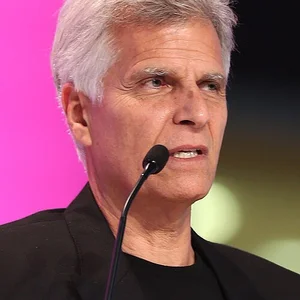

American swimmer born in 1950, considered one of the greatest in the history of swimming. At the 1972 Munich Olympic Games, he won seven gold medals, each accompanied by a world record, a feat that remained unmatched until Michael Phelps.
Mark Spitz(1950 — ?)
Mark Spitz
États-Unis
6 min read
Frequently asked questions
Key Facts
- Born on February 10, 1950, in Modesto, California.
- Won 2 team gold medals at the 1968 Mexico City Olympic Games.
- Won 7 gold medals at the 1972 Munich Olympic Games, with 7 world records.
- Held the record for the most golds in a single Olympics until Michael Phelps in 2008.
- Attempted an Olympic comeback in 1992, at age 42, without success.
Works & Achievements
A historic feat: seven Olympic titles in a single Olympics, each set alongside a world record — a longevity record that stood unmatched until 2008.
Spitz dominated short-distance freestyle and set world benchmarks in these premier events.
He established himself as the undisputed master of the butterfly, a demanding stroke in which he shattered the clock.
Two Olympic relay titles that launched his international career despite his personal disappointment.
In Winnipeg, he won five gold medals — the first great display of his superiority.
Honoring the best amateur American athlete of the year, a crowning achievement before Munich.
Anecdotes
At the 1972 Munich Games, Mark Spitz won seven gold medals in a single Olympics, and each of his victories came with a new world record. No one had ever achieved such a feat, which would remain unmatched for thirty-six years, until Michael Phelps in 2008.
Before the 1968 Mexico City Games, the young Spitz had confidently declared that he would win six gold medals. In the end, he won only two, both in relays, and experienced those Games as a humiliation. That disappointment fueled his stunning redemption at Munich four years later.
Spitz swam with a thick mustache, at a time when most swimmers shaved to gain speed. He later joked that a Soviet coach had asked him whether it slowed him down: he replied that it “deflected water away from his mouth,” and the following year the entire Soviet team was wearing one.
On 5 September 1972, in the midst of the competition, a Palestinian commando group took hostage and then murdered eleven members of the Israeli delegation. Spitz, an American athlete of Jewish faith and a star of the Games, was then quietly evacuated from Munich under police protection out of fear that he might become a target.
In 1992, at the age of 41, Spitz attempted a comeback to qualify for the Barcelona Games. Despite intense training, he failed to reach the qualifying times, proving just how much elite swimming had evolved and grown younger since his glory days in the 1970s.
Primary Sources
Mark Spitz won his seventh gold medal, setting a seventh world record — an unprecedented performance in the history of the Olympic Games.
The image of the swimmer posing with his seven gold medals around his neck becomes one of the most famous sports photographs of the decade.
He had promised six gold medals and won only two; he himself called these Games the greatest disappointment of his career.
Key Places
Birthplace of Mark Spitz in 1950. It was in California that he made his early start in swimming.
Home of the Santa Clara Swim Club, where the young Spitz trained under George Haines and revealed his talent.
University where Spitz studied and trained with James 'Doc' Counsilman, one of the greatest swimming coaches in history.
Olympic pool of the 1972 Games where Spitz won his seven gold medals and broke seven world records.
Host city of the 1968 Olympic Games, where Spitz suffered a bitter disappointment before his Munich redemption.
Typical Objects

The seven gold medals won in Munich in 1972, a symbol of his historic feat. The photograph of Spitz wearing them all together has become iconic.

Equipment that protects the eyes from chlorine and improves visibility underwater. Their use in competition became widespread precisely during the 1970s.

A short, tight-fitting nylon swimsuit worn by swimmers of the era, long before modern technological bodysuits. It prioritized lightness and freedom of movement.

A time-measuring instrument essential to training and competition. In Munich, electronic timing to the hundredth of a second validated his world records.

A small raised platform from which the swimmer launches into the pool. The quality of the start there is crucial for gaining precious fractions of a second.

His thick mustache became a genuine personal emblem, going against the grain of swimmers' shaving habits. It helped forge his media image as a star.
School Curriculum
Vocabulary & Tags
Key Vocabulary
Tags
Daily Life
Morning
An elite swimmer's day begins very early, often before sunrise, with a first training session in the pool. Spitz would swim thousands of meters to work on his endurance and technique even before breakfast.
Afternoon
The afternoon was devoted to a second water session, complemented by strength training and flexibility exercises. At Indiana University, this routine also revolved around classes and student obligations.
Evening
The evening was for recovery: rest, body care, and restorative sleep were essential to handle considerable training volumes. Spitz, a young man in the media spotlight, also had to cope with growing fame.
Food
A swimmer expending enormous energy followed a very high-calorie diet, rich in carbohydrates and proteins. The dietary approaches of the 1970s, however, remained empirical, far from the scientific sports nutrition of today.
Clothing
In both training and competition, Spitz wore a simple skintight nylon swimsuit, a cap, and, from the 1970s onward, swimming goggles. Outside the pool, he adopted the casual style of American youth of the era.
Housing
As a student-athlete, he lived on the Indiana University campus, in a setting organized around training and studies. His fame later opened the doors to a comfortable lifestyle tied to his advertising contracts.
Historical Timeline
Period Vocabulary
Liens externes & ressources
Références
Œuvres
Sept médailles d'or aux Jeux de Munich
1972
Records du monde du 100 m et 200 m nage libre
1972
Records du monde du 100 m et 200 m papillon
1972
Médailles d'or aux Jeux de Mexico
1968
Cinq titres aux Jeux panaméricains
1967
Trophée Sullivan
1971