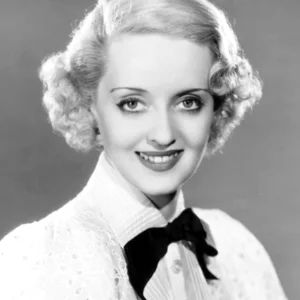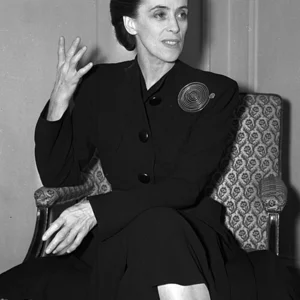

Martha Graham (1894-1991) was an American dancer and choreographer, founder of modern dance. She revolutionized the art of choreography by breaking away from classical ballet, developing a technique based on contraction and release of the body.
Martha Graham(1894 — 1991)
Martha Graham
États-Unis
9 min read
Frequently asked questions
Famous Quotes
« Movement never lies.»
« The body says what words cannot express.»
Key Facts
- 1894: Born in Allegheny, Pennsylvania
- 1926: Founded the Martha Graham Dance Company in New York
- 1930: Creation of 'Lamentation', an iconic work of modern dance
- 1944: Creation of 'Appalachian Spring' with music by Aaron Copland, awarded the Pulitzer Prize
- 1976: Presidential Medal of Freedom, the highest civilian honor in the United States
- 1991: Died in New York at age 96, having created more than 180 choreographies
Works & Achievements
A choreographic solo in which Graham, encased in a tube of jersey fabric, embodies universal grief through twisting and contracting movements. This eight-minute piece is considered one of the founding works of modern dance.
A triptych inspired by Native American and Catholic rituals from New Mexico, hailed as a masterpiece from its premiere. The work illustrates Graham's ability to draw on non-European cultural sources to renew the language of dance.
Graham's first work to weave historical American texts — including the Declaration of Independence — into the choreography. A true artistic manifesto, it asserts the plural, democratic identity of the nation at a time of fascist threat.
Commissioned by the Library of Congress with a score by Aaron Copland and sets by Isamu Noguchi, this piece celebrates pioneer life in America. The score won the Pulitzer Prize in 1945, and the work is now a symbol of American cultural identity.
Inspired by the Greek myth of Medea, this piece explores jealousy and romantic revenge with visceral intensity. Isamu Noguchi's sets and Graham's performance showcase her mastery of ancient myth as a vehicle for exploring psychological interiority.
Graham's first full-evening ballet, drawn from Aeschylus's *Oresteia*, explores guilt and redemption through Clytemnestra's eyes in the Underworld. Considered the pinnacle of her dramatic work, it reveals the full depth of her art of dance-theater.
Martha Graham's final creation, choreographed at age 96 to the music of Scott Joplin, this light and playful piece bears witness to her undiminished creative vitality until the very end of her life. It proves that modern dance is not condemned to solemnity alone.
Anecdotes
Martha Graham didn't discover dance until she was sixteen, when she attended a performance by Ruth St. Denis in Los Angeles. This late revelation — unusual for a professional dancer — didn't stop her from becoming the most influential figure in American modern dance. Her father, a physician, used to say that the body never lies — an intuition that would become the philosophical cornerstone of her entire technique.
In 1930, for her piece *Lamentation*, Martha Graham appeared on stage wrapped in a tube of stretchy jersey fabric, leaving only her face, hands, and feet visible. This radical costume, which sculpted and distorted the body, deeply shocked audiences accustomed to classical ballet. A tearful woman approached her after the performance and told her she had never seen anyone express her own grief so faithfully.
As Nazism rose to power, the German government invited Martha Graham to perform at the **1936 Berlin Olympics**. She refused outright, declaring that no true artist could lend their name to such a regime. This courageous stand earned her lasting admiration in American artistic and intellectual circles.
The collaboration between Martha Graham and composer **Aaron Copland** gave birth to *Appalachian Spring* in **1944**, commissioned by the Library of Congress. The sets were designed by sculptor **Isamu Noguchi**, exemplifying the fusion of the arts that defined Graham's work. The score won the **Pulitzer Prize** in **1945**, cementing the piece as a symbol of American cultural identity.
Martha Graham continued to choreograph long after she stopped dancing, creating new works well into her eighties. Her final creation, *Maple Leaf Rag*, was performed in **1990** to the music of **Scott Joplin** when she was 96 years old. She proved that an artist can remain creative until the very end of their life — the body may fade, but the vision endures.
Primary Sources
I believe that we learn by practice, whether we do something well or not. The way to learn is assuredly to try everything, to do everything, to participate in everything that stirs our curiosity.
Movement never lies. It is a form of truth we cannot afford to lose in our world of false appearances.
Dance is the hidden language of the soul. It is a communication of humanity to humanity through the body, that instrument which we all have in common.
There is a vitality, a life force, an energy, a quickening that is translated through you into action, and because there is only one of you in all of time, this expression is unique. And if you block it, it will never exist through any other medium and it will be lost.
Key Places
Martha Graham's hometown, where she grew up in a middle-class family. It was here that her physician father taught her the importance of body language — a principle that would guide her entire artistic approach.
Founded in 1926 in Manhattan, this studio was the laboratory where Graham developed her revolutionary technique and trained generations of dancers. It remains to this day the world center for the transmission of the Graham technique.
Graham taught her technique here for decades, shaping an entire generation of choreographers and dancers. This legendary institution allowed American modern dance to gain international academic recognition.
Graham deposited her archives here and received the commission for *Appalachian Spring* in 1943, sponsored by the Elizabeth Sprague Coolidge Foundation. The library holds one of the most significant documentary collections on her work.
During her first European tour, Graham performed in Paris, where French artistic circles gave her an enthusiastic reception. This recognition definitively established American modern dance as a major art form on the world stage.
Typical Objects

A stretchy, form-fitting fabric used by Graham, notably for 'Lamentation'. This material allowed her to visually sculpt contraction and twisting movements, transforming the costume into a living dramatic extension of the body.

Graham was one of the first choreographers to systematically embrace floor work in concert dance. These mats embodied her conviction that the relationship between the body and the earth — symbolizing fall and resurrection — was at the heart of human expression.

Present in all her studios, the piano accompanied rehearsals alongside collaborative composers such as Louis Horst, Aaron Copland, and Samuel Barber. Graham made the dialogue between music and movement a founding principle of her creative work.

Martha Graham recorded her reflections, movement sketches, and dramaturgical intuitions in notebooks. Published in 1973 under the title 'The Notebooks', they reveal the philosophical and poetic depth that underpinned each of her works.

Japanese-American sculptor Isamu Noguchi created the sets for many of Graham's major works, including Appalachian Spring and Cave of the Heart. Their refined, symbolic forms became an integral part of the visual language of modern dance.

Unlike classical ballet, which demands pointe shoes, Graham danced largely barefoot or in simple soft slippers. This choice symbolized a return to a primal corporeal expressiveness, freed from European academic conventions.
School Curriculum
Vocabulary & Tags
Key Vocabulary
Tags
Daily Life
Morning
Martha Graham began her mornings with floor exercises in her New York studio, from the earliest hours of the day. She practiced her own technique of contraction and release, believing the body had to be prepared with the same rigor as a musical instrument. This morning ritual, maintained well into old age, was both physical and meditative.
Afternoon
Afternoons were devoted to rehearsals with her company, during which she demanded absolute precision and intensity from her dancers. She also worked on developing new choreographies, collaborating with composers and set designers in an exacting artistic dialogue. The Manhattan studio was the beating heart of her creative life.
Evening
Evenings were often spent at performances or socializing with New York's artistic and intellectual circles. Graham frequented figures such as sculptor Isamu Noguchi, composer Aaron Copland, and dancer Doris Humphrey. She was known for her lively dinner parties where she debated dance, philosophy, and politics with passion.
Food
Martha Graham maintained a simple, functional diet suited to the extreme physical demands of her practice. She paid close attention to keeping her body strong and supple, without excess. Like many artists of her generation, she viewed dietary discipline as inseparable from artistic discipline.
Clothing
Outside of rehearsals, Graham dressed simply and elegantly, often in black, reflecting her pared-down aesthetic. In the studio and on stage, she wore close-fitting jersey garments that allowed every movement of the body to be seen. She collaborated with designers to create costumes that were not ornaments but dramatic extensions of the body in motion.
Housing
Martha Graham spent most of her adult life in a Manhattan apartment, close to her studios. Her spare living space reflected a philosophy of simplicity: everything was subordinated to artistic creation. She owned few material possessions, believing that true wealth lay in the intensity of the artistic life.
Historical Timeline
Period Vocabulary
Liens externes & ressources
Références
Œuvres
Lamentation
1930
Primitive Mysteries
1931
American Document
1938
Appalachian Spring
1944
Cave of the Heart
1946
Clytemnestre
1958
Maple Leaf Rag
1990