 flip
flipSeelbrot — Soul Bread with Caraway
Seelbrot — Soul Bread with Caraway
Why this dish? Convents distributed to the poor and offered for the repose of the dead alms breads—Seelbrot, 'soul bread.' For a mystic inhabited by the union of souls with God, this shared bread extended prayer into the gesture of charity.
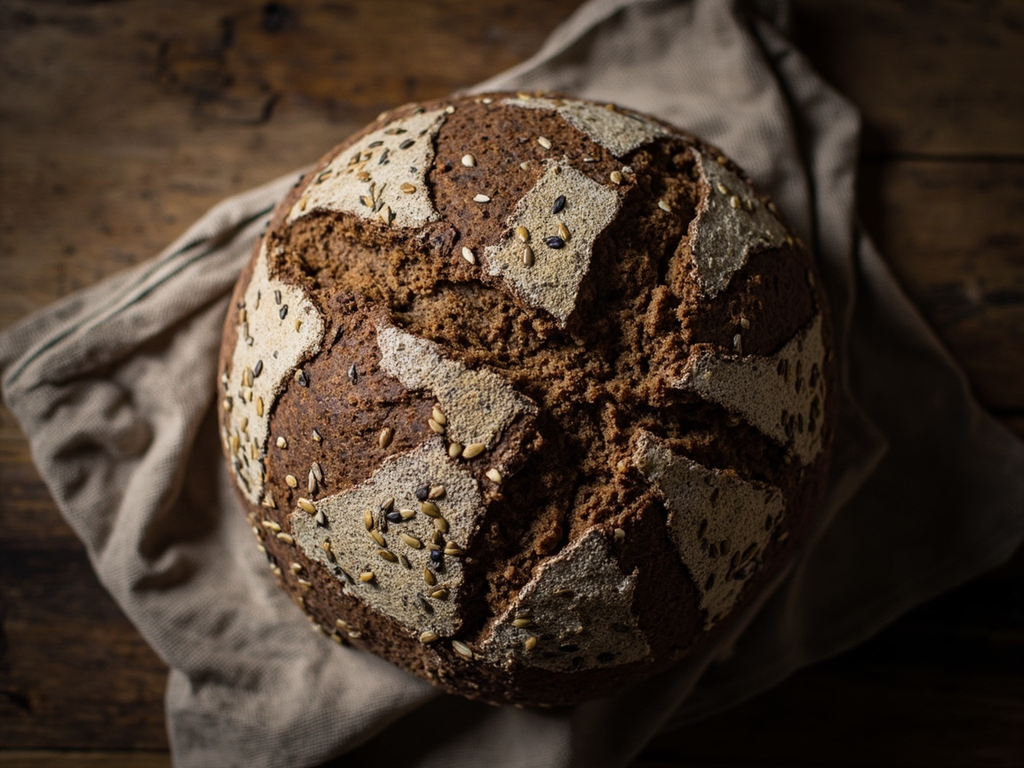
A rye sourdough bread, scented with caraway, baked to be given: to the poor at the convent gate, or in memory of the departed. A humble, dense, long-lasting bread marked by the fine acidity of sourdough.
This bread, I did not knead for myself. It was carried to the gate, to beggars and the hungry, and it was offered for souls awaiting the light. I marked a cross on the rye crust, I scattered caraway that awakens the heavy belly of the poor, and the sourdough worked all night like a secret prayer. Give your bread, you who read me, for the soul that shares its loaf already shares something of the Kingdom.
- •Rye flour — as needed (base of dark bread)
- •Sourdough starter — a piece from yesterday (fermentation)
- •Water — for a supple dough (hydration)
- •Caraway seeds — a spoonful (digestive fragrance)
- •Salt — a pinch (seasoning)
Seelbrot — Soul Bread with Caraway
A rye sourdough bread, scented with caraway, baked to be given: to the poor at the convent gate, or in memory of the departed. A humble, dense, long-lasting bread marked by the fine acidity of sourdough.
Why this dish? Convents distributed to the poor and offered for the repose of the dead alms breads—Seelbrot, 'soul bread.' For a mystic inhabited by the union of souls with God, this shared bread extended prayer into the gesture of charity.
This bread, I did not knead for myself. It was carried to the gate, to beggars and the hungry, and it was offered for souls awaiting the light. I marked a cross on the rye crust, I scattered caraway that awakens the heavy belly of the poor, and the sourdough worked all night like a secret prayer. Give your bread, you who read me, for the soul that shares its loaf already shares something of the Kingdom.
Ingredients (period version)
- Rye flour — as needed (base of dark bread)
- Sourdough starter — a piece from yesterday (fermentation)
- Water — for a supple dough (hydration)
- Caraway seeds — a spoonful (digestive fragrance)
- Salt — a pinch (seasoning)
Ingredients
- Rye flour — 400 g (base of dark bread)
- All-purpose flour (T80) — 100 g (structure (aids rising))
- Active sourdough starter — 120 g (fermentation)
- Warm water — 330 ml (hydration)
- Caraway seeds — 1 tbsp (digestive fragrance)
- Salt — 9 g (seasoning)
Method
- Mix flours, starter, water, salt, and caraway into a sticky dough.
- Knead briefly, cover, and let rise for 3–4 hours at room temperature.
- Shape into a dense round loaf and place in a floured banneton.
- Let rise another 2–3 hours. Preheat oven to 230°C.
- Score a cross on top, bake for 40–45 minutes until dark and crusty.
- Cool completely before sharing.
How it was made : Rye sourdough was the everyday bread of the northern Empire; white wheat bread remained a luxury. Distribution of bread to the poor (Almosen) and loaves offered for the dead (Seelbrot, Seelenbrot) were common charitable practices in convents. Caraway, abundant in Saxony, flavored and aided digestion of dense breads.
The contemporary twist : Baked as small individual loaves marked with a cross, to be given away—a loaf to offer rather than to keep.
Sources : Rule of Saint Benedict, ch. 39 (the daily pound of bread) · Medieval monastic alms practices (Seelbrot)
Mechthild of Magdeburg · Charactorium