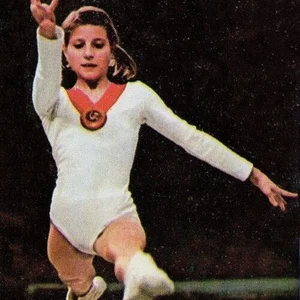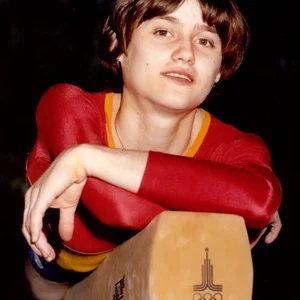

A Romanian gymnast, at age 14 she became the first athlete in history to score a perfect 10 at the Olympic Games, in Montreal in 1976. A multiple Olympic champion, she revolutionized artistic gymnastics worldwide.
Nadia Comăneci(1961 — ?)
Nadia Comăneci
États-Unis, Roumanie
6 min read
Frequently asked questions
Key Facts
- Born on November 12, 1961, in Onești, Romania
- First gymnast to score a perfect 10 at the 1976 Montreal Olympics, at the age of 14
- Won 3 gold medals at the 1976 Montreal Olympics (all-around, balance beam, uneven bars)
- Earned a total of 7 perfect 10 scores during the 1976 Olympics
- Defected to the United States in 1989, shortly before the fall of Ceaușescu's regime
Works & Achievements
In Montreal, she scored the first 10.00 in the history of the Games, revolutionizing scoring and the image of gymnastics.
She won gold in the individual all-around, the uneven bars, and the balance beam, becoming the star of the Games.
Her first major international title, revealing her exceptional potential at age 13.
She claimed gold on the balance beam and floor exercise, confirming her longevity at the highest level.
A technical element on the uneven bars bearing her name, reflecting her contribution to the discipline's repertoire.
An account in which she shares her experience and advice with young athletes, becoming an inspiring reference.
Anecdotes
On 18 July 1976, at the Montreal Games, Nadia performed a flawless routine on the uneven bars. The scoreboard then displayed “1.00”: built by the Omega company, it could not show a two-digit score, because no one had ever imagined that a perfect 10.00 might one day be possible. It was the first 10 in the history of the Olympic Games.
During those Montreal Games alone, Nadia earned a total of seven perfect scores of 10 and left with three gold medals, at only 14 years old. Overnight, her name spread around the world and she became the most famous athlete on the planet.
Her coach Béla Károlyi had spotted her when she was only 6: he was looking for little girls in a schoolyard in Onești and noticed two small girls doing cartwheels. When the bell rang, he ran from classroom to classroom to find out which ones they were.
In December 1989, just a few weeks before the fall of Ceaușescu's regime, Nadia secretly fled Romania by crossing the Hungarian border on foot at night, before making her way to the United States. She left behind a country where her fame had become a gilded cage watched over by the regime.
In 1981, the theme tune of her routines became so closely associated with her that a melody by Bart Howard was nicknamed “Nadia's Theme” in American popular culture, even though it originally had no connection to the gymnast.
Primary Sources
Romanian gymnast Nadia Comăneci scores the maximum mark of 10.00 on the uneven bars, a score never before achieved in the history of Olympic competition.
I didn't know I had just made history; to me, it was just another routine I had practiced thousands of times. It was only when I saw the crowd's reaction that I understood.
At fourteen, the slight Romanian rewrote the rules of the sport: the electronic scoreboard, unable to display a perfect ten, had to settle for a “1.00.”
Key Places
Industrial town in Romanian Moldavia where Nadia is born and where she is spotted by Béla Károlyi. This is where her intensive training begins.
Olympic arena where Nadia earns the first perfect 10 in history in July 1976. The site of her rise to global fame.
Capital where Nadia settles and trains among the national sporting elite after her successes. The seat of power of the Ceaușescu regime.
Host of the 1980 Games where Nadia wins two more gold medals, on the balance beam and the floor exercise. A competition marked by the Western boycott.
Town where Nadia settles after her defection and her marriage to Bart Conner. There she runs a gymnastics academy.
Typical Objects

Apparatus made of two parallel bars at different heights, on which Nadia earned her first perfect 10. On it she linked release moves and regrasps with unprecedented precision.

A narrow apparatus 10 cm wide raised to about 1.25 m, demanding perfect balance. On it Nadia was crowned Olympic champion in Montreal and then in Moscow.

Form-fitting outfit worn by gymnasts, often in Romania's national colors. It allowed judges to clearly assess the alignment of the body.

White magnesium carbonate powder that gymnasts apply to their hands to improve their grip on the bars. It reduces sweat and the risk of slipping.

The supreme reward won five times by Nadia at the 1976 and 1980 Games. It also symbolized the prestige that the Ceaușescu regime drew from its champions.

A panel responsible for displaying the gymnasts' scores; in Montreal, it could not show the “10.00” and instead displayed “1.00.” It unwittingly became the witness of a historic feat.
School Curriculum
Vocabulary & Tags
Key Vocabulary
Tags
Daily Life
Morning
From the moment she woke, Nadia headed to the gymnasium for long hours of training even before school. Warm-ups, stretching, and apparatus drills set the rhythm of every morning under the demanding eye of Béla Károlyi.
Afternoon
The afternoon was split between compulsory school lessons and a second training session. The tireless repetition of the same movements aimed for the technical perfection that would make her a legend.
Evening
The evening was devoted to stretching, body care, and the rest essential for an athlete subjected to intense exertion. The social life of a young elite gymnast was almost entirely consumed by the sport.
Food
Her diet was strictly controlled to keep her weight very light, a guarantee of performance on the apparatus. Measured portions and dietary discipline were part of everyday life for gymnasts of that era.
Clothing
In training, she wore a simple leotard and leather hand guards for the bars. In competition, the leotard in Romania's colors displayed her national allegiance.
Housing
As a teenager, she lived in facilities run by the Romanian sports federation, far from ordinary comforts. Her life was organized around the training center rather than the family home.
Historical Timeline
Period Vocabulary
Liens externes & ressources
Références
Œuvres
Premier 10 parfait olympique (barres asymétriques)
1976
Triple championne olympique de Montréal
1976
Championne d'Europe de Skien
1975
Double championne olympique de Moscou
1980
Salto périlleux dit « salto Comăneci »
1976
Autobiographie « Letters to a Young Gymnast »
2004