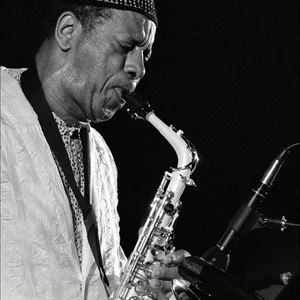

Ornette Coleman (1930-2015) was an American saxophonist, composer, and theorist. A major figure of avant-garde jazz, he was the leading pioneer of free jazz, a movement that freed improvisation from traditional harmonic frameworks.
Ornette Coleman(1930 — 2015)
Ornette Coleman
États-Unis
6 min read
Frequently asked questions
Famous Quotes
« It was when I found out I could make mistakes that I knew I was on to something.»
Key Facts
- Born on March 9, 1930, in Fort Worth, Texas, in the United States.
- In 1959, released the album The Shape of Jazz to Come, a manifesto for a new jazz aesthetic.
- Gave the movement its name with the album Free Jazz: A Collective Improvisation (1961).
- Developed his musical theory of “harmolodics,” based on the equality of melody, harmony, and rhythm.
- Received the Pulitzer Prize for Music in 2007 for the album Sound Grammar; died on June 11, 2015, in New York.
Works & Achievements
The saxophonist's first album, which already signals his determination to break free from harmonic rules.
A manifesto album with Don Cherry, Charlie Haden and Billy Higgins, regarded as a high point and a turning point of modern jazz.
A collective improvisation of nearly forty minutes by a double quartet; the title would give its name to the entire movement.
A work for symphony orchestra that applies his harmolodic ideas to classical music.
An electric album with the band Prime Time, a manifesto of his harmolodic theory blending funk, rock and improvisation.
An acclaimed collaboration with guitarist Pat Metheny that broadened his audience beyond the jazz circle.
A live album awarded the Pulitzer Prize for Music in 2007, a belated recognition of a revolutionary career.
Anecdotes
Too poor to afford a metal saxophone while living in Los Angeles in the 1950s, Ornette Coleman played a white plastic Grafton alto saxophone. This cheap instrument, with its nasal, piercing tone, became his trademark and one of the visual symbols of free jazz.
In 1949, while touring the American South with a rhythm and blues band, Coleman was assaulted after a dance in Baton Rouge: his bebop-influenced style, long hair, and beard rubbed people the wrong way, and it is said that his saxophone was thrown away or smashed. The episode left a deep mark on the young musician and fueled his desire to play entirely free music.
In the autumn of 1959, Coleman's quartet moved into New York's Five Spot Café for a long run of concerts. His music, which abandoned the usual chord changes, violently divided audiences: some hailed it as genius, others denounced it as a scandal, and the jazz world came away shaken.
In 1961 came the album Free Jazz, recorded by a “double quartet” of eight musicians improvising together, one group in each stereo channel. This record gave its name to an entire musical movement, and its cover featured a painting by the abstract artist Jackson Pollock.
In 2007, Ornette Coleman received the Pulitzer Prize for Music for his album Sound Grammar, an exceptionally rare honor for a jazz musician. Long mocked as a troublemaker, he was now hailed as one of the most inventive composers of his century.
Primary Sources
“The Shape of Jazz to Come” — with this title alone, Coleman announces that his music aims to chart the future of the genre.
Subtitled “A Collective Improvisation,” the record brings together two quartets playing at the same time, with no written theme dictating to all.
“It was when I found out I could make mistakes that I knew I was on to something.”
The 2007 Pulitzer Prize for Music is awarded to Ornette Coleman, of New York, for his album Sound Grammar.
Key Places
Coleman's birthplace, where he taught himself the saxophone and played in marching bands and rhythm and blues groups.
Site of the 1949 assault that left a lasting mark on him and drove him away from the segregated South.
Coleman lived here in the 1950s, working odd jobs while studying music and recording his first albums.
In the summer of 1959 he attended the prestigious Lenox School of Jazz, which brought him to the attention of the New York jazz scene.
Club where his 1959 residency caused a scandal and thrust free jazz into the heart of the New York scene.
City where Coleman settled for good, ran the avant-garde venue “Artists House” in the 1970s, and where he died in 2015.
Typical Objects

A cheap Grafton saxophone bought for lack of anything better in Los Angeles; its nasal tone became Coleman's signature sound and visual trademark.

His main instrument, on which he built a deeply vocal language that sounds like a cry or a human voice speaking.

A small trumpet he taught himself to play from the 1960s onward, to break free from his ingrained saxophonist's habits.

Coleman used it in an unconventional way, strumming or scraping the strings to produce free and unpredictable textures.

It reproduces an abstract painting by Jackson Pollock, drawing a parallel between Coleman's improvised music and avant-garde painting.

Notes and diagrams in which Coleman lays out his “harmolodics,” the idea that melody, harmony, and rhythm all carry equal importance.

On stage, Coleman took great care with his appearance, wearing elegant, vivid suits that mirrored the refinement of music many nonetheless judged chaotic.
School Curriculum
Vocabulary & Tags
Key Vocabulary
Tags
Daily Life
Morning
A thinker as much as a musician, Coleman devotes part of his mornings to composing and deepening his harmolodic theory, with pencil and instrument within reach. Known as gentle and thoughtful, he enjoys long discussions about musical ideas.
Afternoon
Afternoons are often devoted to rehearsals with his loyal companions (Don Cherry, Charlie Haden, and later his son Denardo). There he seeks a rapport in which each musician improvises while listening to the others, without an imposed chord chart.
Evening
In the evening come the concerts in clubs and festivals, from the early days at the Five Spot to the great international venues. His performances, long controversial, eventually drew a loyal and passionate audience.
Food
Like any jazz musician living to the rhythm of tours and clubs, his diet follows the irregular hours of concerts, between meals grabbed on the go and late-night restaurants in the great American cities.
Clothing
Mindful of his appearance, Coleman wore elegant and often colorful suits on stage, a deliberate contrast with the “wild” image that critics attached to his music.
Housing
After his modest years in Los Angeles, he settled in New York, where he occupied lofts and apartments; in the 1970s, he transformed a SoHo space, “Artists House,” into a hub for creation and avant-garde concerts.