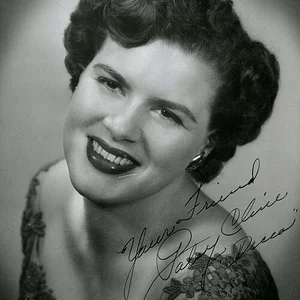

Patsy Cline (1932–1963) was a pioneering American country singer celebrated for her powerful, expressive voice. She was one of the first country artists to cross over to mainstream pop audiences with songs like 'Crazy' and 'I Fall to Pieces'. Her career was abruptly cut short when she died in a plane crash at the age of 30.
Patsy Cline(1932 — 1963)
Patsy Cline
États-Unis
8 min read
Frequently asked questions
Famous Quotes
« I've never thought about who I was singing to. I just sang.»
« Crazy, I'm crazy for feeling so lonely.»
Key Facts
- 1932: Born Virginia Patterson Hensley in Winchester, Virginia
- 1957: Achieved national fame with 'Walkin' After Midnight' following her appearance on Arthur Godfrey's Talent Scouts
- 1961: Became a member of the Grand Ole Opry, the home of country music in Nashville
- 1961: Released 'I Fall to Pieces', her first number one on both the country and pop charts
- 1963: Died in a plane crash near Camden, Tennessee, at age 30
Works & Achievements
Patsy Cline's first major hit, recorded after her win on Arthur Godfrey's talent contest. The song charted simultaneously on country and pop charts, foreshadowing her ability to reach a broader audience.
A song produced by Owen Bradley that reached number one on the country charts and entered the pop Top 20. It marks the crossover turning point in Patsy Cline's career and the beginning of her fruitful collaboration with Decca Records.
Written by Willie Nelson, this ballad — recorded despite Patsy Cline's injuries — has become one of the undisputed standards of American music. It is regularly cited as the greatest country song ever recorded.
Number one on the country charts in 1962, this melancholy song confirms Patsy Cline's vocal mastery and her rare talent for conveying heartbreak with exceptional intensity.
One of Patsy Cline's final recordings, released just weeks after her death. The song posthumously became one of her biggest hits and lent its title to the biographical film made about her in 1985.
Her debut studio album on Decca Records, produced by Owen Bradley. It definitively established the Patsy Cline sound: a rich voice over understated orchestrations, blending country and pop with a previously unseen elegance.
Anecdotes
Patsy Cline's real name was Virginia Patterson Hensley. She chose the stage name "Patsy" by shortening her middle name, and kept the surname of her first husband, Gerald Cline, even after their divorce. This forged identity illustrates the determination of a young woman from a modest Virginia family who did everything in her power to break through in a male-dominated industry.
In 1957, Patsy Cline appeared on the radio and television show "Arthur Godfrey's Talent Scouts
one of the most-watched talent competitions in America. She performed "Walkin' After Midnight" dressed in a fringed western outfit and won the contest hands down. Overnight, she became a national figure, launched from the anonymity of small rural stages.
In June 1961, Patsy Cline was seriously injured in a car accident: she suffered multiple fractures, a forehead laceration, and broken ribs. Just a few weeks later, still convalescing and in great pain, she recorded "Crazy" while seated — a song written by Willie Nelson. Her producer Owen Bradley adapted the session to her condition, and the result became one of country music's greatest classics.
Patsy Cline was one of the first country artists to cross the line between country music and the mainstream pop audience, a phenomenon known as "crossover." Songs like "I Fall to Pieces" and "Crazy" climbed the country and pop charts simultaneously in 1961–1962, blazing a trail that artists like Dolly Parton and Kenny Rogers would follow decades later.
On March 5, 1963, the private plane carrying Patsy Cline back from a benefit concert in Kansas City crashed in the woods of Tennessee, killing all four people on board, including singers Cowboy Copas and Hawkshaw Hawkins. Patsy was 30 years old. A few days before her departure, she had confided to a friend that she had a premonition something was going to happen to her. Her untimely death cemented her status as a legendary figure in country music.
Primary Sources
I want to be remembered as a singer who gave it everything she had, every time she stepped in front of a microphone.
I don't know what's wrong with me… I feel like something's getting ready to happen. I keep having these dreams.
I've always had to fight for everything. I was never handed anything. But I knew one day I'd make it, because I wouldn't stop until I did.
Patsy Cline wins the competition with a performance of “Walkin’ After Midnight,” acclaimed by both the jury and the audience.
Bradley noted in his studio notebooks that Patsy was still on medication from her accident, but that she insisted on recording the song in a single night.
Key Places
Patsy Cline's hometown, where she grew up in a modest family and began singing in local clubs as a teenager. A museum dedicated to her now stands in the city.
The historic home of the Grand Ole Opry until 1974, this red-brick building nicknamed "the Mother Church of Country Music" is the stage where Patsy Cline performed regularly after her induction into the Opry in 1961.
Owen Bradley's recording studio where all of Patsy Cline's major hits were produced, from "I Fall to Pieces" to "Crazy." This location is considered the birthplace of the Nashville Sound.
A wooded area in western Tennessee where Patsy Cline's plane crashed on March 5, 1963. A commemorative monument now marks the site of the tragedy.
The museum and institution that preserves Patsy Cline's legacy. She was inducted in 1973, the first woman to be honored as an individual inductee, and her costumes, recordings, and personal archives are on display there.
Typical Objects

In the studio, Patsy Cline recorded with the professional microphones of the era at Owen Bradley's. Her powerful, warm voice was ideally captured by these devices, enabling the long reverb passages characteristic of the Nashville Sound.

Early in her career, Patsy wore typical country western outfits: fringed dresses, embroidery, and a cowgirl hat. This stage image matched the genre's codes, before she gradually shifted toward more elegant cocktail dresses as her crossover success grew.

The dominant format of the 1950s–60s, the "single

Found in every diner, drugstore, and honky-tonk across 1950s–60s America, the jukebox was the primary vehicle for popular music distribution. Patsy Cline's songs played on repeat, reaching audiences far beyond country radio listeners.

A central instrument in Nashville recording sessions, the electric guitar accompanied Patsy both on stage and in the studio. The session guitarists of Nashville's "A-Team" notably used Fender Telecasters to give her recordings their characteristic sound.

Owen Bradley's Nashville studio, nicknamed "Quonset Hut" after the converted corrugated metal building it occupied, was equipped with a multi-track analog console. Almost all of Patsy Cline's major recordings were made there between 1960 and 1963.
School Curriculum
Vocabulary & Tags
Key Vocabulary
Tags
Daily Life
Morning
During touring periods — which made up the bulk of a country artist's work — Patsy would rise early to hit the road, traveling by car or chartered plane, sometimes covering two to three cities a week. Back in Nashville, her mornings were devoted to rehearsals or discussions with her producer Owen Bradley about upcoming recording sessions.
Afternoon
Studio afternoons took place at Bradley's Quonset Hut, where Patsy worked with the session musicians known as the "Nashville A-Team." Recordings were often done in a single take, with professional precision as the standard. Outside the studio, she gave interviews to the country music press or signed autographs after shows.
Evening
On performance nights, Patsy played the Grand Ole Opry or venues across the United States. She was known for staying after concerts to talk with fans. At home in Nashville, she spent her evenings with her family — she was the mother of two children — and was celebrated for her warmth and sharp sense of humor.
Food
Patsy Cline had a deep attachment to traditional Southern American cooking: fried chicken, grits, slow-cooked green beans, and peach pies. Like many Americans of her generation and region, her diet was simple and hearty, far removed from the carefully managed regimens of today's stars.
Clothing
Early in her career, Patsy wore flamboyant Western outfits — fringed dresses, floral embroidery, cowboy boots, and hats. From 1960 onward, buoyed by her crossover success, she shifted toward more sophisticated cocktail dresses and long gloves, moving away from the "cowgirl" image in favor of a more glamorous look.
Housing
After her first successes, Patsy Cline settled into a suburban home in Goodlettsville, just outside Nashville, with her second husband Charlie Dick and their two children. The house was modest but comfortable, typical of the American middle class in the 1960s — a far cry from the lavish estates some stars of the era liked to flaunt.