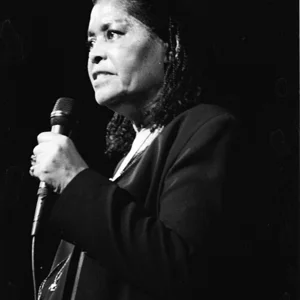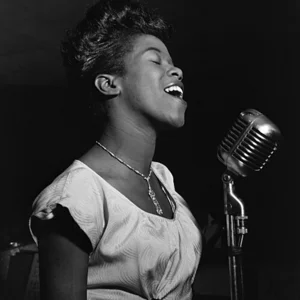

American jazz singer (1924–1990), nicknamed “The Divine One” or “Sassy,” Sarah Vaughan is considered one of the greatest voices of the 20th century. Her exceptional timbre, vibrato, and technical mastery earned her international recognition.
Sarah Vaughan(1924 — 1990)
Sarah Vaughan
États-Unis
7 min read
Frequently asked questions
Famous Quotes
« I don't think I'm anything special.»
« Jazz is not just music, it's a way of life.»
Key Facts
- Born on March 27, 1924, in Newark, New Jersey
- Won an amateur contest at the Apollo Theater in 1942, which launched her career
- Collaborated with Dizzy Gillespie and Charlie Parker, founding figures of bebop, starting in 1944
- Recorded hundreds of albums between the 1940s and 1980s
- Died on April 3, 1990, in Hidden Hills, California, of lung cancer
Works & Achievements
One of her first major recordings, revealing to the public her unique phrasing and mastery of rubato. This jazz standard remains associated with her voice more than any other interpreter's.
Recorded live at the Birdland club, this version is considered one of the finest showcases of her bebop style and her ability to improvise vocally.
Taken from the musical *Damn Yankees*, this track became a popular hit that opened doors to a wider audience while preserving her exacting jazz standards.
A ballad composed by Erroll Garner, Vaughan's interpretation of which has become the definitive reference. Her version showcases her deep vibrato and harmonic intelligence.
Album recorded in concert with the Count Basie Orchestra, considered one of the high points of her discography and an essential document of vocal jazz from the 1950s.
A bold reinterpretation of Stephen Sondheim's standard that earned her a Grammy Award in 1982. Her version transforms the show tune into a jazz meditation of profound emotional depth.
Anecdotes
In October 1942, Sarah Vaughan, then 18 years old, entered the famous Amateur Night at the Apollo Theater in Harlem. She performed 'Body and Soul' and won the contest hands down. Billy Eckstine happened to be in the audience and immediately recommended her to bandleader Earl Hines — her professional career began just a few weeks later.
Sarah Vaughan was one of the first singers to embrace bebop, the revolutionary style invented by Charlie Parker and Dizzy Gillespie in the early 1940s. She met them in Earl Hines's orchestra and absorbed their daring harmonic language, transposing bebop's complex instrumental improvisations into her voice — something that was entirely unprecedented at the time.
Her fellow musicians nicknamed her 'Sassy' because of her assertive personality and sharp wit. But it was the nickname 'The Divine One,' coined by music critic George Trow, that stuck: it paid tribute to the exceptional range of her voice, which spanned more than three octaves and allowed her to move from contralto to soprano with disconcerting ease.
During the recording of 'Send in the Clowns' in 1981, taken from Stephen Sondheim's musical, Sarah Vaughan surprised everyone by improvising freely on the original melody. This jazz interpretation, far removed from the original, earned her a Grammy Award in 1982 in the category of 'Best Female Jazz Vocal Performance.' Sondheim himself declared that her version surpassed all others.
Despite her international fame, Sarah Vaughan faced racial segregation throughout her life in the United States. As late as the 1950s, she would sometimes perform in clubs or hotels where she was not allowed to stay or enter through the main entrance. She nonetheless continued to perform in Europe's most prestigious venues, where she was welcomed without discrimination — earning her an enormous following on the continent.
Primary Sources
"I don't sing a note I don't feel. Every song is a story, and I have to live it before I can pass it on."
Early contractual documents attesting to Sarah Vaughan's signing with Continental Records for her first professional recording sessions.
Down Beat places Sarah Vaughan at the top of the annual jazz best female vocalist rankings, highlighting her unique vibrato and unparalleled harmonic mastery.
"I sang all my life because I didn't know how to do anything else. But if I had known it would bring me here, I would have started even earlier."
Key Places
Sarah Vaughan's hometown, where she grew up in the African American community and began singing in church. Newark was an industrial city marked by de facto segregation.
A landmark of African American culture, the Apollo hosted Vaughan's winning performance at Amateur Night in 1942. That contest became the springboard for her professional career.
A legendary jazz club that opened in 1949 on Broadway, named in honor of Charlie Parker, known as "Bird." Sarah Vaughan performed there on many occasions and cemented her legend within its walls.
A prestigious Parisian concert hall where Sarah Vaughan performed during her European tours. In France, she was welcomed without discrimination and celebrated as a first-rank artist.
A suburb of Los Angeles where Sarah Vaughan lived during the final years of her life and where she passed away in April 1990.
Typical Objects

Professional microphone used in recording studios of the 1940s–1950s. Sarah Vaughan recorded her first hits with this type of equipment, whose warm, velvety sound showcased her exceptional timbre.

Sarah Vaughan was a self-taught pianist before she was a singer. She regularly used the piano to compose, rehearse her arrangements, and communicate with her musicians.

Lead sheets (simplified scores with chord symbols) circulated throughout the jazz world as a way to pass down standards. Vaughan often annotated hers to indicate her own harmonic variations.

Jazz singers of the 1950s–1960s wore long, elaborate gowns on stage. Sarah Vaughan was renowned for her sartorial elegance, which stood in contrast to her reputation as a strong-willed personality.

The dominant format until the 1950s, the 78 RPM record held roughly 3 minutes per side. Most of Vaughan's early hits were pressed in this format, before the shift to the long-playing 33 RPM record.

An indispensable item for touring artists, it recorded dates, venues, and contacts. For African American musicians of the 1940s–1960s, the *Negro Motorist Green Book* served a similar purpose by listing hotels and restaurants where Black travelers were welcome.
School Curriculum
Vocabulary & Tags
Key Vocabulary
Tags
Daily Life
Morning
Sarah Vaughan, accustomed to late-night concerts, rarely rose before noon. She would start her day with a strong coffee and browse the press, especially the arts pages. She might also sit down at the piano to work on new harmonies or review scores.
Afternoon
Afternoons were devoted to rehearsals with her musicians, recording sessions in the studio, or interviews with journalists. She placed great importance on vocal preparation and practiced breathing and articulation exercises before every performance.
Evening
Evenings were the heart of her professional life: careful dressing, vocal warm-up, then taking the stage. After the concert, she would often join fellow musicians at the clubs for informal jam sessions that could stretch on until dawn.
Food
Like many jazz musicians of her era, she kept an irregular eating schedule, often dining late at night in restaurants near the clubs. She enjoyed Southern cuisine (soul food): fried chicken, beans, rice, and slow-cooked dishes rooted in African American culinary tradition.
Clothing
On stage, Sarah Vaughan wore long satin or silk gowns, often in vivid colors, paired with striking jewelry. In everyday life, she favored comfortable yet polished outfits. Her fashion sense evolved over the decades, shifting toward a more relaxed style in the 1970s.
Housing
At the height of her fame, Sarah Vaughan lived in comfortable apartments and houses in New York and later California. In her youth, she had shared modest lodgings in Newark and Harlem, as was the case for most African American jazz musicians of the time, who were often confined to segregated neighborhoods.