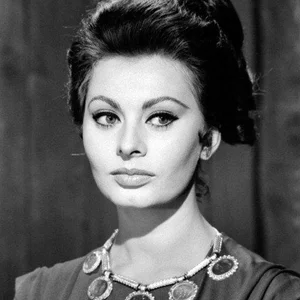

Italian actress born in 1934, Sophia Loren is one of the greatest stars in world cinema. The first actress to win an Academy Award for a role performed in a foreign language, she embodies both glamour and Italian neorealism.
Sophia Loren(1934 — ?)
Sophia Loren
Italie, France
9 min read
Frequently asked questions
Famous Quotes
« Everything you see, I owe to spaghetti.»
« Beauty is how you hold yourself — it's the light in your eyes.»
Key Facts
- Born on September 20, 1934, in Rome, under the name Sofia Villani Scicolone
- Won the Academy Award for Best Actress in 1962 for Two Women, directed by Vittorio De Sica
- Worked with the greatest directors of her era: De Sica, Chaplin, Cukor, Donen
- Named among the 25 Greatest Female Stars of Classic Hollywood by the AFI in 1999
- Received an Honorary Academy Award for Lifetime Achievement in 1991
Works & Achievements
An anthology film by Vittorio De Sica in which Sophia Loren plays a mischievous Neapolitan pizza maker. The role revealed to a wide audience her ability to perform across every register, from comedy to pathos, and established her as a major Italian actress.
A British comedy adapted from George Bernard Shaw, in which Sophia Loren stars alongside Peter Sellers. The film confirmed her international reach, and the song *Goodness Gracious Me* she recorded with Sellers became a worldwide hit.
A masterpiece by Vittorio De Sica about a mother and daughter fleeing the horrors of war in central Italy. This devastating role earned Sophia Loren the Academy Award for Best Actress in 1962 — the first ever awarded for a performance in a non-English language.
A comic triptych by Vittorio De Sica with Marcello Mastroianni, offering three glimpses of the contemporary Italian woman. The film won the Academy Award for Best Foreign Language Film in 1965 and cemented the Loren–Mastroianni partnership.
An adaptation of a play by Eduardo De Filippo, directed by Vittorio De Sica, in which Sophia Loren plays a fiery, tempestuous woman opposite Marcello Mastroianni. The role earned her a second Oscar nomination and is considered one of the high points of her career.
Memoirs co-written with A. E. Hotchner, in which Sophia Loren reflects on her impoverished childhood in Pozzuoli, her relationship with Carlo Ponti, and the behind-the-scenes world of her international career — an invaluable document for understanding postwar Italy through one remarkable personal journey.
Anecdotes
Sophia Loren grew up in extreme poverty in Pozzuoli, a coastal town near Naples, during the Second World War. She and her family had to take shelter in railway tunnels to escape the Allied bombing raids of 1943. This traumatic experience of war and famine left a deep mark on the actress and fueled the authenticity of her performances, most notably her role as a mother in *Two Women*.
In 1962, Sophia Loren became the first actress in history to win the Academy Award for Best Actress for a role performed in a foreign language — Italian. Too overwhelmed and certain she would not win, she had not made the trip to Los Angeles and learned the news in her hotel room in Rome. Greer Garson took the stage to accept the statuette on her behalf.
Sophia Loren met producer Carlo Ponti in 1950 at a beauty pageant in Rome: she was 15, he was 38. After several years of a relationship conducted under fire from critics and the Italian Catholic Church, they were forced to obtain French citizenship and officially remarry in France in 1966 for their union to be legally recognized.
In 1982, at the height of her international fame, Sophia Loren was convicted by Italian courts of tax fraud and had to voluntarily surrender herself for 17 days at Caserta, under the flashbulbs of photographers. She experienced this episode as a profound injustice, but her popularity with the worldwide public was not lastingly affected.
Sophia Loren and actor Marcello Mastroianni formed one of the most celebrated duos in European cinema, appearing together in more than ten films under the direction of Vittorio De Sica. Mastroianni readily admitted that he was "in love with Sophia on screen
but that their chemistry rested above all on a deep friendship and an unwavering mutual admiration.
Primary Sources
I was born of a man who refused to acknowledge me and a woman society would not accept. I grew up amid war, hunger, and shame. Everything I am, I seized with both hands.
This award belongs to Vittorio De Sica. Without him, without his absolute faith in me, I would never have had the courage to go so far into this character.
I dedicate this award to all the women in the world who have had the courage to believe in themselves, in spite of adversity.
Italy is my mother, my nourishment, my language. I can live in Paris or Geneva, but I think and dream in Neapolitan.
Key Places
A volcanic coastal town near Naples where Sophia Loren grew up in poverty during the war. The bombings and famine she endured there shaped her acting, most notably her portrayal of a wartime mother in Two Women (*La Ciociara*).
Sophia Loren's birthplace and the city where her career took off: it was in Rome that she entered her first beauty pageant in 1950 and met Carlo Ponti. She has a residence there and is regarded as a national icon.
The famous Roman film studios nicknamed the "Hollywood on the Tiber." Sophia Loren shot most of her major Italian films of the 1950s–1960s there, largely under the direction of Vittorio De Sica.
Sophia Loren appeared in several films at major American studios between 1957 and 1960 (Paramount, United Artists), pursuing a Hollywood career before returning for good to European cinema, which better suited her artistic sensibility.
Sophia Loren and Carlo Ponti settled here during the 1970s–1980s, partly for tax reasons and to protect their privacy, while maintaining a deep attachment to Italy and their Neapolitan roots.
Typical Objects

An indispensable tool on every film set, the clapperboard synchronizes sound and image by snapping at the start of each take. Sophia Loren watched it clap hundreds of times on the sets of Cinecittà, particularly during the films directed by Vittorio De Sica in the 1950s and 1960s.

The physical medium of cinema in her era, 35mm film captured every take of her movies. The widespread adoption of color Technicolor in the 1950s transformed the image of stars like Sophia Loren, whose Mediterranean beauty blossomed under the shimmering hues of the new process.

Sophia Loren, a symbol of Italian elegance, wore the creations of great Italian fashion designers such as Emilio Schuberth, helping to shape the international image of a refined and modern Italy in the immediate postwar years.

The heavy arc or tungsten spotlights that illuminated the sets of the 1950s and 1960s gave off intense heat, subjecting actresses to grueling filming conditions that Sophia Loren often recalled in her memoirs.

The photographers who stalked Roman celebrities in the 1960s — dubbed 'paparazzi' after Fellini's film — made Sophia Loren one of the most photographed women in the world, helping to sustain her status as an international diva.

The gilded metal statuette awarded by the Hollywood Academy symbolizes the crowning achievement of Sophia Loren's career in 1962 and the international recognition of Italian neorealist cinema on the world stage.
School Curriculum
Vocabulary & Tags
Key Vocabulary
Daily Life
Morning
During film shoots in the 1960s, Sophia Loren would rise at dawn to make her way to the Cinecittà studios in Rome. She spent several hours in the hair and makeup rooms, surrounded by entire teams of professionals, before she could step onto the set, blazing under the powerful incandescent lights.
Afternoon
Afternoons were devoted entirely to filming, often long and grueling. Between takes, Sophia Loren would discuss dramatic intentions with director Vittorio De Sica, whose method of directing actors she deeply admired — a method rooted in the neorealist tradition and built on emotional truth rather than technique.
Evening
In the evenings, Sophia Loren returned to her Roman villa to be with Carlo Ponti and her loved ones. She often cooked Neapolitan dishes herself, recipes learned from her mother — *pasta e fagioli*, *spaghetti alle vongole* — a lifelong passion she openly celebrated, summed up in her famous line: "Everything you see, I owe to spaghetti."
Food
Her diet was typically Mediterranean: fresh pasta, seasonal vegetables, fish, olive oil, and fruit from Campania. She ate lightly on set to stay alert and focused, but the evening meal shared with family was, for her, an essential ritual rooted in her Neapolitan upbringing.
Clothing
On set, costume designers dressed her according to each role's demands, from the ragged peasant woman of *La Ciociara* to the elegant lead of *Matrimonio all'italiana*. Off screen, she wore the creations of major Italian and French couturiers, embodying — alongside Gina Lollobrigida — the image of the Italian screen goddess, a symbol of postwar Italy's renewal.
Housing
Sophia Loren and Carlo Ponti lived in a villa in the Roman countryside, then in luxury apartments in Paris and Geneva, moving as professional and financial circumstances required. She always kept a deep sentimental attachment to the Campania of her childhood, returning regularly to Pozzuoli and the Naples region.
Historical Timeline
Period Vocabulary
Liens externes & ressources
Références
Œuvres
La Ciociara (Two Women)
1961
Matrimonio all'italiana (Mariage à l'italienne)
1964
Sophia Loren: Living and Loving (autobiographie)
1979