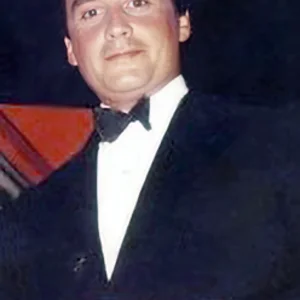

Thierry Le Luron was a French comedian and impressionist of the 1970s and 1980s, famous for his biting parodies of the political class and show business. A major figure of the music hall, he left his mark on television and the stage before his untimely death in 1986.
Frequently asked questions
Key Facts
- Born on 2 April 1952 in Paris, he emerged very young as an impressionist in the 1970s
- Becomes a star of the music hall and television with his impressions of political figures
- Launches in 1985 his parody 'Chanté sur France', a spoof of Renaud that remained famous
- Famous for his media 'fake wedding' with Coluche in 1985
- Dies on 13 November 1986 in Paris at the age of 34
Works & Achievements
His most famous routine, parodying the speech patterns and catchphrases of the President of the Republic.
A satirical parody of Boris Vian's “Le Déserteur”, a provocative hit single taking aim at employment policy.
A provocative media hoax that left its mark on 1980s popular culture.
Impersonation recitals that filled the largest venues in Paris.
His television appearances made him a national star known in every household.
He raised the art of impersonation to the level of a grand popular spectacle.
Anecdotes
Thierry Le Luron revealed his talent as an impressionist very young: as a teenager, he reproduced voices from television and radio to entertain those around him. Discovered in the early 1970s, he quickly became one of the stars of French variety shows, where audiences discovered his parodies of politicians.
His most famous impression is that of President Valéry Giscard d'Estaing, whose peculiar delivery and signature phrase “Frenchwomen, Frenchmen” he mimicked. Le Luron pushed satire so far as to parody the presidential television address, deliberately blurring the line between comedy and genuine political speech.
In 1985, he reworked Boris Vian's song “The Deserter” into “The Unemployed Man” to mock the promises of the left in power, a satirical hit that caused a scandal and topped the charts. That same year, he staged a fake media wedding with Coluche at the Palace, a provocative pastiche that left a lasting impression.
Le Luron was a relentless perfectionist about detail: he listened and re-listened to recordings to capture not only the voice but the verbal tics of his targets. This precision earned him the respect even of those he imitated, with some politicians coming to attend his shows.
Though ill, he continued to perform until the end. He died on 13 November 1986 at just 34 years old, officially of a pulmonary embolism. His premature death deprived the French stage of one of its most biting satirists, at the height of his popularity.
Primary Sources
Mister President, I'm writing you a note that you may read if you have the time… — a satirical spin targeting employment policy.
“Frenchwomen, Frenchmen…” — Le Luron takes up the president's solemn address and delivery to turn it into a comic signature.
Le Luron strings together the voices of political and showbiz figures live on air, cheered on by the studio audience.
Key Places
His birthplace and the main stage of his career. This is where Le Luron was born and where he conquered the great stages.
Legendary Parisian music-hall venue where Le Luron performed before packed houses. A temple of French variety entertainment.
Famous Parisian venue for shows and parties, the setting of the mock media wedding with Coluche in 1985.
Parisian stages where he performed his one-man shows. The music hall was his favorite playing field.
Typical Objects

The impressionist's indispensable tool, it carried his voice through large music-hall venues. Le Luron played with it to modulate his impressions and create closeness with the audience.

The central medium of the 1970s-1980s that made Le Luron famous. It was through the small screen that his impressions reached millions of French households.

Le Luron listened on loop to the voices of his targets to capture their quirks. The tape recorder was his working tool for preparing his impressions.

Tuxedo and elegant music-hall outfits that embodied the star. Le Luron took great care of his appearance as a star of the French stage.

The format that spread his sung parodies such as “Le Chômeur”. Vinyl extended his stage success into people's homes.
School Curriculum
Vocabulary & Tags
Key Vocabulary
Daily Life
Morning
A music-hall performer's morning began late, after evening shows that ended in the middle of the night. Le Luron devoted his first hours to reading the press and listening to the radio to spot new voices and political news to parody.
Afternoon
The afternoon was set aside for work: listening to recordings, rehearsing and perfecting his impressions. He honed speech tics and the writing of his sketches, often tied to the burning issues of the day.
Evening
In the evening, it was time for the stage or the television sets. Le Luron strung together music-hall recitals, galas and recordings, driven by the adrenaline of live performance and the audience's laughter.
Food
Like a Parisian star of the 1970s and 1980s, he frequented restaurants and brasseries after the shows. The nightlife of the artistic scene mixed late dinners with high-society outings.
Clothing
On stage, he wore the tuxedo and elegant outfits of grand variety entertainment. Around town, he sported the polished look of a show-business star of his era.
Housing
He lived in Paris, at the heart of the entertainment world. His life was set to the rhythm of music-hall venues, television studios and the haunts of Parisian nightlife.
Historical Timeline
Period Vocabulary
Liens externes & ressources
Références
Œuvres
Imitation de Valéry Giscard d'Estaing
années 1970
« Le Chômeur »
1985
Faux mariage avec Coluche au Palace
1985
One-man-shows à l'Olympia
années 1980
Passages dans les émissions de variétés
1970-1986
Galas et tournées de music-hall
années 1970-1980