Imaginary interview with Roger Blachon
by Charactorium · Roger Blachon (1941 — 2008) · Visual Arts · 6 min read
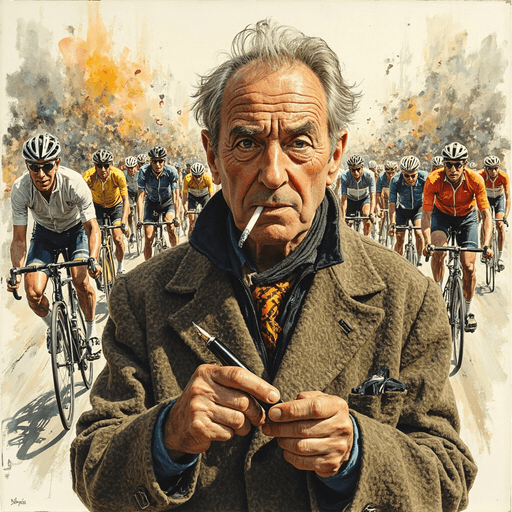
We pushed open the door of a sunlit studio, somewhere between the Rhône Valley and a drawing table cluttered with watercolor pans. Roger Blachon, pencil behind his ear and a smirk on his face, is about to talk about those paper crowds where a little fellow always hides to make you laugh. An imaginary meeting with a virtuoso of humorous drawing.
—You were born in Romans-sur-Isère in the middle of the war. What remains of that Drôme region in your work?
I am a child of Romans, the shoe town, born in the Drôme in 1941, when the country was counting its ration cards. People think a humorist cartoonist must come from the Parisian asphalt; but I come from a region where you take the time to watch people, to gently tease your neighbor without ever wishing them harm. That's where my laughter comes from, I think: a laughter of the terroir, a laughter of a shared table, that makes fun of ordinary little weaknesses rather than putting anyone down. I have remained attached to this Rhône Valley, to its almost Provençal landscapes, as one stays faithful to an accent. When I sketch a round fellow with too big a nose, there is always a bit of my fellow citizens in him.
My laughter comes from the shared table: it makes fun of little weaknesses, it never puts anyone down.
—Your crowd scenes are teeming with hundreds of characters. How does such a swarming come to life?
It all starts with the pencil, with the eraser never far away. I first lay down the large architecture of the scene, then I go down into the crowd, one fellow after another, like a station master calling each traveler by their first name. Each must have his own business: this one missed his train, that one loses his hat, a third steals his neighbor's sandwich without him noticing. I can fit hundreds in a single drawing, and that's exactly what I love: that the reader stops, squints, and goes hunting for the hidden detail in a corner. A good crowd scene is not a mass, it's a hundred little stories jostling on the same sheet.
A crowd scene is not a mass, it's a hundred little stories jostling together.
—Why this obsession with the tiny detail that almost no one will notice?
Because that's where the pleasure hides, and pleasure is a secret pact with the reader. I spend hours at my drawing board slipping, in a lost corner, a tiny little fellow doing something silly that nothing obliges you to see. Most will miss it; but the one who finds it feels like they've discovered a treasure, and that smile is my reward. I've always thought a humorous drawing should be readable quickly and re-readable for a long time. Children love that, they explore my human anthills as if looking for an object in a messy room. Immediate laughter is easy; the laughter that is earned in a corner, that's what I'm after.
Immediate laughter is easy; the laughter that is earned in a corner, that's what I'm after.
—Rugby holds a huge place in your work. Where does this love for the oval ball come from?
The rugby ball is my true model. I've always been passionate about this sport, and especially about what it shows of man: the scrum where giants crush in the mud, the locker room smelling of liniment, the pot-bellied flanker puffing like a seal. I don't draw the muscular heroes of posters, I draw the others: the breathless, the clumsy, the one chasing a ball he'll never catch. It's a tender mockery, never malice. My Scènes de rugby et de sport ended up in both specialized press and textbooks, and I'm as proud of it as of a last-minute converted try. Sport, deep down, is human comedy in shorts.
I don't draw the heroes of posters, I draw the breathless one chasing a ball he'll never catch.
—What do you seek to capture in these sportspeople you sketch with such mischief?
The moment when effort betrays the man. On a field, everyone watches the champion; I watch the one behind, with his jersey crooked and a lost look. Sport promises glory, but it mostly delivers sweat, grimaces, ridiculous falls — and that's infinitely funnier and more human. I sketched scrums and locker rooms for decades for the illustrated press, with my watercolor laid over a quick line, because the movement had to stay alive, the fellow had to seem about to tumble off the page. I'm not making fun of sportspeople, I love them: I just show that a scrum-half, deep down, is you and me on a Sunday morning.
Sport promises glory, but it mostly delivers sweat and ridiculous falls — infinitely more human.
—People talk about a “Blachon universe” recognizable among thousands. How would you describe it?
It's a world of round fellows, prominent noses, slightly off-kilter silhouettes that always seem ready to topple. The recipe, if you can call it that, comes down to two gestures. First the line, drawn with pen and India ink, nervous, lively, never too well-behaved — that's what gives life, movement, the impression that my characters are about to stir. Then the watercolor, with its brushes and pans of transparent color, which lays light on top. My colleagues eventually spoke of a “Blachon universe,” and that touches me: it means someone can recognize my hand without even reading my signature. A style is like handwriting, you don't manufacture it, you let it grow.
A style is like handwriting: you don't manufacture it, you let it grow.
—Why did you choose watercolor rather than a cleaner, more graphic line?
Because watercolor breathes. It's a water-based paint, made of transparent colors that you can't take back: once laid down, it lives its own life, it bleeds a little, it catches the light. I prefer to work in the morning, when the studio is bathed in light, because without light watercolor gives nothing. On my pen line, it brings a freshness, a radiance that makes the scene vibrate. A drawing that's too clean, too mechanical, doesn't laugh; it lacks the tremor, the happy accident. My little fellows need this living material to seem on the verge of moving. Rigor, I keep for composition; color, on the other hand, must remain joyful and a bit disobedient.
A drawing that's too clean doesn't laugh; it lacks the tremor, the happy accident.
—In 1993, Angoulême awarded you its Grand Prix. What did that distinction mean to you?
A nice surprise, and I must admit, a little irony. In 1993, in Angoulême, I was given the city's Grand Prix, the highest distinction of the 9th art, the one that crowns an entire career. Yet I never really saw myself as a comic strip man with panels and speech bubbles. I am an illustrator, a humorist cartoonist, a pressman who places a drawing here and there across the pages. That this world opened its doors to me and placed me alongside the great authors of comic strips was to receive recognition I didn't expect. Angoulême, that capital of comics, made me understand that humorous drawing also belonged to this great family of the 9th art.
They crowned me in comics, me who always saw myself as a simple pressman.
—How do you situate humorous drawing in relation to comics and caricature?
They are three cousins that don't quite resemble each other. Comics tell a story in panels and speech bubbles, they take their time, page after planche. Political caricature aims, bites, takes sides. Humorous drawing, my domain, is something else: an image, often single, that must make you laugh or smile at a glance, without necessarily commenting on current events. I never wanted to hurt or settle scores; my humor is good-natured, it makes fun of the flaws we all share. I grew up in the era when the illustrated press gave immense space to images, when a magazine without drawings seemed almost naked. It's in that space, between two articles, that I placed my little fellows.
Humorous drawing is an image that must make you smile at a glance, without ever hurting.
—You claim a humor “without malice.” Is that a choice, almost a moral stance?
It's a way of being before being a moral stance. You can make people laugh by demolishing them; that's not my path. I prefer to make fun of ordinary little weaknesses — the vanity of the man sucking in his stomach, the clumsiness of the Sunday athlete, the bewildered look of someone lost in a crowd. These are our shared flaws, and laughing about them together is a form of tenderness. I come from a region, the Drôme, where conviviality, shared meals, local products are cherished; my humor has the same taste, that of a laughter that brings together rather than divides. Making people laugh without hurting is harder than you think: you have to aim accurately while keeping a light hand.
Making people laugh without hurting is harder than you think: aim accurately while keeping a light hand.
This imaginary interview was generated by artificial intelligence from sources documented in Roger Blachon's profile. It dramatises what the figure might have said based on what we know about them, but does not constitute attested historical testimony. For primary sources and factual documentation, refer to the full profile.