 flip
flipLekach, Honey Cake for Sweet Days
Lekach, Honey Cake for Sweet Days
Why this dish? At Rosh Hashanah, the Jewish New Year, honey is eaten to call for a sweet year — and lekach is given to loved ones, or to children beginning Torah study, so that the holy words may be sweet on their lips. For a man of prayer like Heschel, sweetness is a prophecy.
A dense, dark cake flavored with honey, spices, and coffee, which improves after a few days.
When a child first opened the book of the Law, a drop of honey was placed on the page, and he licked it: so that he might know, from the very first day, that the word is sweet. This cake is the same idea kneaded into the dough — honey, spices, and just enough bitterness from coffee so that we don't forget that life has two flavors. Keep it for two or three days before tasting: it only gets better.
- •Honey — a large jar (sweetness and binder)
- •Flour — a bowl (structure)
- •Eggs — a few (binder)
- •Oil — a glass (moistness (no butter, pareve dish))
- •Cooled black coffee — a cup (bitterness and depth)
- •Cinnamon, ginger, and cloves — to season (holiday spices)
Lekach, Honey Cake for Sweet Days
A dense, dark cake flavored with honey, spices, and coffee, which improves after a few days.
Why this dish? At Rosh Hashanah, the Jewish New Year, honey is eaten to call for a sweet year — and lekach is given to loved ones, or to children beginning Torah study, so that the holy words may be sweet on their lips. For a man of prayer like Heschel, sweetness is a prophecy.
When a child first opened the book of the Law, a drop of honey was placed on the page, and he licked it: so that he might know, from the very first day, that the word is sweet. This cake is the same idea kneaded into the dough — honey, spices, and just enough bitterness from coffee so that we don't forget that life has two flavors. Keep it for two or three days before tasting: it only gets better.
Ingredients (period version)
- Honey — a large jar (sweetness and binder)
- Flour — a bowl (structure)
- Eggs — a few (binder)
- Oil — a glass (moistness (no butter, pareve dish))
- Cooled black coffee — a cup (bitterness and depth)
- Cinnamon, ginger, and cloves — to season (holiday spices)
Ingredients
- Honey — 300 g (sweetness and binder)
- Flour — 350 g (structure)
- Eggs — 3 (binder)
- Neutral oil — 120 ml (moistness (pareve, no butter))
- Cold black coffee — 200 ml (bitterness and depth)
- Sugar — 100 g (sweetness)
- Baking powder — 1 packet (leavening)
- Cinnamon, ground ginger, cloves — 1 tsp total (holiday spices)
Method
- Mix eggs, sugar, honey, and oil until smooth.
- Add cold coffee, then sifted flour with baking powder and spices.
- Pour into a greased and floured loaf pan.
- Bake at 160°C for 50 to 60 minutes; check with a skewer that comes out clean.
- Let cool, then wrap and wait two days: the cake becomes moister and more aromatic.
How it was made : The word "lekach" comes from Yiddish and also means "teaching" in Hebrew — an ancient wordplay: the cake was offered so that study might be sweet. Without butter, it is "pareve" and can accompany a meat meal according to kashrut.
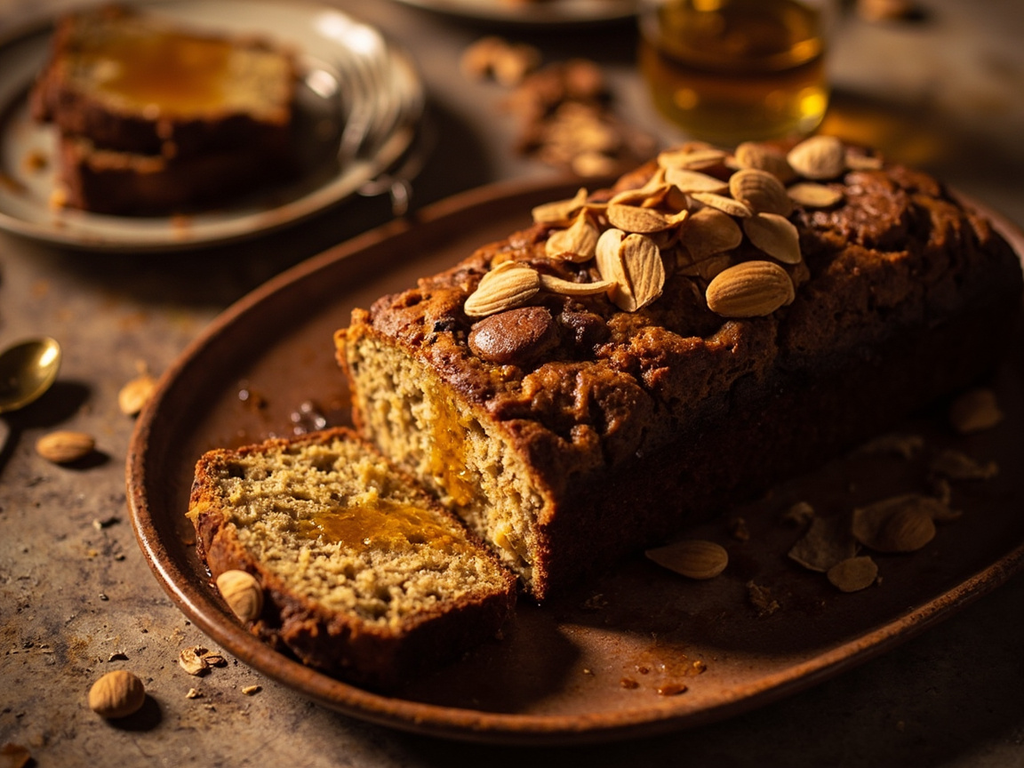
The contemporary twist : A light orange juice glaze and a few slivered almonds on top, as a nod to Middle Eastern markets without altering the original recipe.
Sources : Claudia Roden, The Book of Jewish Food (1996) · Gil Marks, Encyclopedia of Jewish Food (2010)
Abraham Joshua Heschel · Charactorium