 flip
flipKibbeh bil sanieh — festive baked kibbeh
Kibbeh bil sanieh — festive baked kibbeh
Why this dish? Kibbeh is the king dish of Syria and Lebanon, served to guests and at celebrations. For a son of the mountain who became a celebrated poet in Damascus and then Beirut, it is the dish of large tables where you receive, where you talk late, where poetry and food mingle.
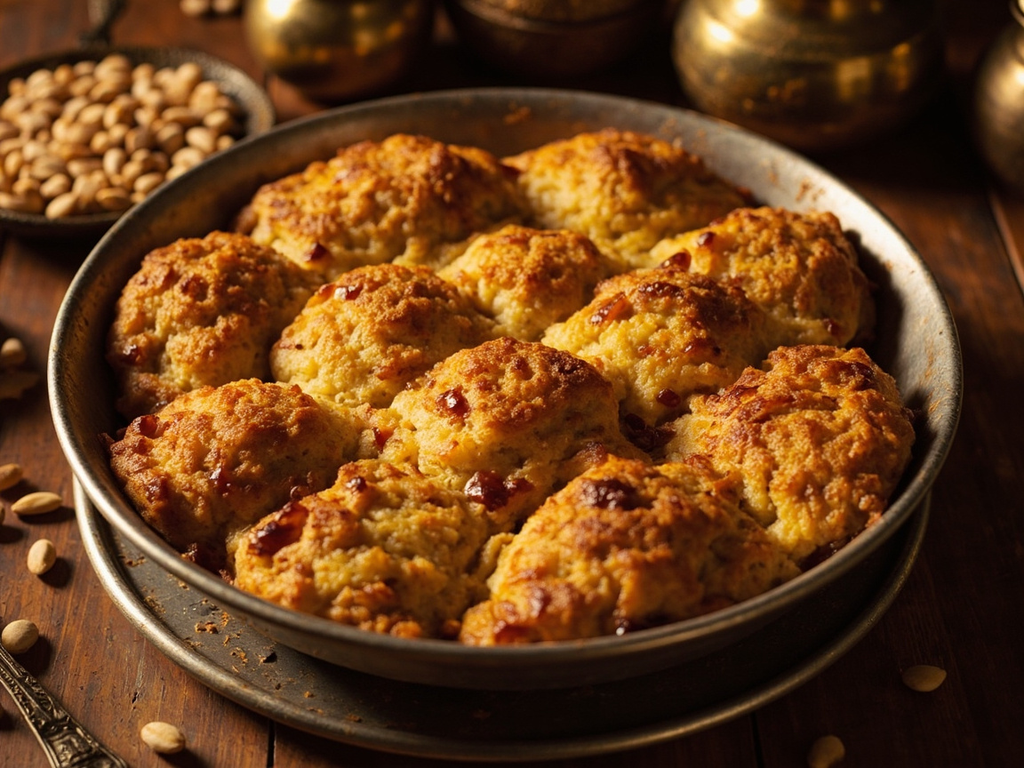
A 'pie' of fine bulgur and minced meat, built in two layers around a stuffing perfumed with onion, pine nuts and spices, then baked in the oven and cut into golden diamonds. It is the pinnacle of the Levantine festive meal.
When I entertained in Beirut, in those years when we wanted to reinvent everything — language, verse, the Arab world itself — my table bore kibbeh like a flag. We pounded the meat and wheat until they became one, like two words that finally form a single image. The stuffing sang of onion, cinnamon and toasted pine nuts. We cut it into diamonds, we discussed modernity until dawn — and believe me, no revolution is waged on an empty stomach.
- •Lamb pounded in a mortar — a good portion (base of shell and stuffing)
- •Fine bulgur — soaked (binder for the shell)
- •Onion — chopped (stuffing aromatic)
- •Pine nuts — a handful (stuffing garnish)
- •Cinnamon, mild Aleppo pepper, salt, pepper — to taste (spices)
- •Clarified butter (samneh) — for cooking (browning and richness)
Kibbeh bil sanieh — festive baked kibbeh
A 'pie' of fine bulgur and minced meat, built in two layers around a stuffing perfumed with onion, pine nuts and spices, then baked in the oven and cut into golden diamonds. It is the pinnacle of the Levantine festive meal.
Why this dish? Kibbeh is the king dish of Syria and Lebanon, served to guests and at celebrations. For a son of the mountain who became a celebrated poet in Damascus and then Beirut, it is the dish of large tables where you receive, where you talk late, where poetry and food mingle.
When I entertained in Beirut, in those years when we wanted to reinvent everything — language, verse, the Arab world itself — my table bore kibbeh like a flag. We pounded the meat and wheat until they became one, like two words that finally form a single image. The stuffing sang of onion, cinnamon and toasted pine nuts. We cut it into diamonds, we discussed modernity until dawn — and believe me, no revolution is waged on an empty stomach.
Ingredients (period version)
- Lamb pounded in a mortar — a good portion (base of shell and stuffing)
- Fine bulgur — soaked (binder for the shell)
- Onion — chopped (stuffing aromatic)
- Pine nuts — a handful (stuffing garnish)
- Cinnamon, mild Aleppo pepper, salt, pepper — to taste (spices)
- Clarified butter (samneh) — for cooking (browning and richness)
Ingredients
- Lean ground lamb — 700 g (shell + stuffing)
- Fine bulgur — 250 g (binder for the shell)
- Onions — 2 large (aromatic)
- Pine nuts — 60 g (garnish)
- Ground cinnamon — 1 tsp (spice)
- Mild Aleppo pepper (or sweet paprika) — 1 tsp (mild spice and color)
- Salt, pepper — to taste (seasoning)
- Clarified butter or olive oil — 4 tbsp (cooking and browning)
Method
- Rinse the fine bulgur and let it swell for 15 min, then drain well.
- Blend half the lamb with the bulgur, salt, pepper and cinnamon until a smooth paste forms: this is the shell.
- For the stuffing, sauté the chopped onions, add the remaining lamb, pine nuts, Aleppo pepper and cinnamon; cook until browned.
- Press half the shell paste into the bottom of an oiled baking dish, spread the stuffing, cover with the remaining paste.
- Score diamond shapes, brush with clarified butter and bake at 200°C (400°F) for 35-40 min until golden.
- Serve warm, cut into diamonds, at the center of the table.
How it was made : Kibbeh was traditionally pounded by hand in a large stone mortar (the jurn), a rhythmic and noisy collective task that announced the village feast. The fineness of the shell measured the skill of the lady of the house.
The contemporary twist : Serve a diamond on a smear of garlic yogurt and pomegranate molasses, contemporary Beirut bistro style.
Adonis · Charactorium