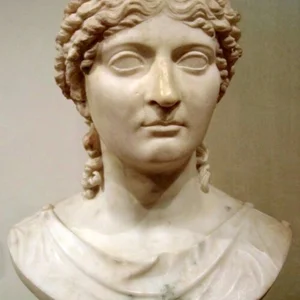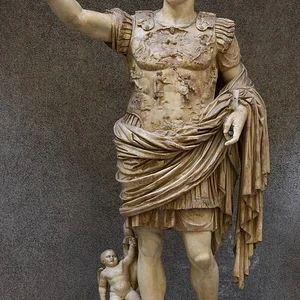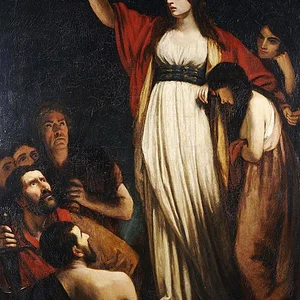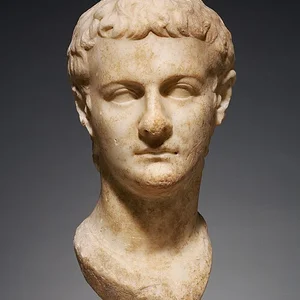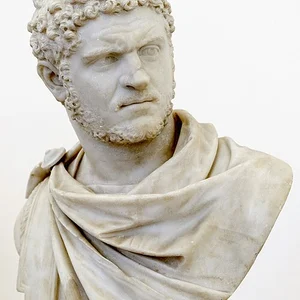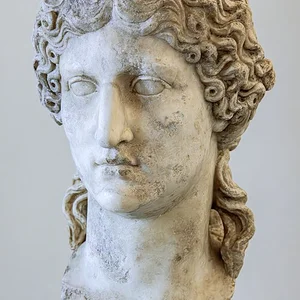

Granddaughter of Augustus and wife of Germanicus, Agrippina the Elder played a major political role during the principate of Tiberius. Her opposition to the emperor led to her exile and death in captivity in AD 33.
Agrippina the Elder(13 av. J.-C. — 33)
Agrippina the Elder
Rome antique
9 min read
Frequently asked questions
Key Facts
- Born around 14 BC, daughter of Agrippa and Julia the Elder, granddaughter of Augustus
- Wife of Germanicus, a popular general, with whom she had nine children including the future emperor Caligula
- Accompanied Germanicus on his military campaigns in Germania and the East (AD 14–19)
- Exiled by Tiberius to the island of Pandateria in AD 29 for political opposition
- Died in captivity in AD 33, most likely from self-starvation
Works & Achievements
A major political and symbolic act: Agrippina personally organized and led the funeral procession of Germanicus from Antioch to Rome, transforming this period of mourning into a popular demonstration of support for the Germanican branch against Tiberius.
Before the Senate convened as a tribunal, Agrippina publicly brought charges of poisoning against Piso and his wife Plancina. Her intervention stands as one of the most remarkable examples of female political engagement in imperial Rome.
In Germania, Agrippina distributed food and care to wounded soldiers and, by her mere presence, defused a panic threatening the bridge over the Rhine. Tacitus explicitly credits her with a role of moral command equivalent to that of a general.
For ten years, Agrippina maintained open opposition to Tiberius, protecting her children and cultivating networks of loyal supporters in the Senate. This resistance, which ultimately cost her her life, left a lasting mark on the memory of opposition to imperial despotism.
Anecdotes
During Germanicus's campaigns in Germania (14–16 AD), Agrippina accompanied her husband and played an unexpected military role. In 14 AD, when panicked soldiers wanted to destroy the bridge over the Rhine to stop a supposed barbarian invasion, she positioned herself at the entrance to the bridge and received the troops returning from battle, distributing food and tending to the wounded. Tacitus reports that Tiberius, consumed by jealousy, saw her popularity with the legions as a direct threat to his authority.
At Germanicus's death in Antioch in October 19 AD, Agrippina refused to break down and personally organized the repatriation of his ashes to Rome. She traveled through Asia and Greece, then disembarked at Brundisium dressed in black, carrying the funeral urn in her arms, before an immense crowd that had gathered spontaneously to pay its respects. Tacitus described this scene of extraordinary dignity as one of the most moving moments of the Tiberian age.
Agrippina publicly accused Gnaeus Calpurnius Piso of having poisoned Germanicus on Tiberius's orders. During the high-profile trial of 20 AD, her determination and her testimony before the Senate weighed heavily in Piso's condemnation; he took his own life before the verdict was delivered. The affair laid bare the tensions tearing apart the Julio-Claudian family.
In 29 AD, Tiberius had Agrippina arrested and exiled to the island of Pandateria — the same volcanic, isolated island where her own mother Julia had been exiled by Augustus a generation earlier. According to Tacitus, a guard struck her so violently during an altercation that she lost the use of one eye. She died in captivity in 33 AD, most likely by voluntary starvation as a final act of defiance.
Caligula, Agrippina's son who became emperor in 37 AD, solemnly repatriated his mother's ashes from Pandateria and laid them to rest in the Mausoleum of Augustus. He instituted annual games in her honor and had coins struck bearing her likeness, thereby publicly restoring her reputation and implicitly condemning the cruelty Tiberius had shown her.
Primary Sources
Agrippina, with a strength of character superior to her sex, showing none of the weakness of a woman, and bearing everything except injustice, placed herself at the head of the bridge, praising and thanking the legions as they returned.
Brundisium was the first port of Italy to receive her. People streamed in from all the neighboring towns; some came from Rome, friends and strangers alike, all to pay their respects. She disembarked carrying the funeral urn, her eyes downcast, accompanied by her two children.
Agrippina died three years after the fall of Sejanus. Tiberius spared her no suffering: she was kept in captivity, and each year the same date reminded her of Sejanus's execution.
He brought back his mother Agrippina's ashes, carrying them in his own hands, and laid them in the Mausoleum; he established annual games in the circus in her honor.
Agrippina, truly worthy of her father Agrippa and her grandfather Augustus, of singular virtue and almost manly courage, bore every blow of fortune with the steadfastness befitting the name she carried.
Key Places
The heart of imperial power where Agrippina lived after Germanicus's campaigns, and where she confronted Tiberius politically. The Forum was the stage for her public stands and her enormous popularity among the Roman people.
Capital of the province of Syria where Germanicus died on October 10, AD 19. It was here that Agrippina collected his ashes before undertaking the long journey back across the entire empire.
The Adriatic port where Agrippina landed in AD 20 carrying Germanicus's funeral urn, welcomed by an immense crowd and grieving legions. This intensely moving scene is described in precise detail by Tacitus in his Annals.
A small volcanic island off the Latium coast where Tiberius exiled Agrippina in AD 29; she died there in 33. It was the same place where her mother Julia had been exiled by Augustus, making it a symbol of the Julio-Claudian tragedy.
The dynastic tomb of the Julio-Claudians on the Campus Martius. After her death, Agrippina's ashes were solemnly interred there by her son Caligula in AD 37, a posthumous tribute to the woman Tiberius had persecuted.
Typical Objects

A long dress worn by Roman women of senatorial or imperial rank, a sign of dignity and virtue. Agrippina, granddaughter of Augustus, wore the stola as a symbol of her exceptional status within the Julio-Claudian family.

A marble vessel used to preserve the ashes of the deceased after cremation. Agrippina entered collective memory by carrying in her own arms the urn containing the ashes of Germanicus as she traveled from Antioch all the way back to Rome.

A metal clasp used to fasten garments, often adorned with precious stones among Roman aristocratic women. Gold jewelry and finely crafted fibulae were outward signs of imperial rank that Agrippina displayed during her public appearances.

A wax-coated wooden tablet on which one wrote with a stylus, used for everyday correspondence. Agrippina maintained an active political correspondence, and her influence also made itself felt through written communications whose effect on those around him Tiberius greatly feared.

A marble bust bearing the likeness of a member of the imperial family, displayed in public spaces and patrician homes. Portraits of Agrippina circulated throughout the empire, testifying to her prestige and political role within the domus Augusta.

An enclosed sedan chair used by aristocratic women to travel around the city. During her movements on the Palatine Hill or in the funeral procession of Germanicus, Agrippina used this form of transport, which visually signaled her rank within Roman urban space.
School Curriculum
Vocabulary & Tags
Key Vocabulary
Tags
Daily Life
Morning
Agrippina rose early according to Roman custom and began her day with ritual ablutions assisted by her personal slaves. She participated in prayers to the household Lares, then held morning audiences for clients, friends, and political allies — she was the center of a highly active network of influence in Rome.
Afternoon
The afternoon was devoted to managing her large family — nine children whose education she oversaw — and to political affairs: correspondence, meetings with senators or officers loyal to the cause of Germanicus. She closely monitored Sejanus's maneuvers at court and in the Senate, seeking to protect her sons, who represented a dynastic threat to Tiberius.
Evening
Agrippina attended aristocratic dinner parties (convivia) held in the grand houses of the Palatine Hill, venues that served as much for political negotiation as for socializing. She was known for her sobriety and gravity, maintaining the image of a virtuous Roman matron worthy of her ancestor Augustus — which strengthened her moral standing against her enemies.
Food
Like the Roman aristocracy, Agrippina ate white bread, Mediterranean vegetables, fish, poultry, and fruit, accompanied by wine mixed with water. She was renowned for her moderation at the table. On Pandateria, her diet was drastically reduced during her captivity, and ancient sources suggest she may have refused to eat as a final act of resistance against Tiberius.
Clothing
Agrippina wore the stola, a long robe of linen or fine wool over an undertunic (tunica), draped with the palla. Her garments were in subdued but luxurious colors — ivory white, saffron, violet — with gold-embroidered borders. She wore gold jewelry, intaglio rings, and pearl earrings, all markers of her imperial rank.
Housing
In Rome, Agrippina lived in Germanicus's domus on the Palatine Hill, an opulent residence featuring an atrium, peristyle, triclinium, and cubicula decorated with frescoes and mosaics. On military campaigns, she lodged in high-quality praetorian tents. On the island of Pandateria, she spent her final years in a rudimentary detention house, cut off from the world and from her children.
Historical Timeline
Period Vocabulary
Visual Style
Le style visuel s'inspire du portrait julio-claudien officiel et des reliefs de l'Ara Pacis : drapés solennels en marbre blanc, lumière froide et frontale, contrastes forts entre la grandeur impériale romaine et la désolation de l'exil insulaire.
Sound Ambience
L'univers sonore d'Agrippine alterne entre la solennité marmoréenne de la cour impériale, le fracas des campagnes militaires sur le Rhin brumeux et le silence pesant de l'exil sur une île battue par les vents méditerranéens.
Liens externes & ressources
Références
Œuvres
Rapatriement solennel des cendres de Germanicus
19-20 apr. J.-C.
Témoignage au procès de Pison
20 apr. J.-C.
Action auprès des légions du Rhin
14-16 apr. J.-C.
Résistance politique face à Tibère
19-29 apr. J.-C.