
Ahmose was an Egyptian queen of the 18th Dynasty, wife of Pharaoh Thutmose I. She is the mother of the famous pharaoh Hatshepsut. Her role at court illustrates the importance of queens in establishing Egyptian dynastic legitimacy.
Frequently asked questions
Key Facts
- Wife of Pharaoh Thutmose I, c. 1504 BCE
- Mother of Hatshepsut, one of the rare women to reign as pharaoh
- Member of the 18th Dynasty, during the Egyptian New Kingdom period
- Her title of 'Great Royal Wife' gave her a central role in legitimizing royal power
Works & Achievements
Although carved by Hatshepsut, these monumental reliefs immortalize Ahmose as a divine mother chosen by Amun, making her a central figure in the royal legitimacy of the 18th Dynasty.
The monuments of Karnak bearing Ahmose's cartouche attest to her recognized official role at the court of Thutmose I and her place in Egypt's official dynastic memory.
Amulets, scarabs, and prestige items bearing the two royal cartouches attest to the public visibility of the royal couple and the official recognition of Ahmose's status as legitimate wife.
Anecdotes
Ahmose held the title of “Great Royal Wife” (Hemet Neswt Weret), the highest rank a woman could attain in the Egyptian court hierarchy. This title gave her a central role in religious rituals and guaranteed the dynastic legitimacy of her children in the eyes of the people and the clergy.
The name “Ahmose” comes from the ancient Egyptian *Iah-mès*, meaning literally “The Moon is born.” The Moon was associated with the god Iah, and this royal name emphasized the sacred link between the royal family and the cosmos — a common practice in the naming conventions of Theban elites during the New Kingdom.
Her daughter Hatshepsut had carved in her funerary temple at Deir el-Bahari a scene of “divine birth” featuring Ahmose and the god Amun. In these famous bas-reliefs, Amun is said to have taken the form of Thutmose I to unite with Ahmose and conceive Hatshepsut, thereby legitimizing the future pharaoh's power in the eyes of all Egypt.
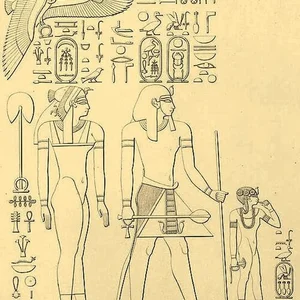
Thutmose I had Ahmose's name inscribed on several monuments at Karnak, attesting to her official honorific status. This practice, reserved for queens whose offspring were destined to reign, shows how Ahmose was regarded as a dynastically essential consort.
Ahmose was the mother of at least two royal children destined to leave their mark on history: Hatshepsut, the future pharaoh, and Neferubity, a daughter who died in infancy but whose memory was preserved in royal inscriptions. This royal motherhood made Ahmose the ancestor of one of the most powerful and best-documented dynasties of the New Kingdom.
Primary Sources
The bas-reliefs depict Queen Ahmose seated before the god Amun, who announces to her the birth of a daughter destined for kingship. Ahmose is described as "the most beautiful of women," and her role as divine mother is emphasized to legitimize the reign of Hatshepsut.
The annals and dedications at Karnak name Ahmose among the members of the royal household of Thutmose I and record her title of Great Royal Wife, confirming her official standing at the Theban court.
Erected by Thutmose I during his military campaign into Nubia as far as the Third Cataract, this stele evokes the military power of the pharaoh whose principal wife was Ahmose, illustrating the imperial context in which she lived.
Several scarabs and amulets bearing the paired cartouches of Thutmose I and Ahmose have been found in Theban funerary contexts, attesting to the reality of the royal couple and to their visibility in official memory.
Key Places
The religious and political capital of Egypt during the New Kingdom, residence of the pharaoh and his court; it was here that Ahmose lived, fulfilled her role as Great Royal Wife, and raised her children destined to rule.
Egypt's principal religious complex dedicated to the god Amun, where Thutmose I erected two obelisks and where the name of Ahmose was inscribed on several official monuments attesting to her dynastic status.
Hatshepsut's temple at Western Thebes, where the famous divine birth scenes were carved, immortalizing Ahmose as the mother chosen by the god Amun to bear the heiress to the throne of Egypt.
The Theban necropolis reserved for royal wives and children, a site symbolizing the sacred status of women in the royal family, where several queens of the 18th Dynasty were buried.
A Nubian site downstream of the third cataract of the Nile, where Thutmose I erected a stele celebrating his military victories, illustrating the extent of the empire ruled by the husband of Ahmose.
Typical Objects

Staff of command symbolizing ritual authority, held by the Great Royal Wife during official ceremonies to affirm her rank and sacred power alongside the pharaoh.

Pectoral jewel adorned with scarabs and divine symbols worn by Egyptian queens as a sign of their divine protection and their belonging to the sacred sphere of royal power.

Ritual headdress made of long braided black locks framing the face, worn by queens during ceremonies as a symbol of divine femininity and dynastic dignity.

Percussion instrument with metal rings used in rites honoring the goddess Hathor; the queen played it during religious ceremonies to please the gods and maintain cosmic harmony.

An indispensable toiletry item in court life, adorned with a handle depicting the goddess Hathor, associated with divine feminine beauty and frequently placed in royal tombs.

Wide collar in blue faience, gold and carnelian composed of concentric rows of colored beads, an emblematic jewel of the Egyptian queens' costume depicted on all official monuments.

Amulet in the shape of the Eye of Horus worn as a pendant, symbol of protection and royal health; Ahmose, like all queens, wore one to guard against evil forces.
School Curriculum
Vocabulary & Tags
Key Vocabulary
Tags
Daily Life
Morning
Ahmès rose at dawn for purification rituals, bathing in a sacred basin and receiving the attentions of her handmaidens, who anointed her with oils scented with myrrh and cinnamon. She then attended the morning prayers at the palace temple, where priests recited ritual formulas to secure the favor of Amun and the rising sun.
Afternoon
In the afternoon, Ahmès presided over official ceremonies alongside Thutmose I, received messages from royal officials, or oversaw the education of her royal children in the palace apartments. As Great Royal Wife, she also directed the royal harem — a large institution encompassing the women and children of the pharaoh's household.
Evening
In the evening, Ahmès attended royal banquets at which musicians, acrobats, and dancers performed before the court, wearing her gold pectoral and a perfume cone atop her wig. Before retiring, priestesses recited divine protection formulas to watch over her sleep and that of her children.
Food
Ahmès enjoyed a remarkably varied diet: breads and flatbreads made from several types of flour, roasted meats (beef, goose, and Nile duck), fresh fish, vegetables grown in the royal gardens (onions, lentils, cucumbers, and leeks), and exotic fruits (figs, dates, pomegranates, and grapes). Wines from Egypt and Canaan, along with fine-quality beer, accompanied official meals.
Clothing
Ahmès wore robes of very fine, pleated white linen — a fabric reserved for the royal elite — often translucent and held in place by golden straps. During ceremonies, she donned a tripartite wig adorned with a gold diadem bearing a uraeus, a wide usekh collar of blue faience and gold, electrum bracelets, and sandals of gilded leather.
Housing
Ahmès resided in the royal palace of Thebes, a vast complex of inner courtyards, irrigated gardens, and hypostyle halls decorated with frescoes depicting Nilotic landscapes and the pharaoh's exploits. Her private apartments, adorned with painted cedarwood columns and woven mats, provided both privacy and coolness, while lotus pools lined her terraces overlooking the Nile.
Historical Timeline
Period Vocabulary
Visual Style
Style hiératique du Nouvel Empire égyptien : compositions frontales formelles, palette chaude de l'ocre, du lapis-lazuli et de l'or, inspirées des reliefs de Deir el-Bahari et des peintures de Karnak.
Sound Ambience
L'atmosphère sonore du palais royal de Thèbes : chants liturgiques des prêtres de Karnak, tintements de sistrums, clapotis du Nil et bruissement des jardins de papyrus.
Liens externes & ressources
Références
Œuvres
Scènes de la naissance divine à Deir el-Bahari
vers 1473-1458 av. J.-C.
Inscriptions commémoratives de Karnak
vers 1504-1492 av. J.-C.
Corpus d'objets royaux aux cartouches jumelés Thoutmosis Ier / Ahmès
XVIIIe dynastie, vers 1504-1492 av. J.-C.